
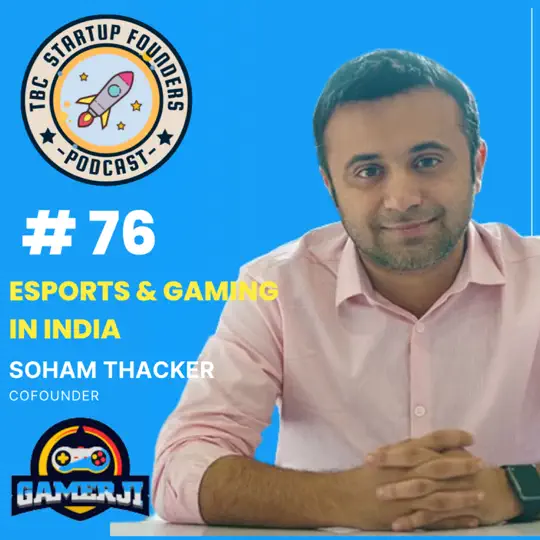
Scaling the “Missing Middle” of Esports: Strategic Insights from Soham Thacker, Founder of Gamerji
The global gaming industry is often viewed through two lenses: the 0.1% professional athletes and the 90% casual players. However, for Soham Thacker, Founder and CEO of Gamerji, the real opportunity lies in the “Missing Middle.”
In this deep-dive discussion, Soham shares the blueprint for building India’s leading esports tournament platform, navigating the 28% GST controversy, and why “Reverse Migration” was the catalyst for his entrepreneurial journey.
Executive Summary: The CXO Perspective
For enterprise leaders and founders, Gamerji is more than a gaming site; it is a masterclass in behavioral data moats and B2B SaaS pivots. By automating tournament infrastructure, Gamerji has scaled to over 10 million users and 500+ daily tournaments, proving that in a fragmented market, the platform is the entry point, but the data is the ultimate asset.
Key Discussion Points & Strategic Takeaways
1. The Thesis of the “Missing Middle”
Most gaming platforms cater to either the casual player (low retention) or the professional athlete (niche audience). Soham identified an underserved segment: the aspiring amateur.
- The “Gaming CV”: Gamerji builds a persistent professional profile for every user, tracking wins, losses, and stats.
- The Scouting Network: By quantifying amateur skill, the platform allows players to be scouted, turning a hobby into a measurable career path.
2. Navigating the Regulatory Storm: Esports vs. RMG
One of the most critical segments of the discussion centers on the 28% GST controversy in India. Soham provides a clear distinction for business leaders:
- Skill vs. Chance: While Real Money Gaming (RMG) often operates in a legal grey area with “casino” mechanics, Esports is a game of skill.
- Regulatory Compliance: To stay “future-proof,” Gamerji avoids the RMG model, focusing instead on in-app purchases, subscriptions, and brand partnerships. This ensures global scalability without the legal friction of gambling regulations.
3. The Pivot to B2B SaaS and Global Expansion
Soham highlights a major strategic shift: expanding from a pure B2C platform to a white-labeled tournament engine for global telcos.
- Partnerships: Gamerji now powers esports for 23+ global telcos, including Vi (Vodafone Idea) in India.
- Geographical Arbitrage: While India offers high volume and mobile-first users, the MENA region (UAE/Saudi Arabia) provides higher purchasing power (ARPPU) and a PC-heavy culture.
4. The Engineering of Retention: 76% and Counting
In a market where acquisition costs are soaring, Soham emphasizes that Retention is the only Mantra.
- The Funnel Paradox: “If your funnel is wider at the bottom and slimmer at the top, it’s a failed venture.”
- Community Moats: High retention is maintained through group chats, leaderboards, and a sense of “belonging” that transcends the game itself.
Discussion Transcript Highlights
Host: “Soham, you mention the ‘fire within’ that brought you back from the US. How did that translate into the gaming space?”
Soham Thacker: “I spent years at Motorola and SAP, but I realized that in the US, I was just a part of a machine. Coming back to India, I saw 400 million gamers with no structured path. We didn’t have a place to elevate our skills from our bedrooms. Gamerji was built to be that bridge.”
Host: “What was the hardest lesson in scaling to 10 million users?”
Soham Thacker: “The realization that if you don’t invest in scale, you fall face down. We had servers crash for five days because of organic traffic. I had to hunt for AWS credits and shift everything to the cloud overnight. You cannot scale a community on fragile infrastructure.”
Founder’s Playbook: Lessons for the 15+ Year Veteran
For experienced leaders, Soham’s journey offers three non-obvious lessons:
- Equity Discipline: Be extremely protective of equity in early “friends and family” rounds. Dilution should stay between 7% and 12% to remain attractive to Tier-1 VCs.
- The Data-as-a-Service (DaaS) Future: By owning behavioral data, a platform can evolve into a Gaming Publisher, predicting the next big title before it hits the mainstream.
- The Solo Journey of Endurance: Entrepreneurship is a marathon. Soham candidly admits to making every “basic mistake,” from wrong corporate structures to text-heavy decks. The winner is the one who endures the small failures.
Frequently Asked Questions (FAQs)
Who is Soham Thacker?
Soham Thacker is a serial entrepreneur and the Founder/CEO of Gamerji. A Rutgers University computer engineer with a background at Motorola and SAP, he returned to India to build the country’s largest amateur esports ecosystem.
What is the difference between Esports and Real Money Gaming (RMG)?
As per Soham Thacker, Esports is a skill-based competition where players earn rewards based on performance, similar to traditional sports. RMG often involves wagering and “casino” mechanics, which face higher regulatory scrutiny and tax (28% GST in India).
How does Gamerji monetize?
Gamerji utilizes a diversified revenue model including in-app purchases, subscriptions, brand sponsorships, and B2B SaaS partnerships where they provide tournament infrastructure to telecom giants.
Why is the “Missing Middle” important in gaming?
The “Missing Middle” represents the millions of gamers who are better than casual players but not yet professional. By providing them with a “Gaming CV” and automated tournaments, Gamerji taps into a high-engagement, underserved market segment.