
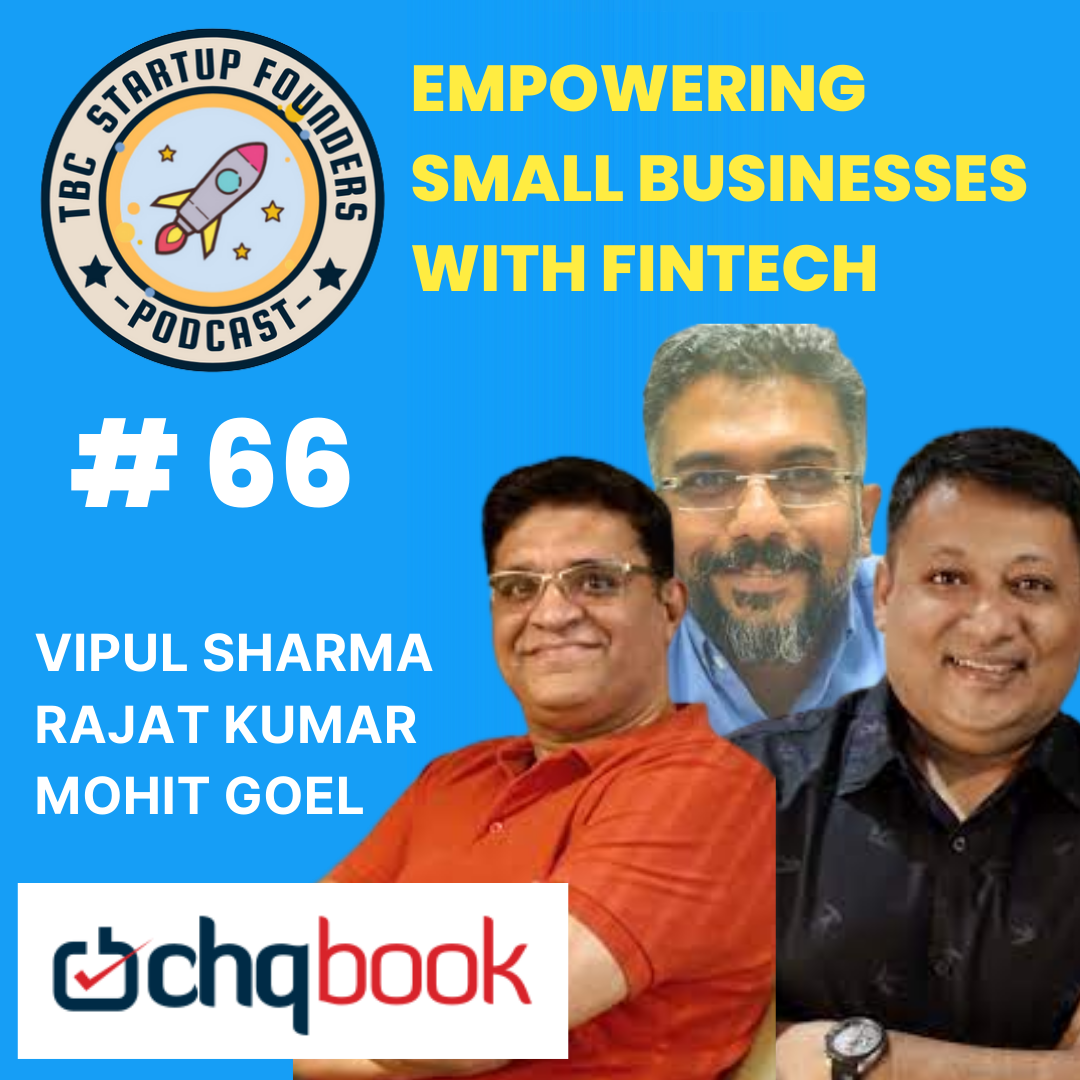
Scaling the Backbone of India: How Chqbook is Reimagining Neobanking for 64 Million MSMEs
In the high-octane world of Indian fintech, while most players were chasing the urban millennial, Vipul Sharma, Rajat Kumar, and Mohit Goel—the founding trio of Chqbook—saw a $1 trillion opportunity hiding in plain sight: the local kirana store, the neighborhood chemist, and the small-scale trader.
In a deep-dive session on The Builders Club Startup Founders Podcast, the founders shared the architectural blueprint of building India’s first “Financial Control Center” for small business owners. For Founders and CXOs, their journey offers a masterclass in segment-specific product design, alternate data underwriting, and sustainable unit economics.
Executive Summary: The Neobank for the “Un-Banked” Enterprises
Chqbook isn’t just a digital wallet; it is a full-stack financial ecosystem built for the 64 million MSMEs that form the bedrock of the Indian economy. By integrating Banking, Lending, Insurance, Khata (Bookkeeping), and Rewards into a single mobile-first interface, Chqbook addresses the “trust deficit” and “documentation gap” that traditionally kept small businesses away from formal credit.
The Strategic Pillars: Insights for Business Leaders
1. Solving for the “Thin-File” Customer
One of the most profound takeaways for leaders with 20+ years of experience is Chqbook’s approach to credit. Traditionally, banks require 3 years of audited financials. Chqbook uses alternate data and AI (their TARA engine) to assess creditworthiness based on digital footprints, transaction velocity, and GST data.
- Leader’s Insight: In a data-rich world, the lack of traditional documentation is no longer a barrier; it’s a data-engineering challenge.
2. The “Financial Control Center” Framework
Instead of a fragmented approach (using one app for payments and another for loans), Chqbook bundles the entire lifecycle. This “Financial Control Center” increases customer stickiness and lowers CAC (Customer Acquisition Cost) by cross-selling high-margin products like insurance and lending to users already using the free Khata service.
3. Hyper-Local Distribution & Trust
With over 60% of their users coming from Tier II and Tier III cities, the founders emphasize that digital-first doesn’t mean “impersonal.” By offering a multilingual platform and products tailored to specific shop sizes, they have built a moat of trust that global giants often struggle to replicate in Bharat.
Minute Details from the Founders’ Discussion
- The Origin Story: Founded in 2017, the team spent years understanding the “daily life of a merchant” before scaling.
- Transaction Velocity: The platform now processes over INR 30 Billion in annualized transaction value, demonstrating the massive scale of micro-transactions.
- The 10-Second Rule: The Chqbook engine is designed to process one application every 10 seconds, emphasizing the need for robust, scalable backend infrastructure in fintech.
- Unit Economics: Unlike many “burn-heavy” startups, the founders highlighted a path to being unit-economics positive by focusing on high-retention features like the Zero-balance Digital Current Account (in partnership with NSDL Payments Bank).
Transcript Highlights: Key Quotes
“Small business owners are the lifeblood of our communities. Our mission is to make them ‘financially fitter’ by giving them the same tools that a large enterprise has, but in the palm of their hand.” — Vipul Sharma, Founder & CEO
“We aren’t just building an app; we are building a bridge between traditional banking rails and the digital-first aspirations of a shop owner in a Tier 3 town.” — Rajat Kumar, Co-founder & COO
FAQ: Understanding the Chqbook Model
Q: Who are the founders of Chqbook? A: Chqbook was founded by Vipul Sharma (CEO), Rajat Kumar (COO), and Mohit Goel (CMO), along with Sachin Arora. The team brings together over 60 years of cumulative experience from institutions like HDFC Bank, IndusInd, and ICICI.
Q: What makes Chqbook different from BharatPe or Khatabook? A: While others focus heavily on payments or digital ledgers, Chqbook is a “full-stack neobank.” It provides a digital current account, life/health/shop insurance, and specialized lending, creating a comprehensive financial home for the business.
Q: Is Chqbook regulated? A: Chqbook operates as a fintech platform in partnership with regulated entities like NSDL Payments Bank and ICICI Lombard, ensuring all financial products are compliant with RBI and IRDAI guidelines.
Q: How does Chqbook use AI? A: The company utilizes its proprietary TARA AI engine for automated underwriting and personalized product recommendations, allowing for near-instant loan approvals for underserved segments.