
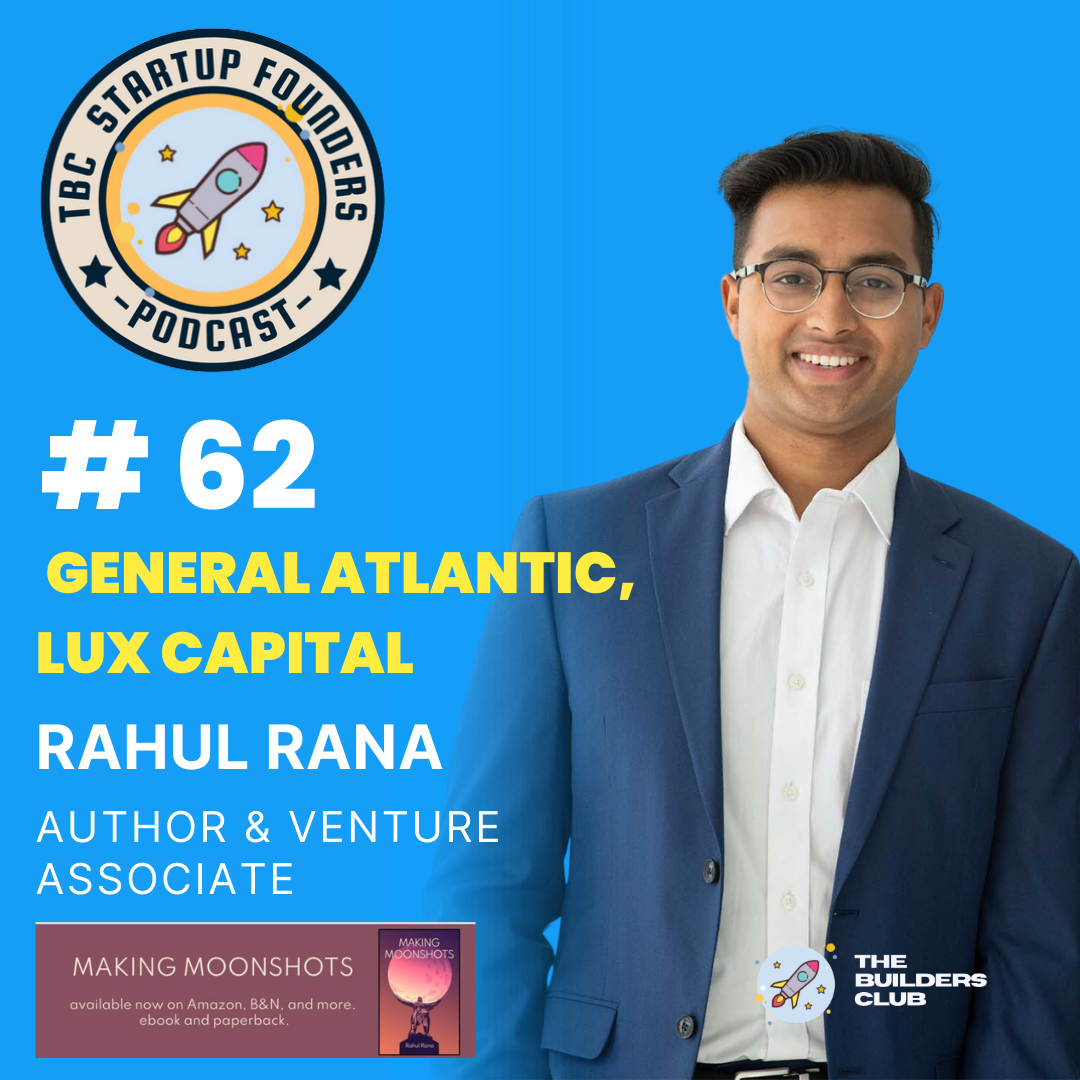
The Architecture of Moonshots: Investing in the Impossible with Rahul Rana
Table of Contents
- The Architecture of Moonshots: Investing in the Impossible with Rahul Rana
- Executive Summary: The Moonshot Framework
- Key Discussion Points & Strategic Takeaways
- Full Discussion Transcript (Abridged Highlights)
- Frequently Asked Questions (FAQs)
In an era of incrementalism, how do the world’s most ambitious founders build companies that redefine human capability? In this deep-dive discussion, Rahul Rana, an investor at Lux Capital (formerly with General Atlantic) and author of Making Moonshots, unpacks the framework for identifying and scaling “moonshot” companies.
From deep-tech investment theses to the psychology of contrarian founders, this conversation serves as a masterclass for Founders, Enterprise CXOs, and Business Leaders looking to understand the next 20 years of technological evolution.
Executive Summary: The Moonshot Framework
A “Moonshot” is not just a bold idea; it is the intersection of advanced science, a radical solution, and a massive global problem. Rahul Rana argues that we are entering a new “Golden Age” where the barriers to deep-tech—long development cycles and capital intensity—are being dismantled by a new breed of venture builders. For the enterprise leader, the takeaway is clear: the greatest risk is no longer failure, but irrelevance in the face of radical breakthroughs.
Key Discussion Points & Strategic Takeaways
1. The Taxonomy of a Moonshot Company
Rahul defines a moonshot through three specific pillars:
- The Problem: Addressing a trillion-dollar pain point or a fundamental human limitation.
- The Radical Solution: Moving beyond 10% improvements to 10x breakthroughs.
- The Deep Tech: Utilizing “Hard Tech” (nanotech, AI, biotech, or space-tech) that creates a defensible “moat” through scientific complexity.
2. Founder Psychology: Navigating the “Valley of Death”
For CXOs and investors, evaluating a founder’s mental resilience is as critical as the technology.
- Contrarian Thinking: The best founders are often “productively crazy”—they hold a view of the world that the consensus finds laughable but the data supports.
- Negotiating with Failure: Rahul emphasizes that moonshot founders do not avoid failure; they “negotiate” with it, using early setbacks to refine their scientific models.
3. The Convergence of Foundational Markets
The discussion highlights how previously siloed industries are now merging:
- Space Exploration: Beyond satellites, we are looking at moon colonization and orbital manufacturing as viable business models within this decade.
- Human-Technology Integration: The bridge between biology and silicon is narrowing, leading to breakthroughs in longevity and life extension.
- Energy & ESG: Deep tech is the only viable path to hitting Net Zero targets, moving beyond carbon credits into carbon capture and fusion energy.
4. Breaking into High-Stakes Venture Capital
Rahul shares his unconventional journey into Lux Capital, highlighting the power of intellectual curiosity and specialized content. By writing Making Moonshots, he built a “Proof of Work” that served as a magnet for high-signal opportunities—a lesson for any leader looking to pivot their career or influence.
Full Discussion Transcript (Abridged Highlights)
On the definition of Moonshots:
“A moonshot isn’t just a high-risk bet. It’s taking an advanced science—something that was previously only in the realm of academia or sci-fi—and applying it to a radical solution for a big world problem. It’s about building the future we were promised in the 1960s.”
On evaluating Deep-Tech startups:
“At Lux, we look for ‘technical risk’ over ‘market risk.’ If the technology works, we know the market will be there. The question is: can they actually build it? That’s where the specialized team and the ‘founder-market-science fit’ come in.”
On the future of Space and Longevity:
“We are moving from ‘Earth-observation’ to ‘Off-earth habitation.’ Similarly, in biotech, we are shifting from treating symptoms to reprogramming the human genome for longevity. These aren’t 50-year bets anymore; they are 5 to 10-year investment horizons.”
Frequently Asked Questions (FAQs)
Who is Rahul Rana?
Rahul Rana is an investor, venture builder, and the author of the acclaimed book Making Moonshots. He has worked with prestigious firms like Lux Capital and General Atlantic, focusing on deep-tech, space, and nanotechnology.
What is Lux Capital’s investment thesis?
Lux Capital invests at the intersection of science and technology. They specialize in “hard tech” or “deep tech” sectors, including robotics, synthetic biology, space, and AI, often taking bets on technologies that others find too complex or “impossible.”
What are the 3 criteria for a moonshot company?
According to Rahul Rana, a moonshot must involve:
- A radical solution to a global problem.
- The use of advanced, breakthrough technology.
- A timeline and scale that seeks to define a new industry.
How can I read “Making Moonshots” by Rahul Rana?
The book Making Moonshots is available on Amazon and major retailers. It provides a deep dive into the mindsets and strategies used by founders of companies like SpaceX, Neuralink, and beyond.