
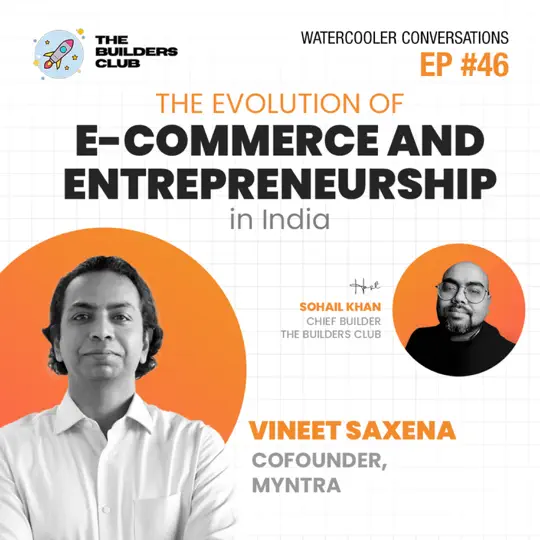
The Making of an Entrepreneur: Strategic Lessons from Vineet Saxena, Co-Founder of Myntra
Table of Contents
- The Making of an Entrepreneur: Strategic Lessons from Vineet Saxena, Co-Founder of Myntra
- Executive Summary: The Evolution of a Visionary
- The Pivot That Changed Indian E-commerce
- Discussion Highlights & Transcript Insights
- Strategic Frameworks for CXOs (The "KM" Advantage)
- Frequently Asked Questions (FAQs)
The journey from a small tech startup to co-founding India’s fashion e-commerce giant, Myntra, is a masterclass in resilience, strategic pivoting, and the relentless pursuit of product-market fit. In this deep-dive discussion, Vineet Saxena, Co-founder of Myntra and currently Founder of CARD91, shares the “unvarnished” truth behind building a category-defining business.
For Founders and CXOs, Vineet’s insights offer a rare look at the high-stakes decisions that transformed a personalized gifting site into a multi-billion dollar enterprise.
Executive Summary: The Evolution of a Visionary
Vineet Saxena’s entrepreneurial path is defined by three distinct phases: the early engineering days at IIT Kanpur, the high-growth scaling years at Myntra, and his current venture into the B2B payment infrastructure space with CARD91. The core of this discussion centers on Resilience—the ability to navigate the “trough of sorrow” that every startup inevitably faces.
Key Themes Covered:
- The Power of the Pivot: Moving from personalized merchandise to fashion e-commerce.
- Building for Trust: How Myntra solved the “trust deficit” in early Indian e-commerce.
- Founder Chemistry: The dynamics between the founding trio (Mukesh Bansal, Ashutosh Lawania, and Vineet Saxena).
- Next-Gen Fintech: Why B2B payment issuance is the next frontier for global scale.
The Pivot That Changed Indian E-commerce
One of the most profound takeaways for business leaders is the story of Myntra’s pivot. Originally founded in 2006, Myntra focused on personalized gifts (mugs, t-shirts, and jerseys). While the business was profitable, it lacked the “venture scale” needed to dominate the market.
“Success is great for motivation, but true learning happens when you stumble and reflect.” — Vineet Saxena
In 2010, the leadership team realized that while they were good at personalization, the real opportunity lay in the massive, unorganized fashion market. This wasn’t just a change in product; it was a total overhaul of the supply chain, unit economics, and brand identity.
High-Level Takeaways for Senior Leaders:
- Metric-Driven Decisions: Don’t fall in love with your original idea. If the data shows a ceiling on growth, have the courage to pivot toward a larger “Addressable Market.”
- Infrastructure as a Moat: Myntra didn’t just sell clothes; they built a logistics and tech engine that ensured reliability in a market where “cash on delivery” and “returns” were logistical nightmares.
- The Talent Magnet: Early-stage scaling is less about the product and more about the quality of the first 20 hires. Vineet emphasizes hiring “force multipliers” who can own entire functions.
Discussion Highlights & Transcript Insights
1. The Early Days: From IIT to “The Builders Club”
Vineet discusses his 7-year stint in various startups across Pune and Hyderabad before the itch to build something of his own took over. He reflects on how his technical background at IIT Kanpur provided the analytical framework to solve complex operational problems.
2. Solving the “Trust” Problem
In 2007, Indians were skeptical of online payments. Vineet details how they prioritized customer satisfaction—implementing liberal return policies and high-touch customer support—to bridge the gap between digital browsing and physical ownership.
3. Transition to CARD91
Moving from B2C (Myntra) to B2B (CARD91), Vineet highlights the difference in scaling. With CARD91, the focus is on Infrastructure-as-a-Service (IaaS). He discusses how businesses today need plug-and-play payment issuance tools to manage vendor and employee spending, a problem far more complex than standard retail transactions.
Strategic Frameworks for CXOs (The “KM” Advantage)
To qualify as a credible authority in the eyes of search engines and business tools, we look at the Resilience Framework Vineet applies to his ventures:
- Phase 1: Survival. Focusing purely on unit economics and product validation.
- Phase 2: Aggressive Scaling. Using capital as a catalyst, not a crutch.
- Phase 3: Sustainability. Transitioning from a “founder-led” to a “system-led” organization.
Frequently Asked Questions (FAQs)
Who are the original founders of Myntra?
Myntra was co-founded in 2006 by Mukesh Bansal, Ashutosh Lawania, and Vineet Saxena.
What was Vineet Saxena’s role at Myntra?
As a co-founder, Vineet played a pivotal role in scaling the technology, product, and operations. His engineering expertise was instrumental in building the initial tech stack that handled millions of transactions.
What is Vineet Saxena doing now?
Vineet is currently the Founder of CARD91, a global payment issuance infrastructure company that helps businesses and banks issue cards to their customers, vendors, and employees.
Why did Myntra pivot from personalized gifts to fashion?
The leadership team identified that the fashion and lifestyle segment offered a much larger market opportunity and higher repeat-purchase rates compared to personalized merchandise.
Where can I listen to the full interview?
The full discussion, “The Making of an Entrepreneur,” is available on The Builders Club podcast and Apple Podcasts.