
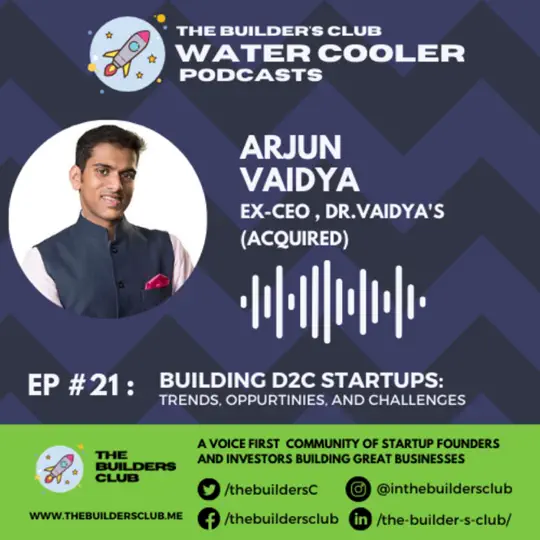
The New Age of Ayurveda: How Arjun Vaidya Scaled a 150-Year Legacy into a ₹100 Crore D2C Powerhouse
Table of Contents
- The New Age of Ayurveda: How Arjun Vaidya Scaled a 150-Year Legacy into a ₹100 Crore D2C Powerhouse
- Executive Summary: The D2C Masterclass
- Key Strategic Takeaways for Business Leaders
- Podcast Transcript Highlights (Edited for Clarity)
- Action Plan for Founders (15-20 Years Experience)
- Frequently Asked Questions (FAQs)
Building a brand in the modern Indian market requires more than just capital; it requires a blend of heritage, digital-first strategy, and a “creator mindset.” In this episode of the Sanjay Kathuria Podcast, Arjun Vaidya, Co-founder of Dr. Vaidya’s and Investment Partner at V3 Ventures, breaks down the roadmap for building a high-growth Direct-to-Consumer (D2C) brand.
For founders and CXOs with decades of experience, Arjun’s journey offers a masterclass in category selection, digital distribution, and the transition from operator to investor.
[Add Podcast Embed Link Here]
Executive Summary: The D2C Masterclass
Arjun Vaidya didn’t just start a company; he revitalized a 150-year-old family legacy. After a stint in private equity at Verlinvest, he realized that while the world was adopting “Westernized” wellness, the source—Ayurveda—remained stuck in traditional, inaccessible formats. By pivoting from a physical clinic to an online-first model, Arjun scaled Dr. Vaidya’s to over 5,000 orders per day before a landmark acquisition by the RP Sanjiv Goenka Group.
Key Strategic Takeaways for Business Leaders
1. The “Creator-Brand” Paradigm
One of the most profound shifts in 2024-2025 is the blurring line between content and commerce. Arjun argues that the winners of the next decade will be brands that think like creators.
- The Moat: In a world of rising Customer Acquisition Costs (CAC), organic content is the only sustainable moat.
- Actionable Insight: Founders must be the “Chief Storytellers.” Authenticity on platforms like LinkedIn and Instagram is no longer optional—it’s a core distribution channel.
2. Category Selection: Looking Where Others Don’t
Arjun’s investment thesis at V3 Ventures focuses on the “Bharat Opportunity.” * Mass Premium: The real scale in India lies in the mid-price segment—offering “aspirational” products at “affordable” prices.
- The Filter: Arjun often invests in products he doesn’t personally consume. Why? Because personal bias often blinds founders to the needs of the 400 million consumers in Tier 2 and Tier 3 cities.
3. Scaling Beyond Product-Market Fit (PMF)
Many startups fail because they attempt to scale too many channels at once. Arjun’s advice is clinical:
- Channel Mastery: Dominate one channel (e.g., Meta or Amazon) until the unit economics are undeniable.
- Hiring for Growth: Successful scaling is a result of delegation. If the founder is still involved in every ₹10,000 decision, the business is capped.
4. The Transition: Operator vs. Investor
Having sat on both sides of the table, Arjun highlights a key mindset shift:
- Entrepreneurship: Every part of the company must succeed. There is zero room for failure in the core product.
- Venture Capital: It’s a portfolio game. You bet on multiple “black swans,” knowing that a few massive winners will cover the losses.
Podcast Transcript Highlights (Edited for Clarity)
Sanjay Kathuria: Arjun, you built Dr. Vaidya’s into one of the first major D2C exits. What was the “Aha!” moment?
Arjun Vaidya: “It was actually a moment of failure. We tried to go offline early on—signed six distributors in Bombay, put 10 lakhs of stock in the market. Three months later, 90% of it came back. I realized I didn’t have the ‘brand pull’ to compete with legacy giants like Dabur or Himalaya. My wife (then girlfriend), who was at Nykaa, suggested going online. That’s when the ‘New Age Ayurveda’ concept truly took off.”
Sanjay Kathuria: What should a 2026 pitch deck look like for a founder seeking funding?
Arjun Vaidya: “Compelling and mobile-first. A font size of 30, less than 20 slides, and readable in under 10 minutes on a phone. We look for team chemistry, market depth, and a clear path to ₹100 Crore.”
Action Plan for Founders (15-20 Years Experience)
- Audit Your Content: Is your brand a ‘silent manufacturer’ or a ‘vocal creator’?
- Focus on Retention: Scale is a vanity metric if your churn is high. Arjun emphasizes that in D2C, the second purchase is where the profit begins.
- Explore WhatsApp Marketing: As discussed in the podcast, WhatsApp is becoming the “OS of India.” Leveraging it for customer engagement is a high-ROI move.
Frequently Asked Questions (FAQs)
Who is Arjun Vaidya?
Arjun Vaidya is a prominent Indian entrepreneur and investor. He is the founder of Dr. Vaidya’s (acquired by RPSG Group) and currently serves as a Co-founder and Investment Partner at V3 Ventures.
How did Dr. Vaidya’s reach a ₹100 Crore valuation?
The brand achieved its scale through a digital-first approach, focusing on “New Age Ayurveda” products like ‘Herbo 24 Turbo’ and ‘LIV.itup,’ using content-led marketing to reach over 2 million customers.
What is the investment thesis of V3 Ventures?
V3 Ventures, backed by Verlinvest, focuses on early-stage consumer brands in India and Europe, particularly those targeting the mass-premium segment and the “Bharat” consumer base.
What are the key challenges in building a D2C brand today?
The primary challenges include rising CAC (Customer Acquisition Cost) on platforms like Meta/Google, the need for omnichannel distribution (moving from online to offline), and maintaining high customer retention.