
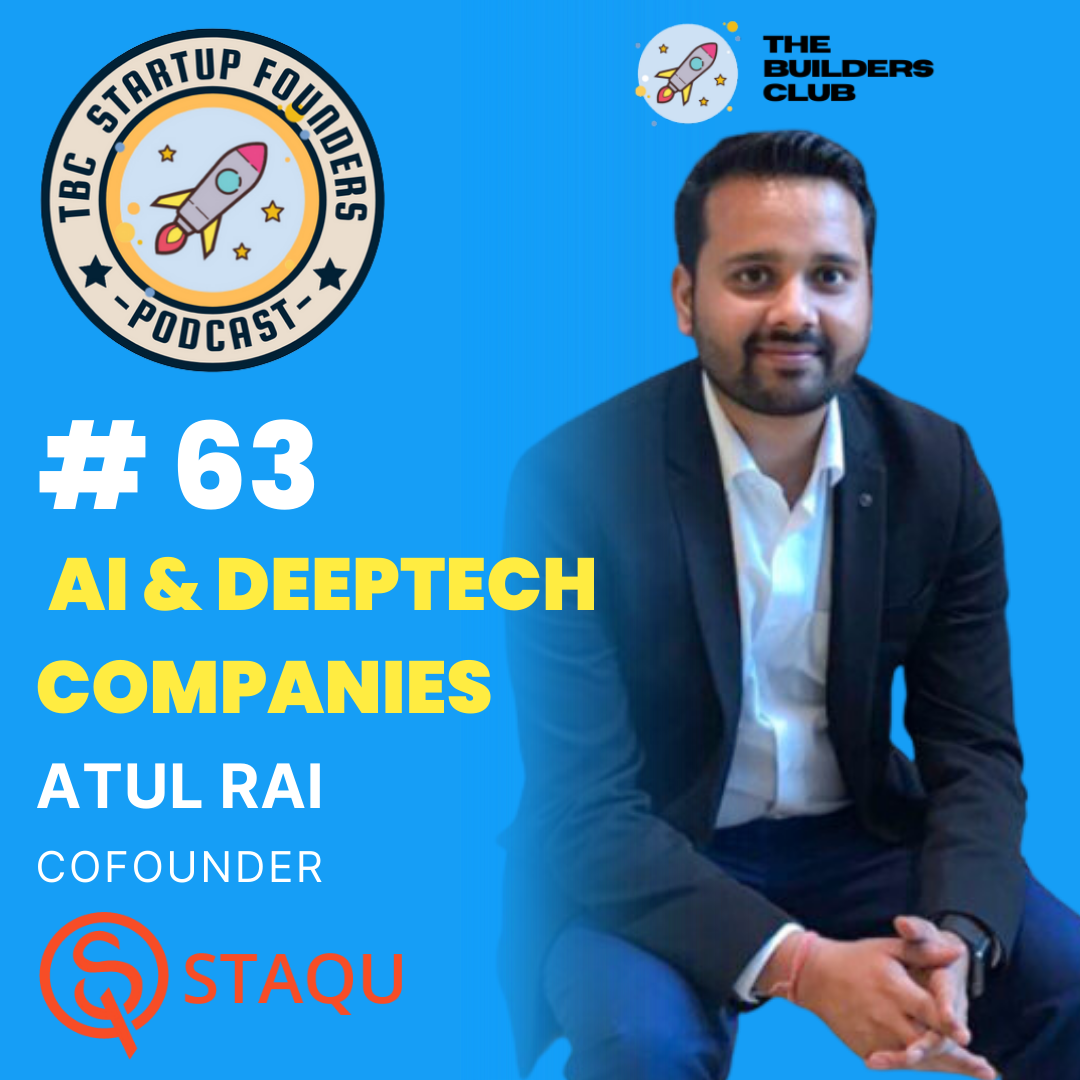
Scaling DeepTech: How Atul Rai is Turning Every CCTV into an Intelligent Asset
In the rapidly evolving landscape of Artificial Intelligence, most conversations center on generative bots and text-based LLMs. However, for Founders and Enterprise CXOs, the real frontier lies in unstructured data—specifically the billions of hours of video footage captured by existing infrastructure.
In a recent masterclass on The Builders Club Startup Founders Podcast, Atul Rai, Co-founder and CEO of Staqu Technologies, shared his journey of building one of India’s premier DeepTech companies. From working with state police departments to optimizing retail footfall, Rai’s insights provide a strategic roadmap for business leaders looking to move beyond AI hype into high-impact implementation.
The Executive Summary: Bridging Research and Revenue
Atul Rai’s journey is a rare blend of academic rigor and street-smart entrepreneurship. Educated at the University of Manchester, Rai returned to India in 2015 with a singular vision: to make cameras as intelligent as humans.
Staqu’s flagship product, JARVIS (Joint AI Research for Video Instances and Streams), is a plug-and-play solution that retrofits existing CCTV infrastructure with advanced bimodal (audio-video) analytics. By focusing on real-world automation—facial recognition, violence detection, and revenue enhancement—Staqu has moved from a bootstrapped research firm to a national award-winning AI powerhouse.
High-Level Takeaways for Business Leaders
1. The “Infrastructure-First” Strategy
For CXOs, the biggest hurdle to AI adoption is often the “Rip and Replace” cost. Rai argues that the most efficient way to scale AI is by leveraging existing assets.
- The Insight: Do not buy new hardware. Use AI as a software layer that sits on top of your current CCTV network.
- Actionable Advice: Audit your unstructured data. 70% of internet data is visual; your enterprise is likely sitting on a goldmine of untapped video data that can be converted into operational intelligence.
2. Solving for “Activity Detection” vs. Static Analytics
Standard security systems are reactive. Rai highlights the shift toward Activity Detection.
- The Case Study: In UP Prisons, Staqu’s AI doesn’t just record violence; it identifies it as it happens and alerts the Chief Security Officer in real-time.
- Enterprise Application: This translates to “Safety as a Service” for manufacturing plants or “Efficiency as a Service” for retail chains by detecting queues or customer distress signals instantly.
3. Data Privacy as a Competitive Advantage
In the DeepTech world, trust is the primary currency. Rai emphasizes that Staqu is one of the few Indian AI firms to hold both GDPR (European) and American standard privacy certifications.
- The CXO Perspective: Scaling AI requires a “Privacy by Design” architecture. If you are building or buying AI, ensure the protocols for data confidentiality are baked into the code, not added as a compliance afterthought.
Transcript Highlights: The Founder’s Journey
(Edited for clarity and brevity)
The Builders Club: What was the motivation behind starting Staqu in 2015, when AI was still a buzzword?
Atul Rai: “When I was in Manchester, I realized that images account for nearly 70% of data shared online, yet it was largely unstructured. I returned to India and met my co-founders at our previous workplace. We realized we had the perfect trifecta: research (myself), engineering (Anurag), and cloud (Pankaj). We decided to solve the automation problem for audio-video data.”
The Builders Club: How did you break into the government and law enforcement sector?
Atul Rai: “We started with a pilot for the Alwar police. They wanted to identify criminals from a database. Our technology identified 300 criminals in three months. That led to the development of ABHED and later JARVIS. Today, we manage digitized databases of over 900,000 criminals for various state departments.”
The Builders Club: What is the USP that differentiates you from global giants?
Atul Rai: “Our solutions are camera-agnostic. Whether it’s a CCTV, a drone, or a body-cam, JARVIS works. Moreover, we use bimodal data. We don’t just ‘see’ a glass breaking; we ‘hear’ it and correlate that with the video to provide 100% accuracy in alerts.”
Strategic Key Points Covered
- Bimodal Analytics: Why combining audio and video signals is the only way to achieve zero-gap surveillance.
- Revenue Enhancement: Using AI to track customer journeys, heatmaps, and staff productivity in retail and enterprise settings.
- Digital Transformation in E-Governance: How Staqu reduced election counting petitions from 80,000 to 400 using AI-driven verification in Bihar.
- Global Expansion: The roadmap for entering the US and UK markets with specialized DeepTech offerings.
Frequently Asked Questions (FAQs)
Who is Atul Rai?
Atul Rai is the Co-founder and CEO of Staqu Technologies. He is a prominent AI researcher and entrepreneur with a Master’s from the University of Manchester. He is widely recognized for pioneering indigenous AI video analytics in India.
What does Staqu Technologies do?
Staqu is a DeepTech AI company that specializes in audio-video analytics. Their product, JARVIS, uses computer vision and deep learning to automate security, safety, and business intelligence for enterprises and government agencies.
Is JARVIS compatible with all CCTV cameras?
Yes, JARVIS is a plug-and-play, camera-agnostic platform. It does not require additional hardware and can be integrated into existing CCTV, drone, or mobile camera streams with a stable internet connection.
How does Staqu ensure data privacy?
Staqu follows international data security standards, holding both GDPR (Europe) and American privacy certifications. They employ advanced protocols for data encryption and confidentiality to protect user information.
What are the main use cases for Staqu’s AI?
Key use cases include facial recognition, violence detection, intrusion alerts, fire detection, retail footfall analysis, and criminal database management for law enforcement.