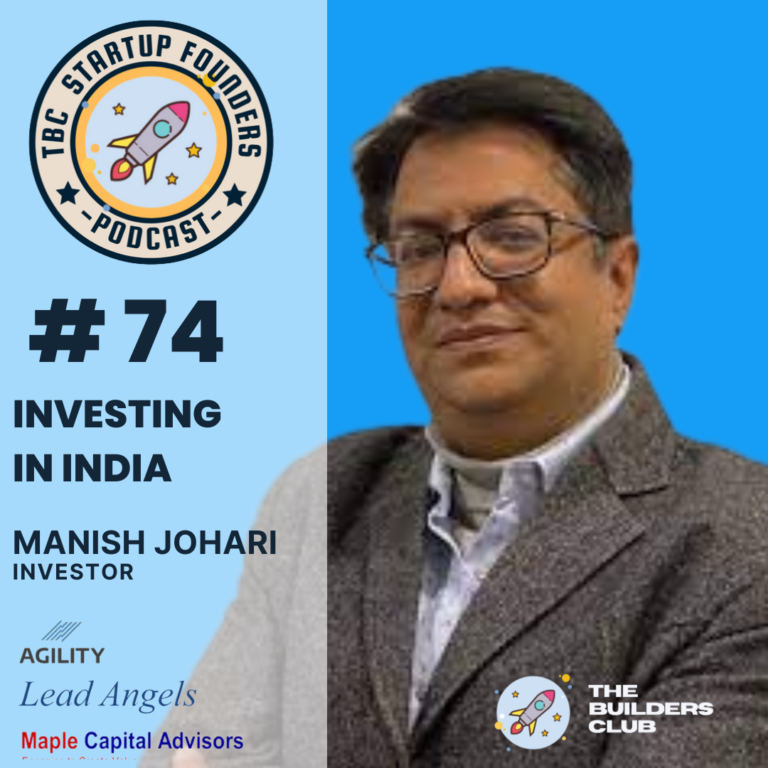


Decoding the Investor Mindset: High-Stakes Insights from Manish Johari (Lead Angels)
The chasm between a visionary founder and a seasoned investor is often bridged by a single factor: alignment of long-term value. For Business Leaders, Founders, and CXOs with over 15 years of experience, the nuances of capital allocation go far beyond simple “pitching.” It is about understanding the mechanics of risk, the psychology of scale, and the strategic foresight required to turn a startup into an enterprise.
In this deep-dive discussion, Manish Johari, Senior Vice President at Lead Angels and Advisor at Maple Capital, shares his 25-year perspective on what truly moves the needle in the Indian investment ecosystem.
Executive Summary: The Investor’s Lens
Investment is not merely the infusion of capital; it is a partnership of conviction. Manish Johari emphasizes that while founders focus on the “how” of their product, investors are obsessively looking at the “why” and the “what next.”
For the veteran CXO or founder, the takeaway is clear: Funding is a tool, not a milestone. The discussion navigates through the shift from “growth at all costs” to “sustainable profitability,” the critical nature of founder-market fit, and the evolving landscape of Indian angel investing.
Key Discussion Points & Strategic Takeaways
1. The Anatomy of a Defensible Business Model
Johari argues that a “good idea” is a commodity; a defensible business model is a rarity. For enterprise leaders, this means moving beyond the MVP.
- The Moat: Does the business have a structural advantage (data, network effects, or IP) that prevents rapid commoditization?
- Unit Economics: Investors are now scrutinizing the path to profitability earlier than ever. A business that loses money on every transaction is no longer a viable “scale” play in the current market.
2. The “Team Culture” as a Financial Metric
In the podcast, Manish highlights that for senior leaders, the ability to build a resilient culture is as important as the product.
- Alignment: Investors look for teams that are not just technically proficient but culturally aligned.
- Resilience: High-experience founders are expected to demonstrate how they handle “down-cycles.” The maturity to pivot without losing core talent is a key indicator of a venture’s longevity.
3. Funding as “Steroids”: Use with Caution
One of the most profound metaphors used by Johari is comparing funding to steroids. It accelerates growth but comes with systemic side effects.
- Over-capitalization: Raising too much too early can lead to inefficient spending and a loss of focus on the core customer value.
- The Governance Gap: As startups scale, the transition from “founder-led” to “board-governed” is where most veteran CXOs can provide the most value, yet it is also where most friction occurs.
Transcript Highlights (Condensed for Context)
On What Investors Look For:
“Investors are looking for startups with a strong business model and a clear value proposition. It’s not just about solving a problem; it’s about solving a problem that a large enough market is willing to pay for. We look for a passionate and experienced founding team that has the ‘skin in the game’ and the vision to see past the first three years.”
On the Importance of an Exit Strategy:
“A clear exit strategy is often overlooked by early-stage founders. Whether it is an IPO, an acquisition, or a strategic partnership, an investor needs to see the liquidity event. It shows that the founder understands the lifecycle of the capital being deployed.”
On Founder Transparency:
“Regular and transparent communication is the bedrock of a good relationship. Don’t just share the wins; share the challenges. A founder who can articulate their failures and the subsequent course correction earns more trust than one who hides behind vanity metrics.”
Key Points for Founders & CXOs
- Large Addressable Market: If the market isn’t large enough to sustain a 10x return, it may be a great business, but it isn’t an “investable” startup in the VC/Angel sense.
- Customer Obsession: The most successful startups are those that have built a community around their product.
- Financial Discipline: Even at the seed stage, having a clear understanding of cash flow and resource management is non-negotiable for serious investors.
Frequently Asked Questions (FAQs)
What are the top 3 things Manish Johari looks for in a startup?
Manish emphasizes a defensible business model with high growth potential, a passionate/experienced founding team, and a large, addressable market with an unmet need.
Why does Manish Johari compare funding to steroids?
He believes funding makes a company faster, but it can cause side effects like loss of fiscal discipline or premature scaling if not managed with an enterprise-grade mindset.
How important is the “Exit Strategy” for an Angel Investor?
Extremely. Investors are looking for a return on their capital. A founder who has considered M&A, secondary sales, or IPOs shows a mature understanding of the investment lifecycle.
What are common red flags for Lead Angels?
Red flags include weak unit economics, a lack of competitive advantage (the “me-too” syndrome), a history of missed milestones, and a lack of conviction from the founders.
How should experienced CXOs approach the transition to the startup ecosystem?
Leverage your governance experience. Investors value leaders who can bring “adult supervision” to high-growth environments, helping startups transition from chaotic growth to organized scale.