
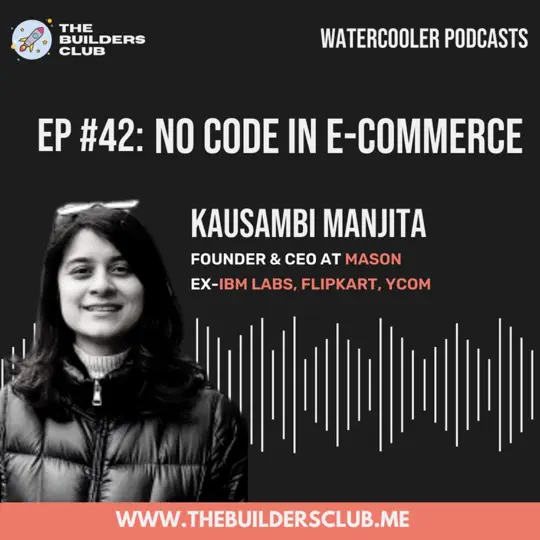
From Storefronts to Sales Engines: Kausambi Manjita on the Future of Autonomous E-commerce
In the rapidly evolving landscape of digital commerce, the distinction between “having an online presence” and “running a high-performance sales engine” has never been more critical. For enterprise CXOs and D2C founders, the challenge is no longer just about building a website; it is about overcoming the “Amazon Tax” and the technical debt of fragmented tools.
In this deep-dive discussion, Kausambi Manjita, Founder of Mason (a Y Combinator alum and Accel-backed venture), shares her insights on how the next generation of commerce is being built on no-code automation, AI-driven merchandising, and the democratization of the complex tech stacks once reserved for retail giants.
The Executive Summary: Moving Beyond “Storage”
Kausambi highlights a fundamental shift in the e-commerce paradigm. While the previous decade was focused on “storing” business information—catalogs, inventory, and customer data—the current era is about action.
Mason was born out of the need to provide brands with an “Amazon-grade” sales engine on their own standalone stores. The goal? To allow brands to reclaim their margins (often losing 35 cents on every dollar to marketplace fees) by automating the middle-ware of commerce: merchandising, personalization, and real-time inventory triggers.
Key Takeaways for Business Leaders (15+ Years Experience)
1. The Death of “Headless” Complexity for SMBs
For years, the gold standard for enterprise commerce was a heavy, custom “headless” implementation. Kausambi argues that for most growing brands, this creates a “technical tax” that stifles agility. The future lies in No-Code Commerce Engines that allow marketing and product teams to execute 10x faster without waiting for a developer sprint.
2. Operationalizing “Emotional Connotation” in Data
Drawing from her experience at IBM, Myntra, and Paytm, Kausambi notes that technical builders often focus on “specs and functions,” whereas the end-user cares about “comfort and achievement.” High-performing stores use AI to bridge this gap—transforming raw inventory data into social proof (e.g., “Trending Now” or “Only 2 Left”) that triggers the emotional impulse to buy.
3. Solving the Customer Acquisition Cost (CAC) Crisis
With CAC skyrocketing across Meta and Google, the only lever left for founders is Conversion Rate Optimization (CRO). Kausambi details how Mason’s “Playbooks” automate the manual work of updating store interfaces based on user behavior, typically leading to a 23% increase in Average Order Value (AOV) within the first 30 days.
4. The Pivot from Kubric to Mason
A masterclass in founder agility: Kausambi discusses the strategic pivot from her previous venture, Kubric, into Mason. This move was driven by a realization that content alone isn’t enough; content must be tied to commerce logic (pricing, inventory, and demand) to be truly effective.
Detailed Discussion Transcript Highlights
On the “Amazon Tax”:
“Most brands are left with no option but to sell at marketplaces and pay huge fees because running a profitable standalone store is just too hard. We want to democratize the tech stack so brands can stay independent and profitable.”
On the Role of AI in Merchandising:
“Commerce is about selling, not storing. We are building a technology layer that helps convert information into action. Whether it’s a price drop alert or a ‘back in stock’ badge, these are the micro-conversions that build a macro-brand.”
On the Future of No-Code:
“The goal of the no-code movement isn’t just to replace programmers; it’s to take programming to a more accessible level. It allows the person who understands the customer—the marketer or the founder—to be the one who actually builds the experience.”
The Strategic Framework: The Mason Methodology
Kausambi outlines three critical pillars that every modern e-commerce CXO must automate:
- Inventory Playbooks: Automating “Low Stock,” “New Arrival,” and “Back in Stock” triggers to create urgency without manual intervention.
- Social Proof Integration: Leveraging real-time data to show what other shoppers are doing (Best Sellers, Trending Products).
- Dynamic Pricing & Personalization: Moving away from static discounts toward AI-driven “Smart Price Drops” that protect margins while enticing the buyer.
Frequently Asked Questions (FAQs)
Who is Kausambi Manjita?
Kausambi Manjita is a serial product builder and the Founder/CEO of Mason. With over 16 years of experience at companies like IBM, Myntra, and Paytm, she is a recognized leader in commerce enablement and a Y Combinator alumna.
What is Mason (getmason.io)?
Mason is an AI-powered commerce automation engine. It helps D2C brands and retailers increase conversions and AOV by automating their store’s merchandising and customer experience layers without requiring a developer.
How does Mason help with Shopify conversion?
Mason offers a “No-Code” interface (often compared to a Canva-meets-Zapier experience) that connects to a Shopify store’s inventory and pricing data. It then automatically updates the storefront with high-converting elements like badges, personalized upsells, and urgency triggers.
Why is the “No-Code” movement important for e-commerce founders?
No-code allows founders to be “proactive” rather than “reactive.” Instead of waiting weeks for a developer to update a sale banner or inventory tag, founders can use automated playbooks to update their site in real-time based on live data.
How does Mason compare to marketplace selling?
While marketplaces like Amazon provide traffic, they charge a high “tax” and own the customer data. Mason enables brands to build “Amazon-grade” functionality on their own platforms, allowing them to keep 100% of their customer data and significantly higher margins.