
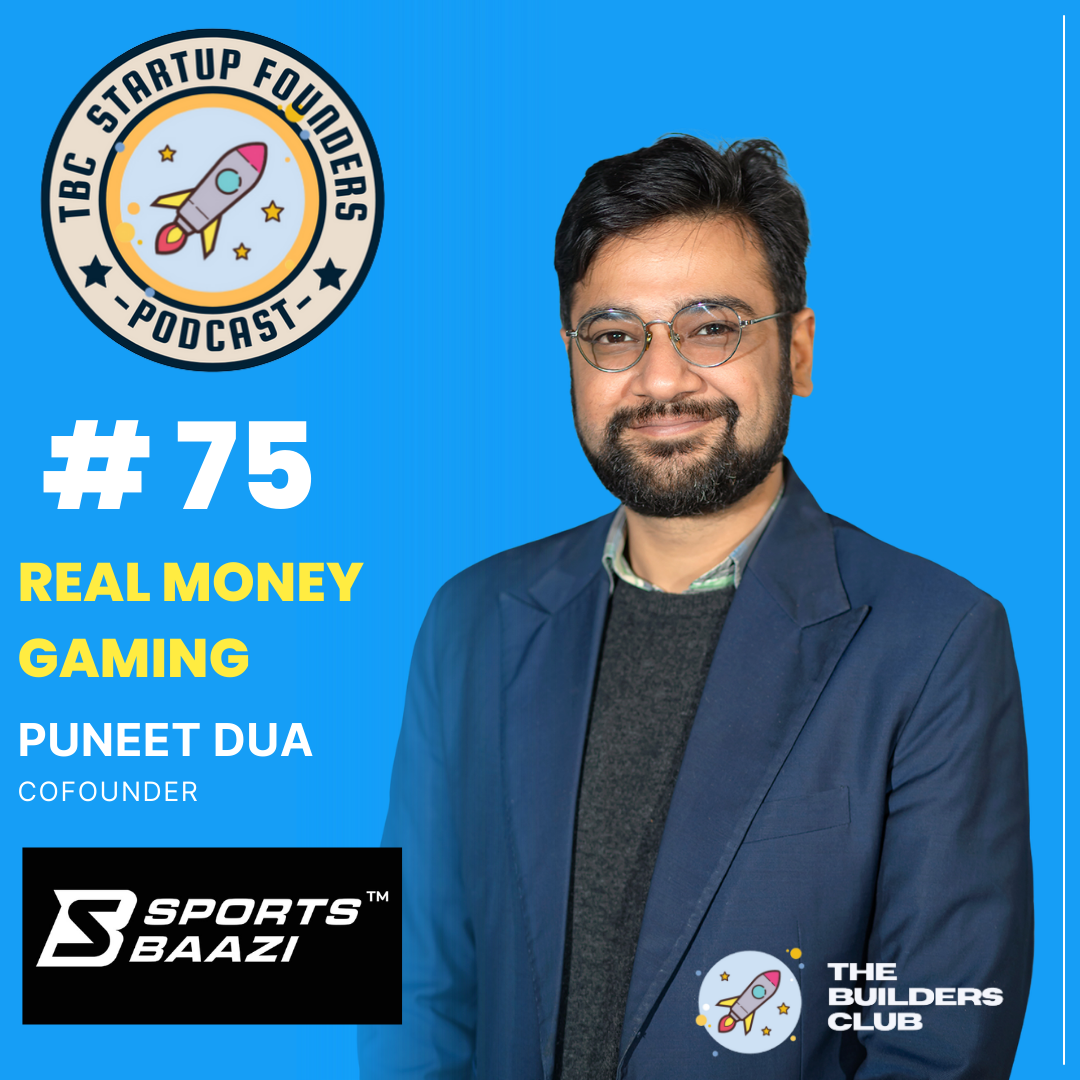
Mastering the High-Stakes World of Real Money Gaming: Insights from Sportsbaazi Co-founder Puneet Dua
In an era where digital entertainment is rapidly evolving, Real Money Gaming (RMG) has emerged as a powerhouse industry in India. In this exclusive deep-dive based on The Builders Club Podcast, Puneet Dua, Co-founder and CMO of Sportsbaazi, shares the strategic blueprint behind scaling a gaming giant, navigating complex regulatory shifts like the 28% GST implementation, and the art of “Constant Innovation.”
For founders and CXOs, this discussion offers a masterclass in unit economics, user psychology, and building resilient organizations in high-velocity markets.
Executive Summary: The RMG Frontier
The conversation tracks the journey of Sportsbaazi (formerly BalleBaazi) from a fantasy sports startup to a full-stack gaming ecosystem. Puneet Dua highlights how the brand achieved profitability within six months of a major tax overhaul by pivoting toward product-led growth and innovative game formats like “Prediction Leagues” and “Player Stocks.”
Watch the full episode here: https://youtu.be/gf1I5FsgVRc
Key Strategic Takeaways for Business Leaders
1. The Pivot from Fantasy to Ecosystem
While many brands remain tethered to the seasonality of the IPL, Sportsbaazi has diversified into Sports Trading and Prediction Leagues.
- The Logic: Fantasy sports require a high barrier of knowledge (pitch conditions, player form). Prediction leagues lower this barrier, attracting “Recreational” users while retaining “Sharks” through depth of data [13:25].
- The Insight: Moving from a “game” to a “spectatorship experience” increases user LTV (Lifetime Value) by engaging them throughout the live match, not just pre-match.
2. Profitability Post-GST: A Unit Economics Masterclass
The introduction of a 28% GST on the RMG sector was a “black swan” event for many. Puneet explains that survival depended on two levers:
- Retention over Acquisition: CAC (Customer Acquisition Cost) only makes sense if there is a 2.5x to 2.8x repeat purchase frequency [04:04].
- Product-Led Growth (PLG): Marketing can drive a user to the app, but only a seamless, high-hygiene product experience ensures they stay [17:31].
3. Segmenting the Modern Indian Gamer
Puneet breaks down the RMG audience into three distinct cohorts, a framework relevant for any B2C enterprise:
- Aspirational (The Volume): Users spending small amounts (₹1–100) for the hope of a life-changing win [09:27].
- Recreational (The Value): High-income earners (salaries of ₹50k to ₹5L+) who play for social proof or FOMO [10:00].
- The “Regs” or Sharks (The Experts): Professional players who use Excel sheets and data-heavy Telegram channels to grind out consistent profits [11:05].
4. The “Content-Led Growth” Engine
In the RMG space, trust is the primary currency. Sportsbaazi leverages:
- Educational Content: Helping losers become winners through expert tutorials, which significantly increases retention [19:23].
- Influencer Ecosystem: Moving beyond simple “shoutouts” to deep integrations with 80+ influencers who act as “torchbearers” for the brand [13:05].
Detailed Discussion Transcript Summary
Early Days and Motivation [01:34]
Puneet Dua traces his roots from the fashion marketing industry at Arvind Internet to the RMG space. His background in e-commerce taught him the vital importance of Repeat Sales and User Experience, which he successfully transplanted into the gaming world in 2017.
The Skill Set of a Founder [05:00]
“The first core skill is being a user of the space,” Puneet notes. Empathy for the player’s journey is the prerequisite for any technical optimization in performance marketing or product design.
Operational Excellence & Productivity [28:58]
Despite the availability of complex tools like Jira, ClickUp, or Notion, Puneet swears by Excel and Google Docs for high-level tracking.
- Organizational Design: A lean team of ~110 people, with about 25–28 focused purely on growth (performance, branding, and retention) [23:41].
- Meeting Culture: He keeps 50% of his calendar open and has a “No Scheduled Meetings” rule on Fridays to allow for spontaneous 1-on-1s and deep work [32:58].
Frequently Asked Questions (FAQs)
Q1: How did Sportsbaazi adapt to the 28% GST on RMG?
Puneet mentions that the company refocused on innovation and profitability within six months. By optimizing retention and introducing formats with higher “ARPU” (Average Revenue Per User) like Poker and Rummy, they managed to offset the tax burden [07:22].
Q2: What is the difference between Fantasy Sports and Prediction Leagues?
Fantasy Sports involve building a 11-player team based on deep stats. Prediction Leagues allow users to answer specific questions about match outcomes using a coin-allocation system, making it more accessible to casual spectators [13:42].
Q3: Is Real Money Gaming legal on Play Store?
Sportsbaazi maintains a “Free to Play” version on the Google Play Store to drive top-of-funnel awareness for their new innovations, while the real-money version is available via their website and the Apple App Store [16:46].
Q4: Can someone actually make a living from these platforms?
Yes. Puneet highlights a category of users called “The Regs” (Regulars) or “Sharks” who use advanced data analysis and Excel sheets to win consistently, sometimes withdrawing tens of lakhs in a single financial year [12:14].
Q5: What are “Player Stocks”?
Similar to the stock market, Player Stocks allow users to “buy” or “sell” an athlete’s performance assets. If the player performs well, the value of the “stock” increases, allowing for trading-based gameplay [26:25].
Watch the full episode here: https://youtu.be/gf1I5FsgVRc