
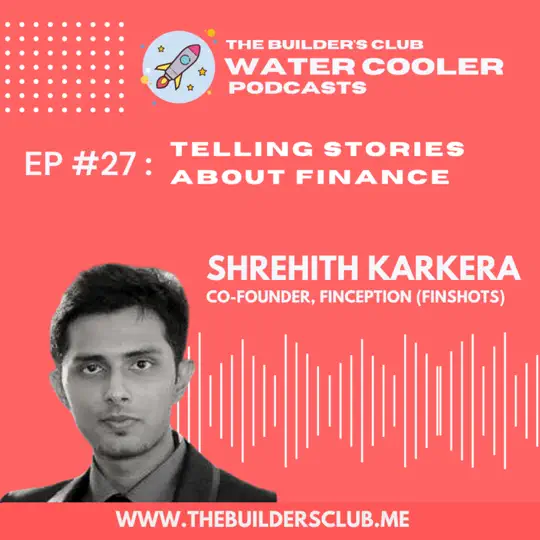
The Art of Financial Storytelling: How Shrehith Karkera Built the Finshots Empire
Table of Contents
- The Art of Financial Storytelling: How Shrehith Karkera Built the Finshots Empire
- Executive Summary: The Finshots Philosophy
- Key Insights for Business Leaders & Founders
- Detailed Discussion Points & Transcript Highlights
- Frequently Asked Questions (FAQs)
In an era of information overload, clarity is the ultimate competitive advantage. For founders and enterprise leaders, the ability to distill complex data into a compelling narrative is no longer just a “soft skill”—it is a core business driver.
In a deep-dive conversation on the Telling Stories podcast, Shrehith Karkera, Co-founder of Finshots and Ditto Insurance, reveals the blueprint behind one of India’s most successful modern media brands. For CXOs and veteran leaders, his journey offers a masterclass in product differentiation, the “Theory of Constraints,” and the discipline required to maintain brand trust at scale.
Executive Summary: The Finshots Philosophy
Finshots didn’t just build a newsletter; they built a “jargon-free” ecosystem. With over 400,000 subscribers and a strategic investment from Zerodha, the platform has redefined how India consumes financial news. The core of their success lies in Shrehith’s personal paradox: a man who once struggled with finance subjects at IIM Ahmedabad became the person most qualified to simplify them for the masses.
Key Insights for Business Leaders & Founders
1. Leverage the “Theory of Constraints” for Product Focus
Many enterprises fail by trying to do too much. Shrehith explains how Finshots applied the Theory of Constraints to their editorial process. Instead of covering every news item, they committed to one high-quality story per day.
- Takeaway for CXOs: Constraints breed creativity. By limiting your output, you force your team to prioritize only the highest-impact initiatives, ensuring your brand stands for quality over quantity.
2. The Hook: Ending with the Headline
Standard journalism often front-loads the conclusion. Shrehith’s storytelling philosophy is the opposite: The “Hook” leads the reader through a journey where the headline is the destination. * Takeaway for Founders: Whether you are pitching to investors or communicating a new strategy to your board, don’t just state the facts. Build a logical narrative arc where your conclusion feels like the only inevitable outcome.
3. Overcoming the “Expert’s Curse”
Shrehith’s lack of a traditional finance background was his greatest asset. He viewed every topic through the eyes of a layman. This allowed him to identify “rabbit holes” and jargon that typically alienate high-level decision-makers who are short on time.
- Takeaway for Leaders: The most effective leaders are those who can translate technical complexity into strategic simplicity. If you can’t explain your business model to a non-expert, you don’t understand it well enough.
Detailed Discussion Points & Transcript Highlights
On the “Viral” Moment and Scaling Trust
Shrehith recounts the early days when Finshots was running low on funds. A single video on Jet Airways went viral, proving that there was a massive, untapped appetite for simplified business history. This wasn’t just luck; it was the result of a disciplined writing process that favored analogies over technical data.
“I went from not having written anything to just starting a publication. My first year MBA grade sheet was a sea of Cs in Accounting and Finance. That discomfort is exactly what made me a better writer for the common person.” — Shrehith Karkera
The Writing Process: Conversations with Self
A unique detail Shrehith shares is his thinking technique: Conversations with himself. He often debates a topic internally to find the friction points in an argument before putting pen to paper.
Strategic Takeaways for Veteran Professionals (15+ Years Exp)
- The Power of Analogies: Shrehith discusses how using relatable comparisons (like the Malthusian Prophecy for Bal Krishna Tyres) makes complex industrial sectors “sticky” in a reader’s mind.
- Hypothesis-Driven Research: Avoid the “research rabbit hole.” Start with a hypothesis of what the story is, and use data to either validate or pivot—don’t just collect data and hope a story emerges.
Frequently Asked Questions (FAQs)
Who is Shrehith Karkera?
Shrehith Karkera is the Co-founder of Finshots (a financial newsletter) and Ditto Insurance. An alumnus of IIM Ahmedabad, he is widely recognized for his ability to simplify complex financial and economic topics through narrative storytelling.
What is the “Theory of Constraints” in the context of Finshots?
In the podcast, Shrehith mentions using this theory to focus the team’s energy. By deciding to publish only one story a day, they removed the bottleneck of “information clutter” and focused entirely on the quality of that single piece of content.
Why is Finshots considered a leader in financial media?
Unlike traditional news outlets that rely on jargon, Finshots uses a 3-minute storytelling format. This approach has garnered them over 400,000 subscribers and investment from industry leaders like Zerodha’s Rainmatter fund.
How can business leaders use Shrehith’s storytelling techniques?
Leaders can adopt his “Ending with the Headline” approach for internal communications and investor relations, ensuring that the audience is engaged by the narrative before the final “ask” or conclusion is delivered.