
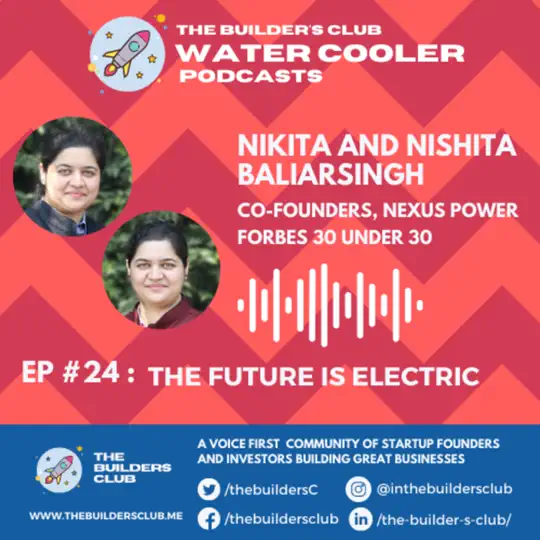
The Circular Revolution: How Nikita and Nishita Baliarsingh are Out-Innovating Lithium with Crop Waste
Table of Contents
- The Circular Revolution: How Nikita and Nishita Baliarsingh are Out-Innovating Lithium with Crop Waste
- Executive Summary: Bridging the Gap Between Agriculture and Autotech
- The Founders’ Journey: From “Car Enthusiasts” to Deep-Tech Disruptors
- Technical Deep-Dive: The “Protein” Advantage
- Strategic Takeaways for Business Leaders & CXOs
- Discussion Transcript (Key Highlights)
- Frequently Asked Questions (FAQs)
The global race for sustainable energy has long been tethered to the limitations of Lithium-ion. While EVs are the future, the “dirty” reality of mineral mining and the slow pace of charging have remained significant hurdles for mass adoption. Enter Nikita Baliarsingh and Nishita Baliarsingh, the twin founders of Nexus Power, who are rewriting the rules of material science by building high-performance, biodegradable batteries from agricultural residue.
In this deep-dive discussion, we explore how these founders transitioned from business graduates to deep-tech pioneers, the chemistry of “protein-based” energy storage, and why the future of the Indian EV market might just be grown in a field rather than mined from the earth.
Executive Summary: Bridging the Gap Between Agriculture and Autotech
For years, India has grappled with two distinct crises: the environmental impact of “stubble burning” in the north and the high cost of EV batteries imported from China. Nexus Power represents a rare “dual-solution” innovation. By extracting proteins and nano-materials from crop waste, the Baliarsingh sisters have developed a battery that is:
- Lithium-Free: Eliminating dependency on scarce minerals and volatile global supply chains.
- Rapid Charging: Achieving full charge in approximately 45 minutes (targeting 10-15 mins in future iterations).
- Fully Biodegradable: The end-of-life battery doesn’t go to a landfill; it can be repurposed as organic manure.
The Founders’ Journey: From “Car Enthusiasts” to Deep-Tech Disruptors
The story of Nexus Power didn’t start in a laboratory, but on a terrace in Bhubaneswar. Despite not having formal engineering degrees, Nikita (CIO) and Nishita (CEO) leveraged their background in business and communication to identify a massive market inefficiency.
“We realized that if you want to solve the EV problem, you have to solve the battery problem first. It’s the heart of the machine.” — Nikita Baliarsingh.
Key Turning Points:
- The Grandfather’s Library: A pivotal moment occurred when they discovered an old biochemistry book suggesting that proteins could potentially facilitate electron transfer.
- Bio-Mimicry: The team utilized the concept of bio-mimicry to replicate natural energy-storing processes found in living organisms.
- The Pandemic Prototype: While the world was under lockdown in 2020, the sisters built their first 5V proof-of-concept cell at home using household tools and localized research.
Technical Deep-Dive: The “Protein” Advantage
For CXOs and technical leads, the allure of Nexus Power lies in its Energy Density and Lifecycle.
| Feature | Nexus Power (Bio-Organic) | Standard Lithium-Ion (LFP/NMC) |
| Raw Material | Agricultural Residue (Stubble) | Lithium, Cobalt, Nickel |
| Charging Time | 45-60 Minutes (8x Faster) | 4-6 Hours |
| Cost Efficiency | 30-40% Lower | High (Import Dependent) |
| Environmental Impact | Biodegradable (Turns to Manure) | Toxic E-Waste |
| Safety | Non-Flammable / High Thermal Stability | Risk of Thermal Runaway |
The Mechanism of Action
Nexus Power utilizes nanodot proteins derived from crop residue to form the three core pillars of a battery: the Anode, Cathode, and Electrolyte. By manipulating the cell chemistry at a molecular level, they have achieved a “fast regenerative” property that allows electrons to move more freely than in traditional chemical-heavy batteries.
Strategic Takeaways for Business Leaders & CXOs
With 15-20 years of experience, leaders know that “cool tech” doesn’t always equal a “viable business.” Here is why Nexus Power is a case study in strategic innovation:
1. Solving the “Import-Dependency” Risk
For Indian enterprises, the reliance on Chinese lithium cells is a massive geopolitical and financial risk. Nexus Power’s model utilizes a “raw material” that India has in excess—crop waste. This creates a resilient, localized supply chain.
2. The Circular Economy as a Revenue Driver
Nexus doesn’t just sell batteries; it creates a circular ecosystem. They procure waste from farmers (providing them an additional income of ~₹25,000 per 100 batteries) and return the spent batteries as bio-fertilizers. This is ESG (Environmental, Social, and Governance) in its purest, most profitable form.
3. Lean Innovation & Government Synergy
The founders’ ability to secure grants from Startup India, MeitY, and BIRAC demonstrates a masterclass in leveraging the public sector for R&D before seeking aggressive VC equity.
Discussion Transcript (Key Highlights)
Interviewer: “How did two non-engineers manage to convince the industry that they could build a better battery?”
Nishita Baliarsingh: “We didn’t start by saying ‘we are engineers.’ We started by saying ‘there is a problem.’ We took certification courses in nanotechnology and battery thermal management at IIT and IIM. We spoke the language of the problem until we learned the language of the solution.”
Nikita Baliarsingh: “The hardest part was the skepticism around biodegradability. People thought if it’s organic, it won’t be powerful. But nature is the most powerful engine we have. We just had to figure out how to bottle that energy.”
On Scaling: The team has grown to 40+ members, including PhD scholars and postdoc researchers, moving from a home-based experiment to a pilot manufacturing line in Bhubaneswar.
Frequently Asked Questions (FAQs)
Who are the founders of Nexus Power?
Nexus Power was co-founded by twin sisters Nikita Baliarsingh and Nishita Baliarsingh. Nikita serves as the Chief Innovation Officer (CIO), while Nishita serves as the Chief Executive Officer (CEO).
What makes Nexus Power batteries different from Lithium-ion?
Unlike traditional batteries that use mined minerals like Lithium and Cobalt, Nexus Power uses bio-organic nano-materials derived from agricultural waste (crop residue). This makes them cheaper, faster to charge, and 100% biodegradable.
Can Nexus Power batteries be used in 4-wheelers?
While their initial focus is on 2-wheelers, 3-wheelers, and Stationary Energy Storage (BESS), the technology is scalable. The company plans to expand into 4-wheelers and commercial e-vehicles as they scale their manufacturing capacity.
Is the technology patented?
Yes, Nexus Power holds several provisional and permanent patents regarding their unique material synthesis and the process of extracting proteins from crop residue for battery applications.
When will Nexus Power batteries be available in the market?
The company is currently in the pilot trial phase with various OEMs (Original Equipment Manufacturers). Commercial launch for specific EV segments is anticipated between 2025 and 2026.