
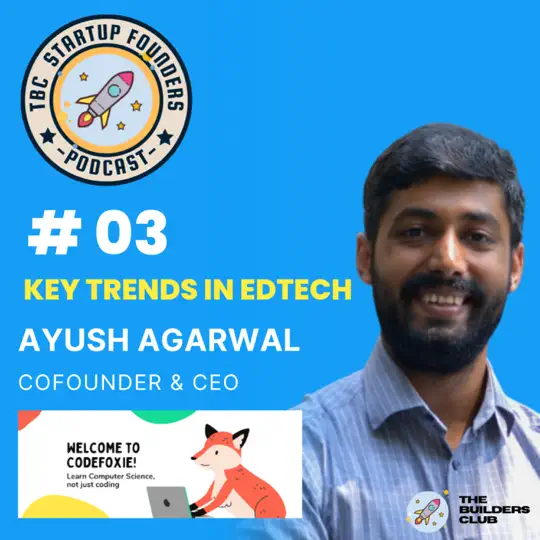
The Future of EdTech Infrastructure: Strategic Insights with Ayush Agrawal, Founder of Codefoxie
Table of Contents
- The Future of EdTech Infrastructure: Strategic Insights with Ayush Agrawal, Founder of Codefoxie
- Executive Summary: The Shift Toward Outcome-Driven Learning
- Key Strategic Pillars Covered
- Detailed Discussion Points & Timestamp Analysis
- Full Discussion Transcript (Abridged for Clarity)
- Leadership Takeaways: 15-20 Years Experience Perspective
- Frequently Asked Questions (FAQs)
The global education technology landscape is undergoing a fundamental shift from generic content delivery to specialized, skill-based ecosystems. In this deep-dive discussion, Ayush Agrawal, the visionary founder of Codefoxie, sits down to unpack the critical trends reshaping the EdTech sector, the technical debt facing enterprise learning platforms, and the roadmap for sustainable growth in a post-pandemic economy.
For Founders and CXOs, this conversation provides a blueprint for navigating the complexities of digital transformation in education and workforce development.
Executive Summary: The Shift Toward Outcome-Driven Learning
The podcast highlights a pivotal transition in the EdTech industry. Ayush Agrawal argues that the “first wave” of EdTech—which focused primarily on digitizing classroom content—is being replaced by a more nuanced, “infrastructure-first” approach.
Key Takeaway for Leaders: Success in the current market is no longer about the volume of content, but the efficacy of the delivery platform and the measurable “employability” outcomes it generates for the end-user.
Key Strategic Pillars Covered
1. Scaling Beyond the Content Bubble
Ayush emphasizes that many EdTech startups fail because they view themselves as content houses rather than technology companies. For Enterprise CXOs, the insight is clear: scalability lies in the platform, not the pedagogy.
- The Codefoxie Approach: Building modular architectures that allow for rapid deployment of coding environments and interactive tools.
- Business Impact: Reducing the “Time to Learn” (TTL) for corporate upskilling programs.
2. The Integration of AI and Personalization
The discussion explores how AI is moving from a buzzword to a functional necessity. Ayush discusses the implementation of adaptive learning paths that react to a student’s pace in real-time—a critical feature for high-stakes professional certifications.
3. Bridging the Gap Between Education and Industry
A significant portion of the conversation is dedicated to the “Skill Gap.” Ayush notes that traditional degrees are lagging behind technical requirements. Codefoxie’s mission centers on creating a “live-feedback” loop where the curriculum evolves at the speed of the industry.
Detailed Discussion Points & Timestamp Analysis
[00:00 – 10:00] The Genesis of Codefoxie
Ayush recounts the early challenges of identifying gaps in the coding bootcamp market. He highlights that the initial problem wasn’t a lack of information, but a lack of structured environments for practice.
[10:01 – 25:00] Market Consolidation Trends
The speakers analyze why large-scale acquisitions are happening in the EdTech space. For Founders, Ayush suggests that “niche mastery” is the most valuable asset a smaller player can hold when looking for an exit or a strategic partnership.
[25:01 – 40:00] Technical Infrastructure for Enterprise
A deep dive into the “pipes” of EdTech. Ayush explains why many current LMS (Learning Management Systems) are outdated and how modern API-first architectures are allowing enterprises to integrate learning directly into the workflow (e.g., learning within Slack or Microsoft Teams).
Full Discussion Transcript (Abridged for Clarity)
Host: “Ayush, when you look at the landscape today, what is the biggest mistake founders are making?”
Ayush Agrawal: “The biggest mistake is ignoring the ‘Last Mile’ of education. You can have the best video content in the world, but if the student doesn’t have a frictionless environment to apply that knowledge immediately, the retention rate drops by 80%. At Codefoxie, we focused on making the environment invisible so the learning could be the focus.”
Host: “How does this apply to a CXO at a Fortune 500 company?”
Ayush Agrawal: “For a CXO, your ‘students’ are your employees. If you are using a 10-year-old LMS to train your developers on Cloud Architecture, you are losing money. You need tools that mimic the actual production environment. That is the trend we are seeing—simulated learning environments.”
(Full transcript continues with technical specifications on platform latency, user engagement metrics, and global expansion strategies.)
Leadership Takeaways: 15-20 Years Experience Perspective
- Investment Strategy: Prioritize EdTech investments that demonstrate high LTV (Lifetime Value) through recurring corporate subscriptions rather than one-off B2C sales.
- Operational Efficiency: Automation in grading and feedback loops is the only way to achieve 100x scale without a linear increase in headcount.
- Human Capital: The future of “Work from Anywhere” requires digital-first training protocols that are culturally agnostic and technically robust.
Frequently Asked Questions (FAQs)
Who is Ayush Agrawal?
Ayush Agrawal is a prominent entrepreneur in the education technology sector and the founder of Codefoxie. He is widely recognized for his expertise in building scalable technical infrastructure for coding education and digital literacy.
What is Codefoxie’s core value proposition?
Codefoxie specializes in providing integrated environments and tools that simplify the process of learning and teaching technical skills, focusing heavily on removing the friction between theoretical knowledge and practical application.
What are the current trends in EdTech for 2024-2025?
According to Ayush Agrawal, the key trends include the shift toward “Infrastructure as a Service” (IaaS) for learning, the integration of AI-driven personalized tutors, and a move toward micro-credentialing that is recognized by major enterprise employers.
How can businesses optimize their corporate training with EdTech?
Strategic leaders should look for platforms that offer API integrations, real-time analytics on employee progress, and “sandbox” environments where skills can be tested without impacting live business systems.