
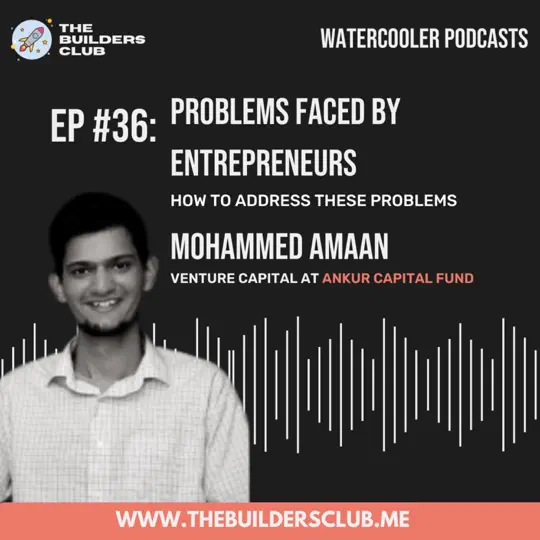
The VC Perspective: Solving Structural Hurdles for Indian Entrepreneurs | Mohammed Amaan, Ankur Capital
In the rapidly evolving landscape of the Indian startup ecosystem, the transition from “product-market fit” to “sustainable scale” remains the ultimate litmus test for founders. In a compelling episode of The Indian Entrepreneur Podcast, Mohammed Amaan, an investment professional at Ankur Capital, breaks down the granular challenges that prevent Indian startups from reaching global institutional quality.
For seasoned business leaders—Founders, CEOs, and Enterprise CXOs—Amaan’s insights offer a rare “behind-the-curtain” look at how venture capital firms evaluate resilience, market depth, and founder-market fit in high-stakes environments.
Executive Summary: The Anatomy of the ‘Next-Gen’ Indian Startup
The discussion centers on the shift from the “growth-at-all-costs” era to a period of disciplined innovation. Mohammed Amaan highlights that while India has no dearth of ideas, the primary bottlenecks lie in supply chain friction, talent retention at the mid-management level, and the complexity of localized scaling. Ankur Capital’s philosophy, as shared by Amaan, focuses on deep-tech and Bharat-centric innovations that solve real-world problems rather than just digitizing existing inefficiencies.
Key Discussion Points & Strategic Takeaways
1. Beyond the Metros: The Complexity of ‘Bharat’
Amaan emphasizes that solving for the “next 500 million” users requires more than just a language translation of a UI. It requires a fundamental understanding of credit cycles, trust-based commerce, and the logistics of Tier 2 and Tier 3 cities.
- CXO Takeaway: Scaling in India is a geographic and cultural challenge, not just a technological one. Infrastructure-light models often struggle where physical trust is a prerequisite for transaction.
2. The Founder’s “Blind Spots” in Early Stages
A common theme in the podcast is the discrepancy between a founder’s vision and operational reality. Amaan notes that many entrepreneurs focus heavily on the “Hero Product” while neglecting the Unit Economics that allow for a Series B or C breakout.
- Leader Insight: For those with 20+ years of experience, the focus should be on building “Anti-Fragile” systems that can withstand capital winters.
3. The Role of Patient Capital in Deep Tech
Unlike generic SaaS, deep tech and AgTech (areas where Ankur Capital is prolific) require a longer gestation period. Amaan discusses how VCs act as partners in “de-risking” the technology before the market is even ready for it.
- Strategic Tip: Strategic partnerships between enterprises and deep-tech startups are becoming the preferred route for corporate R&D.
Transcript Highlights (Selected Insights)
On Founder Resilience:
“The difference between a successful founder and one who stalls isn’t just the idea; it’s the ability to pivot the ‘how’ while remaining obsessed with the ‘why.’ In the Indian context, the ‘how’ changes every six months due to regulatory or market shifts.”
On Market Entry:
“Many founders mistake a ‘large market’ for an ‘accessible market.’ We look for entrepreneurs who have mapped the friction points of the value chain before they write their first line of code.”
Critical Analysis for Senior Leadership
For a leader with two decades of experience, the primary value of Amaan’s discourse lies in the Validation of Fundamentals. The “VC Hype” is being replaced by a rigorous focus on Positive Contribution Margin.
If you are an Enterprise CXO looking to acquire or partner with startups, Amaan’s criteria for investment—Technical Moat, Scalable Unit Economics, and Management Depth—should serve as your due diligence checklist.
Frequently Asked Questions (FAQs)
Who is Mohammed Amaan?
Mohammed Amaan is a prominent venture capital professional at Ankur Capital, a leading early-stage fund in India that invests in transformative technologies in sectors like AgTech, HealthTech, and DeepTech.
What are the main problems faced by Indian entrepreneurs according to the podcast?
The podcast identifies three core challenges:
- Navigating Regulatory Gray Areas: The speed of innovation often outpaces policy.
- Operational Scalability: Moving from a localized pilot to a national rollout.
- Talent Quality at Scale: Finding mission-aligned talent beyond the founding team.
How does Ankur Capital evaluate startups?
Ankur Capital looks for “category-defining” companies. As Amaan discusses, they prioritize startups solving “hard problems” that require technical innovation rather than just marketing spend.
Why is this podcast relevant for Founders and CXOs?
It provides a benchmark for what institutional investors expect in a post-2023 funding environment, emphasizing sustainability, governance, and deep-market penetration.