
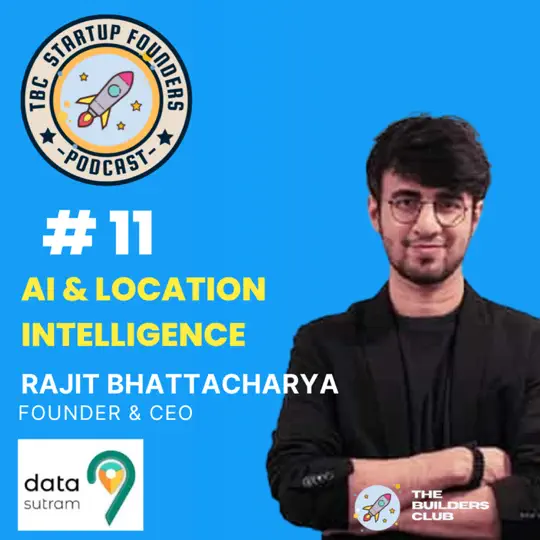
Unlocking the Invisible City: How Rajit Bhattacharya is Redefining Location Intelligence for the Modern Enterprise
Table of Contents
- Unlocking the Invisible City: How Rajit Bhattacharya is Redefining Location Intelligence for the Modern Enterprise
- Executive Summary: The Data Sutram Thesis
- Key Discussion Points & Strategic Takeaways
- Transcript Highlights (Condensed)
- Actionable Lessons for Founders
- Frequently Asked Questions (FAQs)
In the digital-first era, data is often called the “new oil,” but for most enterprise leaders, the challenge isn’t a lack of data—it’s the lack of clean, actionable intelligence. In a recent deep-dive discussion, Rajit Bhattacharya, Co-founder and CEO of Data Sutram, shared his journey of building one of India’s most formidable AI-driven location intelligence and fraud-detection layers.
For Founders and CXOs, Rajit’s insights offer a masterclass in navigating the “chicken and egg” problem of product development and the strategic necessity of alternative data in a credit-hungry economy.
Executive Summary: The Data Sutram Thesis
Data Sutram began with a simple but profound observation: while 97% of organizational data sits unused, external data—from satellites, mobile signals, and point-of-sale (POS) systems—remains a fragmented mystery. Rajit Bhattacharya and his team built an AI engine that cleans, structures, and blends data from over 250 sources to provide a “Trust Score” and “Location Profile” for over 1 billion consumers and 60 million businesses.
The core value proposition for the BFSI (Banking, Financial Services, and Insurance) sector is clear: Alternative data is no longer a “nice-to-have”; it is the primary engine for financial inclusion and risk mitigation.
Key Discussion Points & Strategic Takeaways
1. Solving the “Chicken and Egg” Product Problem
Rajit highlights that in the early days of Data Sutram, they faced a classic dilemma: they needed a platform to collect data before they could get clients, but they needed client revenue to build the platform.
- The CXO Insight: Focus on the problem statement, not just the solution. By validating the need for better data in the financial sector first, Data Sutram was able to secure seed funding from 100X.VC to build the infrastructure required to scale.
2. Beyond SDKs: The Privacy-First Data Approach
Unlike many competitors who install SDKs to “snoop” on user behavior, Data Sutram uses a consented, privacy-first model. They partner with ad exchanges and telecom giants to analyze anonymized digital footprints.
- The Strategic Move: Moving from “surveillance” to “intelligence.” By staying GDPR-compliant and focusing on public/anonymized data, they’ve built a more sustainable and ethical moat that appeals to Tier-1 banks like HDFC, Axis, and Canara.
3. The Shift from Location Intelligence to RegTech
One of the most significant pivots mentioned is the application of location data to fraud detection. Data Sutram’s “Trust Score” now underwrites transactions by identifying synthetic identities and identity theft through digital anomalies.
- The Result: A 45% drop in fraud cases for their partners and an accuracy rate that captures 35-40% of frauds at the onboarding stage.
4. Hyper-Personalization as a Core Philosophy
For enterprise leaders, Rajit emphasizes that hyper-personalization isn’t just a marketing buzzword; it’s a muscle memory. By using location data to understand “affluence, demography, and spending capacity,” brands can reduce marketing burn by up to 60%.
Transcript Highlights (Condensed)
Host: How did the idea of Data Sutram come about during your time at Jadavpur University?
Rajit Bhattacharya: It started with empathy. I entered data science because I heard it was the “sexiest job,” but the reality was that we didn’t have enough clean information to solve real problems. We skipped placements because we were obsessed with the problem of external data. We saw a Kirana store borrower and realized that to lend to him, you didn’t need his bank statement—you needed to know how many people walked into his store, if the area was accessible, and his digital footprint.
Host: How do you differentiate your “Trust Score” from a traditional credit score?
Rajit Bhattacharya: A traditional score looks at your past repayment. Our Trust Score looks at your existence. We process millions of data sets—from satellites to rental sites—to see if the address you provided matches your digital and physical footprint. We’re building a financial ecosystem based on trust, ensuring that even if you are “New-to-Bank” (NTB), your data tells a story of reliability.
Actionable Lessons for Founders
- Zero to One is about the Problem: Don’t get married to your product; get married to the friction your customer feels.
- Diversify your Investor Base: Rajit notes that as young founders, they valued “consistent counsel” from seasoned players (B Capital, Lightspeed) to balance their ambition with achievable targets.
- Build Culture for Innovation: Encourage your team to think from the user’s perspective. At Data Sutram, innovation is incentivized by allowing room for experimentation with unstructured data.
Frequently Asked Questions (FAQs)
Who is the founder of Data Sutram?
Rajit Bhattacharya, along with co-founders Ankit Das and Aisik Paul, founded Data Sutram in 2018 while they were still in their final year of engineering at Jadavpur University.
What does Data Sutram actually do?
It is an AI-driven B2B SaaS platform that provides location intelligence and fraud detection. It helps financial institutions and retailers understand consumer behavior and risk by analyzing alternative data from 250+ sources.
What is the “Trust Score” by Data Sutram?
The Trust Score is a proprietary risk assessment tool that analyzes digital footprints and location data to detect synthetic identities and fraud, helping banks reduce NPAs (Non-Performing Assets).
How much funding has Data Sutram raised?
As of May 2025, Data Sutram raised $9 million in a Series A round co-led by B Capital and Lightspeed, bringing their total funding to approximately $11 million.
Which industries benefit most from Data Sutram’s solutions?
While they started in retail and e-commerce, their primary impact is now in the BFSI sector (Banking, NBFCs, and Fintech), as well as CPG, Healthcare, and Real Estate.