WebEngage success story - The Builders Club

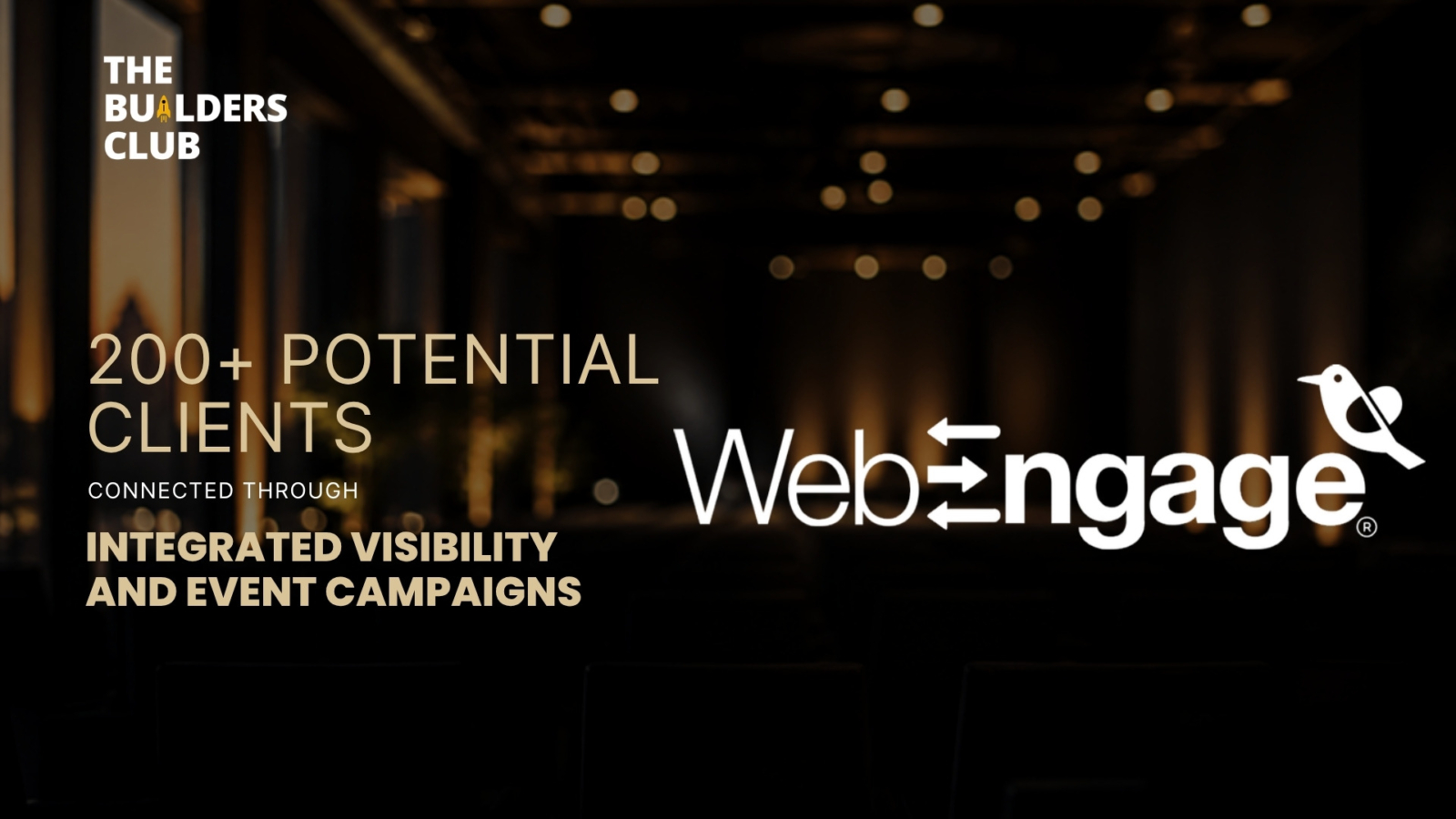
How WebEngage Connected with 200+ Potential Clients Through Integrated Visibility and Event Campaigns

Enterprise buyers have seen every marketing automation pitch there is. Standing out in a crowded martech market takes more than another product demo.

WebEngage, a marketing automation and customer engagement platform, worked with The Builders Club on a six-month programme that combined newsletter visibility with executive roundtables. It connected WebEngage with 200+ qualified enterprise prospects, mixing marketing leaders, CTOs and growth executives at companies of 500 to 5,000+ employees, and 70 to 80% of event attendees requested follow-up.

This case study explains the challenge, the three-part campaign, the results and why leading with insight instead of product pitches builds enterprise trust.

Case Study Summary

  • Client: WebEngage, a marketing automation and customer engagement platform
  • Goal: reach enterprise clients and showcase the platform to large-scale businesses
  • Audience: marketing leaders, CTOs and growth executives at enterprises of 500 to 5,000+ employees
  • Channels: newsletter campaigns to 100,000+ business leaders and executive roundtables
  • Headline results (6 months): 200+ qualified enterprise prospects, 70 to 80% follow-up requests from event attendees

What problem did WebEngage need to solve?

WebEngage needed to connect with marketing leaders and CTOs at enterprise companies in a competitive market with many marketing automation tools. Enterprise clients require trust and credibility before they evaluate a platform, and WebEngage needed visibility among the right audience of potential buyers.

It also had to demonstrate value to large-scale operations. The core challenge: how do you stand out in a crowded martech space and connect with enterprise clients who are skeptical of yet another marketing platform?

What did The Builders Club do for WebEngage?

We ran an integrated six-month campaign that combined content visibility with strategic events to build awareness and generate qualified leads.

How did newsletter campaigns build visibility?

We ran 3 to 4 content campaigns featuring WebEngage in our newsletter, which reaches 100,000+ business leaders. Each campaign was built around an enterprise theme:

  • “How Enterprise Brands Scale Customer Engagement”
  • “Marketing Automation for High-Growth Companies”
  • “Personalization Strategies for Large-Scale Operations”
  • Expert insights from the WebEngage team on customer engagement trends

WebEngage appeared in dedicated sections of the weekly newsletter, aimed at marketing leaders, CTOs and growth-stage founders. We included case study highlights from WebEngage’s enterprise customers and calls to action for product demos and consultations.

The result was consistent visibility with the target audience, which positioned WebEngage as an enterprise-ready solution.

Why did we host executive roundtables?

Visibility opens the door, but enterprise trust is built in conversation. We hosted exclusive roundtables of 8 to 12 senior marketing executives per session, focused on enterprise-scale marketing challenges.

WebEngage shared insights and best practices in an intimate setting, and received direct feedback on what enterprise clients need. Smaller groups created deeper relationships and a clearer understanding of enterprise requirements.

How did we qualify leads and hand them to WebEngage?

After the campaign we connected interested prospects with the WebEngage team. We identified leads with genuine enterprise-scale needs and shared full context: company size, current stack and pain points.

We scheduled product demos and consultations and made warm introductions based on each prospect’s event interactions and content engagement.

What results did the campaign deliver in six months?

Lead generation

  • 200+ enterprise prospects connected with WebEngage, all qualified
  • A mix of marketing leaders, CTOs and growth executives
  • Companies ranging from 500 to 5,000+ employees

Content and event engagement

  • 3 to 4 major content campaigns executed
  • Consistent newsletter presence to 100,000+ readers, with high engagement on enterprise marketing topics
  • Multiple mixer and roundtable events with strong attendance from the target enterprise audience
  • 70 to 80% of attendees requested follow-up conversations

Pipeline and brand impact

  • Qualified enterprise opportunities generated
  • Shorter evaluation cycles from pre-built trust
  • Higher average deal sizes from the enterprise segment
  • Strong brand recognition among the target audience
  • Word-of-mouth referrals from event attendees

Face-to-face relationships with key decision-makers differentiated WebEngage from competitors, and thought leadership in customer engagement reinforced that position.

Why did this integrated approach work?

  • Integrated approach: content and events reinforced each other for maximum impact
  • Enterprise focus: all messaging and events were tailored to large-scale business needs
  • Thought leadership: we led with insights, not product pitches
  • Multiple touchpoints: newsletter visibility plus event presence built familiarity and trust
  • Qualified targeting: we focused on genuine enterprise prospects, not small businesses
  • Warm handoffs: the sales team received context-rich introductions, not cold contacts

Frequently asked questions

How can a martech company win enterprise clients in a crowded market?

Lead with expertise instead of product pitches. WebEngage ran enterprise-themed newsletter campaigns and hosted executive roundtables, which connected it with 200+ qualified prospects from companies of 500 to 5,000+ employees.

How big should an executive roundtable be?

These sessions hosted 8 to 12 senior marketing executives. That size keeps discussion focused and intimate, and 70 to 80% of attendees requested follow-up conversations afterwards.

What results can an integrated content and events campaign deliver?

Over six months this programme produced 200+ qualified enterprise leads, shorter evaluation cycles from pre-built trust and higher average deal sizes. It also earned word-of-mouth referrals from event attendees.

Conclusion

WebEngage needed to prove itself to skeptical enterprise buyers in a crowded martech market. By featuring thought leadership in front of 100,000+ business leaders and hosting intimate executive roundtables, The Builders Club connected WebEngage with 200+ qualified enterprise prospects and built the trust that shortens evaluation cycles.

Selling a SaaS or martech platform to enterprises? Join The Builders Club, our community of 35,000+ founders and CXOs, or explore more success stories to see how integrated visibility and event campaigns can help you connect with enterprise decision-makers.
HSBC success story - The Builders Club

How HSBC Connected with 150+ Funded Founders Through Curated Mixer Events

The Builders Club ran three invite-only mixers for HSBC in Delhi, Mumbai and Bangalore, each for 40 to 50 funded founders. The events connected HSBC with 150+ funded founders whose companies represent $500M+ in cumulative funding. Attendance was 85%, and multiple founders opened HSBC accounts after the events.

Case Study Summary

  • Client: HSBC
  • Objective: understand the banking needs of funded startups and build relationships with founders who had recently raised capital
  • Audience: seed to Series A founders funded in the last 6 to 12 months
  • Programme: three curated mixers in Delhi, Mumbai and Bangalore
  • Results: 150+ founders connected, $500M+ cumulative funding represented, 85% attendance

What was HSBC’s challenge?

HSBC needed to reach founders who had closed a funding round recently and learn what banking services venture-backed startups require. Standard banking outreach was not getting traction with this group. The bank wanted direct conversations about post-funding requirements and a position as a banking partner for growth-stage companies.

What did The Builders Club do?

How did we select the founders?

Attendance was by invitation only. We selected seed to Series A startups that had raised funding in the last 6 to 12 months and whose founders were setting up banking infrastructure for growth. Founders came from the Delhi, Mumbai and Bangalore ecosystems. All of them were managing fresh capital and scaling operations.

What was the event format?

We organised three mixers with 40 to 50 founders per city. The format was informal and peer-led, with no presentations. The HSBC team attended as advisors. Founders discussed:

  • Runway and burn rate management
  • International payment solutions for global operations
  • Multi-currency accounts for overseas hiring
  • Credit facilities for growth
  • Treasury management for funded startups

What did HSBC learn from the founders?

HSBC held informal conversations on banking pain points during each event. The team identified gaps in existing startup banking solutions, needs common across funded startups, what founders look for in a banking partner, and specific challenges in fund deployment and compliance.

How were HSBC’s services introduced?

HSBC presented services only in response to challenges founders raised. The team explained how HSBC supports funded startups globally, connected founders with relationship managers and shared resources on startup banking.

What happened after the events?

We scheduled follow-up meetings with interested founders and connected them with HSBC for detailed consultations. HSBC shared case studies of how it supports funded startups and continued the conversations after the events.

What results did the mixers deliver?

  • 150+ funded founders connected across three cities
  • $500M+ in cumulative funding represented by the companies in attendance
  • 85% attendance rate
  • 150+ warm relationships established with funded founders
  • Multiple founders opened HSBC accounts after the events
  • Referrals to other funded companies in founders’ networks

HSBC also gathered direct input on startup banking needs, common pain points of growth-stage companies and gaps in current offerings, along with founder feedback on HSBC’s positioning. Founders rated the peer networking and HSBC’s approach of listening first positively, and several asked for further mixers.

Why did the format work?

  • Funded founders only: every attendee had an immediate banking need
  • Listening before selling: HSBC gathered requirements before presenting services
  • Three cities: Delhi, Mumbai and Bangalore cover India’s top three startup ecosystems
  • Peer format: founders discussed post-funding challenges with each other
  • Informal setting: conversations stayed candid
  • Decision-maker access: HSBC spoke directly with founders

Frequently asked questions

How can a bank reach recently funded startup founders?

Through a curated, invite-only event for founders who raised capital in the last 6 to 12 months. HSBC’s three mixers gave its team direct conversations with 150+ founders while they were setting up banking for new capital.

What is a founder mixer?

A founder mixer is a small, informal event built around peer conversation instead of presentations. These mixers had 40 to 50 founders per city, with the sponsor attending as an advisor.

What did HSBC achieve with the mixers?

HSBC connected with 150+ funded founders at 85% attendance and built 150+ warm relationships. It also collected direct input on startup banking needs, and multiple founders opened accounts after the events.

Conclusion

HSBC ran three curated mixers through The Builders Club and connected with 150+ funded founders in Delhi, Mumbai and Bangalore. The events gave the bank direct input on startup banking needs and led to accounts opened after the events.

Planning to reach funded founders? Join The Builders Club, our community of 35,000+ founders and CXOs, or read more success stories.

DBS success story - The Builders Club

How DBS Connected with 70+ Investors Through Founder-Investor Roadshows

The Builders Club ran a founder-investor roadshow for DBS Bank in Delhi, Mumbai and Bangalore. The events brought 200+ founders and 70+ investors into the same rooms and connected DBS with 70+ investors. Attendance was 90%, against 60 to 70% typical for startup events, with an average NPS of 9.1/10. Social coverage reached 1 million+ impressions.

Case Study Summary

  • Client: DBS Bank
  • Objective: build relationships with investors and their portfolio companies and position DBS as a banking partner during fundraising
  • Audience: 200+ founders (seed to Series B) and 70+ venture capitalists, angel investors and fund managers
  • Programme: three city roadshows with 60 to 80 attendees each, in Delhi, Mumbai and Bangalore
  • Results: 70+ investors connected, 90% attendance, 9.1/10 NPS, 1 million+ social impressions

What was DBS’s challenge?

DBS had limited visibility among early-stage and growth-stage founders and needed relationships with venture capitalists and angel investors. Traditional banking outreach was not working in the startup ecosystem. The bank also needed the trust of both investors and their portfolio companies, and had to show it understood the fundraising journey.

What did The Builders Club do?

How did we build the attendee list?

We identified 200+ founders from seed to Series B who were fundraising or planning to raise. We invited 70+ venture capitalists, angel investors and fund managers. The programme ran in three hubs: Delhi, Mumbai and Bangalore. The mix covered both founders, who make banking decisions, and investors, who influence them.

What was the event format?

Each city event had 60 to 80 attendees, a mix of founders and investors. The programme combined panel discussions with investor-founder one-on-one networking sessions. DBS presented on how banking partners support a fundraising journey.

  • Fundraising strategies in current market conditions
  • Building investor relationships
  • Financial planning for growth-stage startups
  • Managing runway and burn rates
  • Banking infrastructure for scaling companies

How were DBS’s services presented?

DBS presented services in the context of fundraising and growth challenges raised at the event:

  • Startup banking packages and credit facilities
  • International payment solutions for global expansion
  • Treasury management for growing companies
  • Connections between portfolio companies and investors

How did we extend reach beyond the venues?

We covered all three events live on social media. Founder and investor testimonials went out on LinkedIn, key panel insights were posted across platforms, and attendees and speakers were tagged to extend organic reach. The content reached well beyond the 270+ in-person attendees.

What happened after the roadshow?

We scheduled follow-up meetings between interested investors and the DBS team and connected DBS relationship managers with relevant founders. We shared investor contacts with DBS for ongoing relationships and introduced DBS to portfolio companies.

What results did the roadshow deliver?

  • 200+ founders attended across three cities
  • 70+ investors participated and connected with the DBS team
  • 90% attendance, against 60 to 70% typical for startup events
  • Average NPS of 9.1/10
  • 1 million+ social media impressions, with LinkedIn shares from attendees

Several investors introduced their portfolio companies to DBS, and multiple portfolio companies opened accounts after the events. Ongoing investor conversations created a referral pipeline, and DBS gained access to deal flow and early-stage company pipelines. DBS built its profile in the startup banking community across India’s three largest startup hubs, and the format can be repeated in other cities.

Why did the roadshow work?

  • Value first: we facilitated founder-investor connections before any banking discussion
  • Curated audience: founders and investors were selected, with no open registration
  • Three cities: Delhi, Mumbai and Bangalore
  • Positioning: DBS attended as an ecosystem enabler, not a vendor
  • Social coverage: reach extended beyond in-person attendees
  • Warm introductions: investors referred portfolio companies to DBS

Frequently asked questions

How can a bank build relationships with startup investors and founders?

By hosting events where founders and investors meet and by presenting banking services only in the context of fundraising topics. DBS followed this format across three cities and connected with 70+ investors.

What is a founder-investor roadshow?

A series of curated city events that bring founders and investors together through panels and one-on-one networking. This roadshow ran in Delhi, Mumbai and Bangalore with 60 to 80 attendees per city.

What did DBS achieve with the roadshow?

DBS connected with 70+ investors and 200+ founders, recorded 90% attendance and a 9.1/10 NPS, and reached 1 million+ social impressions. Multiple portfolio companies opened accounts after the events.

Conclusion

DBS used The Builders Club roadshow to meet 70+ investors and 200+ founders in Delhi, Mumbai and Bangalore. The events recorded 90% attendance and a 9.1/10 NPS, produced 1 million+ social impressions and led to portfolio company accounts and investor referrals.

Planning to reach founders and investors? Join The Builders Club, our community of 35,000+ founders and CXOs, or read more success stories.

Ditto Finance success story - The Builders Club

How Ditto Finance Generated 150+ Consultations Through Content Marketing and Community Engagement

The Builders Club ran a six-month educational content programme for Ditto Finance across our newsletter and social channels. It generated 150+ free consultations, all self-qualified, with no cold outreach. The programme also delivered 1 million+ social impressions and 500,000+ newsletter opens.

Case Study Summary

  • Client: Ditto Finance, a financial services platform launching insurance and wealth advisory services
  • Objective: build awareness and trust with working professionals and enterprise leaders, and generate qualified consultation requests
  • Channels: a newsletter section, polls, the Finsights content series and social media
  • Duration: 6 months
  • Results: 150+ consultations, 100% self-qualified leads, 1 million+ impressions, 500,000+ newsletter opens

What was Ditto Finance’s challenge?

Ditto Finance was a new brand in a crowded insurance market with no brand awareness. Its products needed explanation, and working professionals do not respond to traditional insurance advertising. Ditto needed to build trust before any sales conversation and identify prospects who were already interested in financial planning.

What did The Builders Club do?

How did we use the newsletter?

We created a finance section in our newsletter, which reaches 100,000+ business leaders and working professionals. The section ran weekly as “Did You Know?” facts on insurance and personal finance, with simplified explanations of financial concepts and real-world scenarios on why coverage matters. It carried no sales messaging.

How did we identify prospects ready for a consultation?

We ran polls asking readers whether they wanted a free financial consultation and which topics interested them: insurance review, investment planning or tax optimisation. Readers who responded were connected directly with Ditto’s team. Every lead opted in, so 100% of leads were self-qualified.

What is Finsights?

Finsights is a branded content series on personal finance and insurance that we launched for Ditto. Themes included:

  • Insurance myths versus reality
  • Financial planning for different life stages
  • Tax-saving strategies
  • Investment basics for working professionals
  • Case studies of financial planning gone right and wrong

Finsights ran in the weekly newsletter and on LinkedIn, Instagram and Twitter, supported by infographics and short-form content.

How were consultations booked?

Every newsletter and social post carried a call to action for a free consultation, and the polls routed interested readers to Ditto’s advisors. Advisors received each prospect’s stated interests before the first conversation.

What results did the programme deliver in six months?

  • 150+ free consultations booked
  • 100% self-qualified leads, all opted in through polls or calls to action
  • Zero cold outreach
  • 1 million+ impressions across social media
  • 500,000+ newsletter opens featuring Ditto content

Newsletter content featuring Ditto had 35% higher engagement than average issues. Social posts averaged a 3 to 5% engagement rate, against a 1 to 2% norm for finance. The “Did You Know?” section became the most-clicked section of the newsletter, and consultation conversion was significantly higher than industry benchmarks. Multiple prospects referred friends and colleagues.

Why did the programme work?

  • Education over selling: content explained products and concepts with no product pitches
  • Intent-based leads: polls identified readers who wanted a consultation
  • Weekly presence: a fixed weekly section kept Ditto in front of the audience
  • Branded series: Finsights gave the content a recognisable name
  • Newsletter and social: both channels carried the same content
  • Opt-in leads: prospects requested consultations themselves

Frequently asked questions

How do you generate insurance leads without cold calling?

Publish educational content and let readers opt in. Ditto’s weekly newsletter section, the Finsights series and consultation polls produced 150+ consultations with no cold outreach.

What is a self-qualified lead?

A lead who requests the conversation, for example by answering a consultation poll or responding to a call to action. All of Ditto’s leads in this programme were self-qualified.

How long did the programme take to produce results?

The results reported here were achieved in six months: 1 million+ impressions, 500,000+ newsletter opens and 150+ consultations.

Conclusion

Ditto Finance launched with no brand awareness. A weekly newsletter section, consultation polls and the Finsights series generated 150+ self-qualified consultations in six months, with no cold outreach.

Launching a financial or insurance product? Join The Builders Club, our community of 35,000+ founders and CXOs, or read more success stories.

Atlassian success story - The Builders Club

How Atlassian Generated Enterprise Deals from Cloud Infrastructure Buyers

The Builders Club ran a six-month programme for Atlassian combining community invitations, targeted email, gated research and virtual boardrooms to reach enterprise cloud buyers. It produced 2,000+ qualified connections, 850+ content-qualified leads and 4 enterprise deals with an average deal size of $85,000 to $250,000. The sales cycle was 40% shorter than with cold outreach.

Case Study Summary

  • Client: Atlassian
  • Objective: reach enterprises investing in cloud infrastructure and convert them into qualified opportunities
  • Audience: CTOs, VPs of Engineering, Cloud Architects and IT Directors at companies with 500+ employees
  • Channels: community invitations, email, content syndication and virtual boardrooms
  • Results (6 months): 2,000+ connections, 3,500+ report downloads, 4 enterprise deals, 40% shorter sales cycle

What was Atlassian’s challenge?

Atlassian needed to reach CTOs and IT leaders evaluating cloud infrastructure across life sciences, technology, finance, retail and manufacturing. These buyers needed tools that integrate with AWS, Azure and GCP environments. Cold outreach was not converting senior executives, and Atlassian had to show how its tools support cloud-native workflows.

What did The Builders Club do?

How did we build the target list?

We started from Atlassian’s ideal customer profile and target account list. We then identified companies investing in cloud infrastructure on AWS, Azure and GCP, and targeted CTOs, VPs of Engineering, Cloud Architects and IT Directors at mid-to-large enterprises with 500+ employees. We prioritised companies in digital transformation or cloud migration.

How did we use community invitations?

We invited target executives to join our community of 100,000+ enterprise IT leaders instead of sending cold emails. Onboarding calls covered the executive’s own challenges. We mentioned the Atlassian partnership during those conversations and connected only interested prospects with the Atlassian team.

What did the email campaigns cover?

Prospects outside the community received personalised email campaigns on DevOps efficiency, team collaboration and CI/CD pipelines, including Atlassian’s integrations with AWS, Azure and Google Cloud Platform. We tracked engagement and flagged high-intent leads for Atlassian to follow up.

What content did we publish?

  • “Cloud-Native DevOps: 2024 Benchmark Report” on cloud adoption and team productivity
  • “The IT Leader’s Guide to Scaling Cloud Infrastructure” with frameworks for cloud migration
  • “Cloud ROI Calculator”, an interactive tool for measuring efficiency gains

The reports were gated downloads that captured prospect details. We featured Atlassian in our weekly newsletter to 100,000+ IT leaders and syndicated the research findings across technology and business segments. Prospects read the content before any sales conversation.

How did virtual boardrooms compare with offline roundtables?

We ran both formats. Each virtual boardroom had 4 to 5 senior IT leaders, with Atlassian as co-host and cloud infrastructure expert. The topics were cloud migration, DevOps transformation and scaling challenges. Offline roundtables followed the same structure in person. Offline events had higher engagement on the day but lower attendance because of travel and location. Virtual boardrooms performed as follows:

  • Attendance of 85% against 60% offline (40% higher)
  • 3x more boardrooms in the same timeframe
  • Cost per qualified lead 65% lower
  • Follow-up conversion of 78% for virtual against 80% for offline
  • Reach across all US regions without travel

After each session we held debrief calls with interested participants and introduced them to Atlassian’s sales team.

What results did the programme deliver in six months?

Connections and engagement

  • 2,000+ qualified connections with IT decision-makers
  • Engagement rate 340% higher than cold outreach benchmarks
  • 78% of boardroom participants requested follow-up

Content

  • 3,500+ report downloads, with 42% converting to email subscribers
  • 38% newsletter open rate, against a 21% industry average
  • 850+ content-qualified leads
  • 60% of closed deals engaged with content first

Revenue

  • 4 enterprise deals closed with companies of 500+ employees
  • Average deal size of $85,000 to $250,000
  • 40% shorter sales cycle than cold outreach
  • 75% of deals had downloaded reports before sales contact

Why did the programme work?

  • Precise targeting: every outreach went to verified decision-makers at qualified accounts
  • Content before sales: reports gave prospects context before any pitch
  • Trust first: community and content came before selling
  • Multiple touchpoints: community, email, content and events supported each other
  • Virtual format: better ROI than offline with similar follow-up conversion
  • Engagement tracking: we measured content engagement and participation, not just email opens

Frequently asked questions

How do you reach enterprise CTOs and IT leaders who ignore cold outreach?

Use community invitations, gated research and peer boardrooms. Atlassian’s programme produced engagement 340% higher than cold outreach benchmarks and 2,000+ qualified connections.

Are virtual boardrooms or in-person roundtables better for B2B lead generation?

In this programme virtual boardrooms performed better on ROI. They had 85% attendance against 60% offline, allowed 3x more sessions and cut cost per qualified lead by 65%. Follow-up conversion was similar at 78% and 80%.

What does gated content deliver for enterprise sales?

The gated reports produced 3,500+ downloads and 850+ content-qualified leads. 60% of closed deals engaged with content first, and 75% of deals had downloaded reports before sales contact.

Conclusion

Atlassian used The Builders Club community, content and virtual boardrooms to reach enterprise cloud buyers. The six-month programme produced 2,000+ qualified connections, 4 enterprise deals and a 40% shorter sales cycle, and virtual boardrooms delivered better ROI than offline events.

Selling to enterprise IT leaders? Join The Builders Club, our community of 35,000+ founders and CXOs, or read more success stories.

Ionic Wealth success story - The Builders Club

How Ionic Wealth Connected with 50+ HNIs Through Executive Leadership Dinners with The Builders Club

The Builders Club hosted executive leadership dinners for Ionic Wealth in Bangalore, Delhi and Mumbai. In one quarter the dinners produced 50+ warm introductions to qualified HNIs, and every introduction led to an exploratory call with an Ionic Wealth advisor. Attendance averaged 90% and attendees rated the events 9.2/10 on NPS.

Case Study Summary

  • Client: Ionic Wealth, a wealth management firm
  • Objective: reach High Net-Worth Individuals across India and offer personalised wealth solutions
  • Audience: entrepreneurs, CXOs and business owners from our community of 35,000+ business leaders
  • Programme: dinners of 15 to 20 guests in Bangalore, Delhi and Mumbai
  • Results (1 quarter): 50+ warm introductions, 85% of attendees requested follow-up, 90% attendance, 9.2/10 NPS

What was Ionic Wealth’s challenge?

HNIs do not respond to cold outreach or advertising, and wealth management depends on trust. Ionic Wealth needed direct access to decision-makers with investable assets through warm introductions rather than sales pitches.

What did The Builders Club do?

How did we select the guests?

We drew on our community of 35,000+ business leaders to identify entrepreneurs, CXOs and business owners with significant wealth who were looking for wealth management solutions. We checked each attendee for investment capacity and decision-making authority.

What was the dinner format?

We hosted dinners in Bangalore, Delhi and Mumbai with 15 to 20 selected HNIs each, at premium venues. Ionic Wealth attended as a partner. Topics were:

  • Wealth preservation
  • Tax optimisation
  • Investment strategies
  • Legacy planning

There was no sales presentation. Ionic Wealth’s advisors showed their expertise through the discussion.

How did follow-up work?

After each dinner we scheduled individual calls between interested HNIs and Ionic Wealth advisors. Each advisor received the attendee’s business, wealth goals and the interests discussed at dinner. The introduction came from our community, and the calls were consultative.

What results did the dinners deliver?

  • 50+ warm introductions to qualified HNIs, all converting into exploratory calls
  • 85% of attendees requested follow-up conversations
  • Zero cold outreach
  • 90% average attendance, against 60% typical for business events
  • 9.2/10 Net Promoter Score
  • 60% of attendees asked to be invited to future events

Ionic Wealth reached HNIs in three cities without opening offices. Multiple HNIs became clients after their first exploratory call, and several attendees referred other HNIs from their networks. The dinner format can be repeated in other cities.

Why did the dinners work?

  • Small groups: 15 to 20 guests allowed real conversation
  • Vetted guests: every attendee had investable assets and decision authority
  • Community introductions: guests knew the host, which made introductions natural
  • No sales pitch: the discussion covered wealth topics, not products
  • Context at handoff: advisors knew each guest’s goals before the first call

Frequently asked questions

How do wealth managers reach HNIs without cold outreach?

Through curated events hosted by a trusted community. Ionic Wealth’s dinners in three cities produced 50+ warm introductions and no cold calls.

How many guests should an executive dinner have?

These dinners had 15 to 20 guests. At that size attendance averaged 90% and the NPS was 9.2/10.

What happens after an HNI dinner?

Advisors hold individual calls with interested attendees, with context on each person’s business and goals. Here every warm introduction led to an exploratory call, and multiple HNIs became clients.

Conclusion

Ionic Wealth used The Builders Club executive dinners to meet qualified HNIs in Bangalore, Delhi and Mumbai. One quarter produced 50+ warm introductions, 90% attendance and clients from the first exploratory calls.

Selling financial services to high-value prospects? Join The Builders Club, our community of 35,000+ founders and CXOs, or read more success stories.

Dell x Intel success story - The Builders Club

How Dell x Intel Generated 500+ Founder & IT Leaders Pipeline Through Community Engagement with The Builders Club

The Builders Club used polls in its community of 35,000+ business leaders to find Indian companies planning technology purchases and connect them with Dell. Over 12 months the programme created 600+ qualified leads and $200,000+ in sales, with a sales cycle 40% shorter than traditional B2B tech sales. It became a recurring annual partnership with Dell x Intel.

Case Study Summary

  • Clients: Dell and Intel
  • Objective: identify Indian businesses with active buying intent for laptops and IT infrastructure and connect them with Dell’s sales team without cold outreach
  • Audience: business owners, CTOs and decision-makers in our community of 35,000+ business leaders
  • Channels: community polls, direct introductions, Bangalore roundtables and a technology conference
  • Results (12 months): 600+ qualified leads, $200,000+ in sales, 40% shorter sales cycle

What was Dell x Intel’s challenge?

Dell x Intel wanted to reach business decision-makers in India who were about to buy laptops for their teams, IT infrastructure for operations or technology for scaling companies. The need was to identify businesses with active buying intent and connect them with sales teams without cold outreach.

What did The Builders Club do?

How did we find businesses ready to buy?

We ran polls in the community on laptop refresh cycles, team size growth and infrastructure upgrades. The polls identified companies planning purchases in the next 3 to 6 months and collected requirements: number of devices, budget range and use cases. Prospects identified themselves as buyers.

How did leads reach Dell’s sales team?

We introduced interested businesses directly to Dell’s sales team. Each introduction included company size, requirements, timeline and budget.

What happened at the Bangalore roundtables?

We hosted in-person roundtables in Bangalore with 8 to 10 business owners and CTOs from the community. Dell x Intel attended as technology partners. Discussions covered scaling technology infrastructure, remote work solutions and productivity tools, and prospects met Dell’s team in person.

What was the technology conference?

We hosted a technology conference with Dell x Intel as technology partners. It connected several high-profile clients directly with the team and included live product demos, networking and on-site consultations for immediate purchase discussions.

What results did the programme deliver?

Sales

  • 600+ qualified leads created
  • $200,000+ in sales generated from the community
  • 85% of poll respondents with active intent became qualified leads

Events

  • 90% of roundtable attendees converted into qualified opportunities
  • 50+ qualified leads from the conference in one day
  • 15+ follow-up meetings scheduled immediately

Partnership

  • Recurring annual partnership with Dell x Intel, with ongoing acquisition and marketing collaboration
  • Dell x Intel uses the community as its primary lead source in India
  • Average sales cycle 40% shorter than traditional B2B tech sales

Why did the programme work?

  • Intent-based targeting: polls identified buyers before any sales conversation
  • Community trust: prospects knew the community, which made introductions natural
  • In-person events: the Bangalore roundtables and conference built relationships faster
  • Context at handoff: sales received requirements, timeline and budget with each lead
  • Opt-in leads: every prospect raised their hand

Frequently asked questions

How do you find businesses with active buying intent?

Ask them in a community they trust. Our polls covered laptop refresh cycles, team growth and infrastructure upgrades, and 85% of respondents with active intent became qualified leads.

Do in-person events work for B2B technology sales?

Yes, when they are small and targeted. Bangalore roundtables of 8 to 10 leaders converted 90% of attendees into qualified opportunities, and one conference day produced 50+ qualified leads.

What did Dell x Intel achieve through the community?

600+ qualified leads and $200,000+ in sales in 12 months, with a 40% shorter sales cycle. Dell x Intel secured a recurring annual partnership and uses the community as its primary lead source in India.

Conclusion

Dell x Intel used The Builders Club community polls, introductions, roundtables and a conference to reach Indian businesses ready to buy. The programme created 600+ qualified leads and $200,000+ in sales in 12 months.

Looking for buyers with active purchase intent? Join The Builders Club, our community of 35,000+ founders and CXOs, or read more success stories.

Banking SaaS US Market Entry success story - The Builders Club

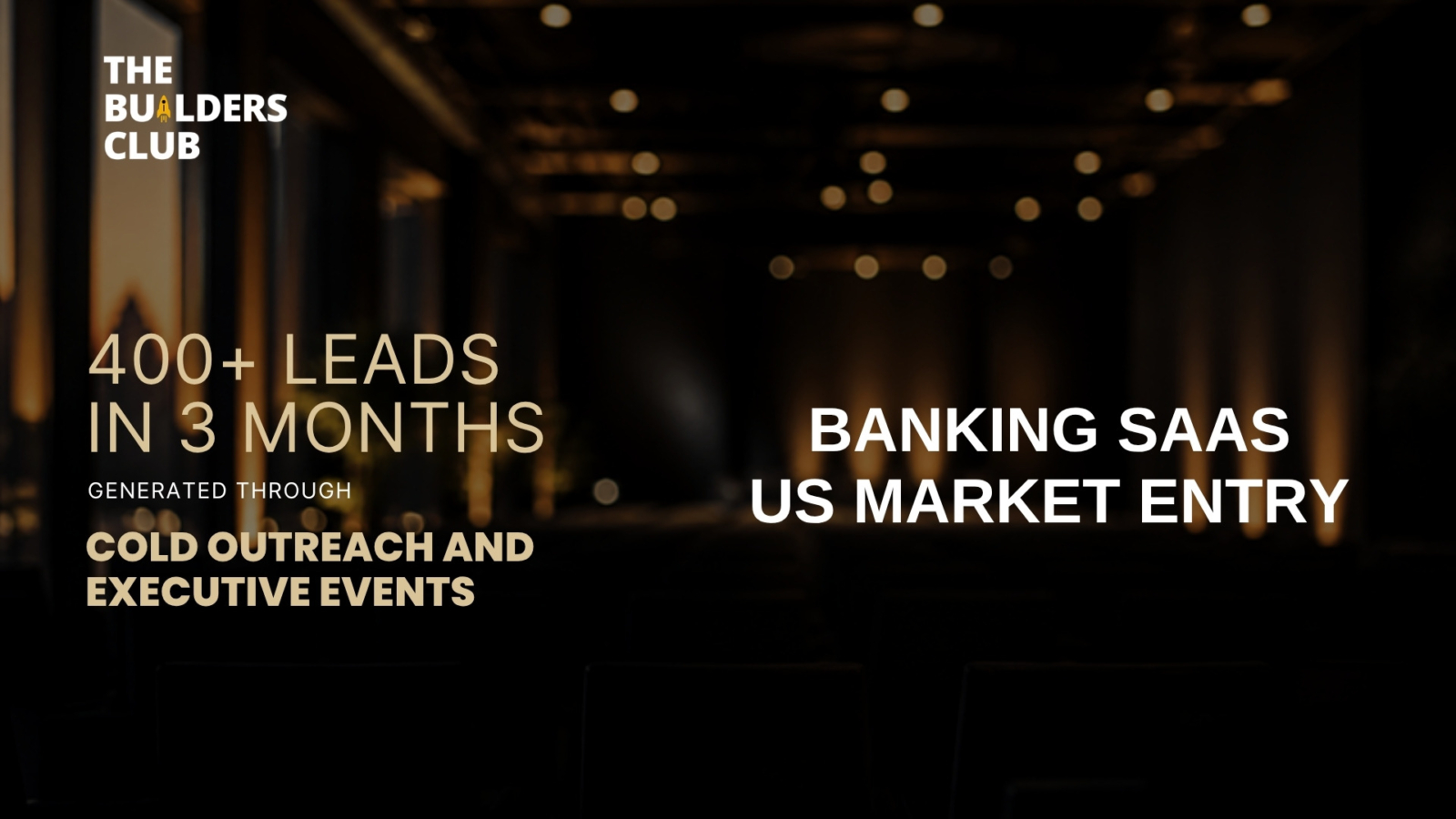
How We Generated 400+ Leads in 3 Months Through Cold Outreach and Executive Events

The Builders Club ran a three-month campaign for a global project management and collaboration software company entering the US banking sector. The campaign combined cold email, newsletter placement and an in-person executive roundtable. It generated 400+ qualified leads and 10+ warm introductions to senior banking executives, with a 65% email open rate against a 25% industry average for cold outreach.

Case Study Summary

  • Client: a global software company offering project management and collaboration solutions
  • Objective: enter the US banking sector and secure meetings with IT decision-makers
  • Audience: CTOs, CIOs, VPs of Technology and IT Directors at mid-to-large US banks and credit unions
  • Channels: cold email, newsletter and an in-person roundtable
  • Results (3 months): 400+ qualified leads, 10+ warm introductions, 8 sales meetings agreed after the roundtable

What was the client’s challenge?

The client had no network in banking and needed qualified leads from IT leaders at financial institutions. Cold outreach to banks typically gets low response rates, so the client also needed warm introductions to senior executives.

What did The Builders Club do?

How did we select the banks and contacts?

We built a list of mid-to-large US banks and credit unions and identified CTOs, CIOs, VPs of Technology and IT Directors at each. We prioritised institutions investing in digital transformation and focused on contacts with budget authority.

What did the email campaigns say?

We ran personalised email campaigns on the client’s behalf, covering security, compliance and legacy systems, and secure team collaboration in regulated environments. We tracked engagement and followed up with high-intent prospects.

How was the newsletter used?

We featured the client in our weekly newsletter to 100,000+ enterprise IT leaders, targeting banking and financial services readers. Calls to action for demos and consultations generated inbound interest from banking executives.

What was the roundtable?

We organised an in-person roundtable for 10 to 12 senior executives from target banks. The client attended as an industry expert. Topics were security, compliance, team productivity and cloud adoption in banking digital transformation. The client also learned the IT priorities of banks directly from attendees.

How did leads become appointments?

We followed up with each attendee individually, introduced interested prospects to the client’s sales team and scheduled appointments. Each introduction included the prospect’s email engagement and event participation.

What results did the campaign deliver in three months?

Leads

  • 400+ qualified leads from the banking sector
  • 10+ warm introductions to senior banking executives
  • Multiple appointments set with decision-makers
  • 65% email open rate, against a 25% industry average for cold outreach

Roundtable

  • 12 banking executives attended
  • 10 requested follow-up conversations
  • 8 agreed to meet the client’s sales team

Lead quality

  • All leads were verified IT decision-makers
  • 40% of leads engaged with multiple touchpoints: email, newsletter and event
  • Prospects were familiar with the client’s solutions before the first meeting

Why did the campaign work?

  • Banking-specific messaging: emails addressed security, compliance and legacy systems
  • Multiple channels: email, newsletter and the roundtable supported each other
  • In-person roundtable: 8 of 12 attendees agreed to a sales meeting
  • Decision-makers only: every lead had budget authority or influence over IT decisions
  • Context at handoff: sales received engagement history with each introduction

Frequently asked questions

How do you generate qualified leads in the banking sector?

Combine bank-specific outreach with a trusted in-person setting. This campaign used targeted email, newsletter placement to 100,000+ IT leaders and a roundtable, and produced 400+ qualified leads in three months.

What email open rate is realistic for cold outreach to banks?

This campaign reached 65% against a 25% industry average. The emails addressed security, compliance and legacy-system concerns specific to banking IT teams.

Why host a roundtable for banking IT leaders?

Banking executives value in-person relationships. Of 12 attendees, 10 requested follow-up and 8 agreed to meet the client’s sales team.

Conclusion

The client entered US banking with no existing network. Bank-specific email campaigns, newsletter placement and an executive roundtable produced 400+ qualified leads, 10+ warm introductions and 8 sales meetings in three months.

Entering a regulated industry? Join The Builders Club, our community of 35,000+ founders and CXOs, or read more success stories.

Life Science SaaS US Appointments success story - The Builders Club

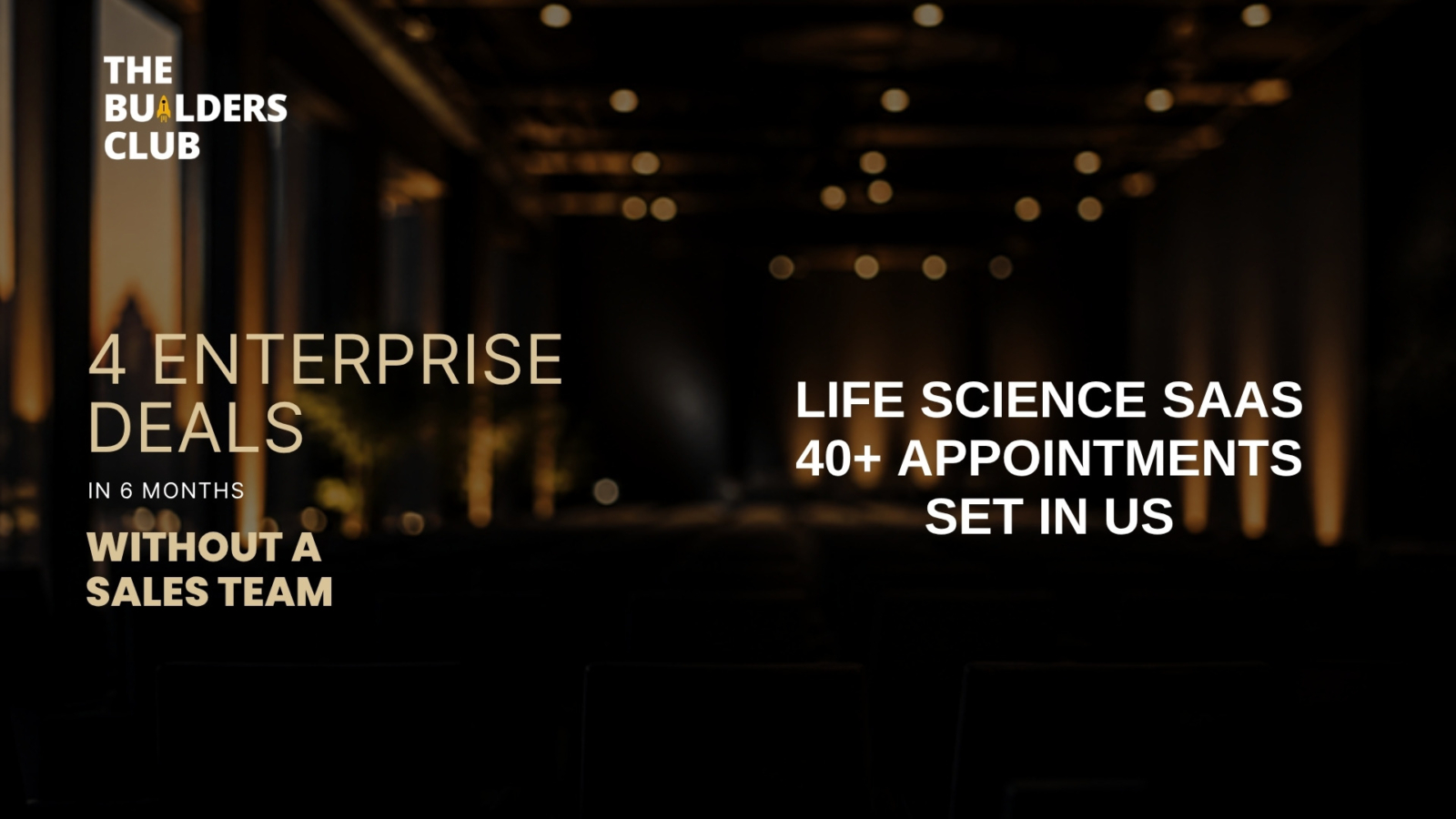
How We Generated 4 Enterprise Deals in 6 Months Without a Sales Team

The Builders Club ran a six-month programme for a global project management and collaboration software company with no US sales team and no budget to travel without confirmed meetings. The programme targeted the US life sciences sector and produced 4 enterprise deals averaging $85,000 to $250,000, 2,000+ qualified connections and 850+ content-qualified leads. Customer acquisition cost was 60% lower than paid ads.

Case Study Summary

  • Client: a global software company specialising in project management and team collaboration
  • Objective: enter the US life sciences sector without a local sales team
  • Audience: CTOs, VPs of Engineering and IT Directors at life sciences companies with 500+ employees
  • Channels: community invitations, email, gated research and virtual boardrooms
  • Results (6 months): 4 enterprise deals, 2,000+ connections, 40% shorter sales cycle, 60% lower acquisition cost than paid ads

What was the client’s challenge?

The client needed to reach CTOs and IT leaders in US life sciences companies. It had no sales team in the United States and would only fly for confirmed appointments. Cold outreach was not working with senior executives.

What did The Builders Club do?

How did we build the prospect list?

We started from the client’s target account list and built a lookalike list of similar life sciences companies. At each company we identified CTOs, VPs of Engineering and IT Directors, focusing on organisations with 500+ employees investing in digital transformation.

How did we use community invitations?

We invited target executives to join our community of 100,000+ enterprise IT leaders instead of sending cold emails. Onboarding calls covered the executive’s own challenges. We mentioned the client’s partnership during those calls and connected only interested prospects with the client’s team.

What did the email campaigns cover?

Prospects outside the community received personalised emails to lookalike accounts, covering life sciences compliance and secure collaboration. We tracked engagement and flagged high-intent leads for the client.

What content did we publish?

  • “The State of DevOps in Life Sciences 2024”, a research report on digital transformation trends
  • “IT Leaders’ Guide to Compliant Collaboration”, a guide for regulated environments
  • “Project Management ROI Calculator”, an interactive efficiency tool

The reports were gated downloads that captured prospect details. We featured the client in our weekly newsletter to 100,000+ IT leaders and syndicated findings across targeted industry segments.

How did virtual boardrooms work?

Because the client could not justify travel, we ran virtual boardrooms with 4 to 5 senior IT leaders from target companies. The client attended as co-host and industry expert. The sessions covered industry challenges and best practices, and the client learned each prospect’s pain points, budget cycles and decision-making process. We held debrief calls with interested participants and introduced them to the client’s sales team.

What results did the programme deliver in six months?

Connections

  • 2,000+ qualified connections with IT decision-makers
  • Engagement rate 340% higher than cold outreach benchmarks
  • 78% of boardroom participants requested follow-up

Content

  • 3,500+ report downloads, with 42% converting to email subscribers
  • 38% newsletter open rate, against a 21% industry average
  • 850+ content-qualified leads
  • 60% of closed deals engaged with content first

Revenue and efficiency

  • 4 enterprise deals closed with companies of 500+ employees
  • Average deal size of $85,000 to $250,000
  • 40% shorter sales cycle than cold outreach
  • 75% of deals had downloaded reports before sales contact
  • 60% lower customer acquisition cost than paid ads
  • 2 to 3 qualified opportunities per boardroom, with no travel costs

Why did the programme work?

  • Precise targeting: every outreach went to verified decision-makers at qualified accounts
  • Content before sales: reports gave prospects context before any pitch
  • Trust first: community and content came before selling
  • Multiple touchpoints: community, email, content and boardrooms supported each other
  • Virtual format: boardrooms replaced travel and still built relationships
  • Engagement tracking: we measured content engagement and participation, not just email opens

Frequently asked questions

How do you sell to US enterprises without a local sales team?

Use a community, gated research and virtual boardrooms. This client closed 4 enterprise deals in six months with no US sales team, and each boardroom produced 2 to 3 qualified opportunities.

How effective is gated content for B2B lead generation?

3,500+ downloads produced 850+ content-qualified leads. 60% of closed deals engaged with content first, and 75% of deals had downloaded reports before sales contact.

What is a virtual boardroom?

A virtual boardroom is an online roundtable of 4 to 5 senior leaders where the vendor attends as co-host and expert. 78% of participants in this programme requested follow-up.

Conclusion

The client had no US sales team and used The Builders Club to enter US life sciences. A lookalike target list, community invitations, gated research and virtual boardrooms produced 4 enterprise deals and a 40% shorter sales cycle in six months.

Entering a new market without a local team? Join The Builders Club, our community of 35,000+ founders and CXOs, or read more success stories.