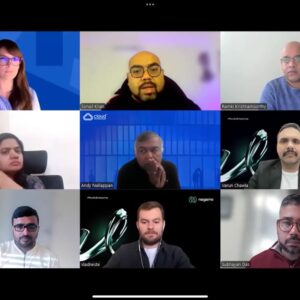
The AI Inflection Point: Reshaping the Life Sciences Ecosystem In a recent Life Sciences boardroom hosted by The Builder Club in partnership with Nagarro and Atlassian, a group of industry leaders convened to cut through the hype surrounding artificial intelligence. The session’s purpose was to foster a real conversation about how AI is tangibly reshaping discovery, delivery, and the operational rhythm of the life sciences, pharma, and healthcare industries. Against a backdrop of accelerating drug R&D, rising regulatory demands, and an intensifying drive for personalized patient care, this dialogue explored what is actually changing inside the labs, data centers, and boardrooms. The insights shared by this panel provide a high-fidelity map of an industry at a critical inflection point, moving beyond hype to execution where the convergence of human and artificial intelligence is now the primary force multiplier for innovation. The Panel of Experts: Voices from the Forefront The discussion was enriched by a diverse panel of experts, each pushing the boundaries of technology and science within their respective domains. Expert & Affiliation Domain of Expertise Ashwin Chandramouli, Portfolio Growth, Baxter Driving the integration of AI and digital health to connect clinical needs with technical innovation. Asha Mahesh, Senior Director of R&D Data Science, J&J Innovative Medicine Leading the deployment of AI to convert biological insight into predictive models for discovery and clinical trials. Kumudha Narayan, Director of IT, Thermo Fisher Scientific Overseeing the digital platforms and infrastructure that underpin R&D, ensuring IT systems enable agility and compliance. Vinod Das, Associate Director, Bayer Healthcare Pharmaceuticals Driving an “AI literacy” movement within Bayer R&D to augment human expertise with digital and scientific transformation. Arun Changamveetil, Head of Partner Solutions, Americas, Atlassian Strategizing how platform technologies can be extended through partnerships to solve complex team collaboration challenges. Vlad Neste, Director, Life Sciences & Healthcare Practice, Nagarro Leading Nagarro’s strategy to help pharma, biotech, and med-tech clients adopt AI and digital engineering. Vivek Bhide, Director & Co-head, Global Atlassian Practice, Nagarro Leading global delivery and partnerships to help enterprises achieve digital transformation through the Atlassian ecosystem. The Market at a Tipping Point: Quantifying the Opportunity The strategic conversations taking place across the industry are substantiated by powerful market indicators. In the United States, the AI and life sciences analytics market was estimated to be approximately 600 million in 2024**. It is projected to surge to almost **1.7 billion by 2034, reflecting a compound annual growth rate (CAGR) of 11.3%. The global picture is even more dramatic; the worldwide AI in life sciences market is forecasted to reach nearly $14.2 billion by 2024, expanding at a remarkable CAGR of 20.2%. These statistics provide undeniable evidence that the industry is at a significant inflection point where the tools are maturing and adoption is accelerating rapidly, moving AI from a theoretical advantage to a core competitive necessity. AI in Action: From Strategic Imperative to Tangible Impact While many organizations remain mired in AI theory, a clear pattern of practical application is emerging among industry leaders. The following examples are not isolated pilots but strategic deployments targeting the industry’s most persistent pain points: workforce strain, clinical trial inefficiency, and a sluggish innovation culture. These initiatives showcase how leading organizations are translating AI potential into operational reality, moving from experimentation to enterprise-scale impact. Augmenting the Human Element: Alleviating Staff Burdens A primary front for AI adoption is in alleviating workforce burdens, a theme echoed across different operational domains. At Baxter, for instance, the focus is on deploying voice technology in clinical settings to combat the cognitive overload, staff shortages, and burnout straining healthcare staff. In parallel, Thermo Fisher Scientific is applying AI to its internal IT organization, using it to streamline change management and guide users through complex systems—proving that augmenting the human element is as critical in the back office as it is at the patient’s bedside. Accelerating Clinical Pathways: Precision in Patient and Site Selection Johnson & Johnson Innovative Medicine has successfully operationalized AI for over five years to fundamentally enhance its clinical trial processes. As described by Asha Mahesh, J&J developed a sophisticated model that analyzes vast datasets, including real-world data and historical study performance, to identify specific patient populations and recommend the most optimal clinical sites and countries for a given trial. This AI-driven approach has a proven track record, having been instrumental in relaunching trials that were put on hold during the pandemic. By improving the probability of enrollment success, this initiative directly tackles one of the most significant challenges in drug development, demonstrating AI’s power to bring treatments to patients faster. Fostering an Innovation Culture: The Power of Enterprise-Wide AI Access In a bold move to embed an AI-native culture, Bayer rolled out its “myGenAI assist” platform in early 2023, as detailed by Vinod Das. This initiative provides all employees with direct access to a range of powerful Large Language Models (LLMs) like Gemini and Anthropic. The strategic rationale was to prioritize ease of use and accelerate experimentation across the entire organization, deliberately avoiding the delays associated with traditional, siloed pilot programs. By democratizing access to cutting-edge AI tools, Bayer is fostering a ground-up innovation movement, enabling teams across the business to discover and implement AI-driven efficiencies. This enterprise-wide cultural shift is creating the fertile ground needed to tackle AI’s most ambitious application: redefining the frontier of Research and Development itself. The New R&D Frontier: Reimagining Discovery and Development Research & Development stands as one of the most promising and complex arenas for AI-led transformation in the life sciences. The journey from a promising molecule to a market-ready therapeutic is fraught with challenges that AI is uniquely positioned to address. This section explores how AI is being deployed to augment the work of scientists, unify siloed institutional knowledge, and help organizations navigate the critical tension between the speed of innovation and the rigors of regulatory compliance. The insights from the panel reveal a new frontier where data-driven intelligence is becoming an indispensable partner in scientific discovery. From Wet Lab to “Lab