Many founders talk about AR, VR and AI. Far fewer have shipped immersive work at scale for film studios, sports teams and global platforms.
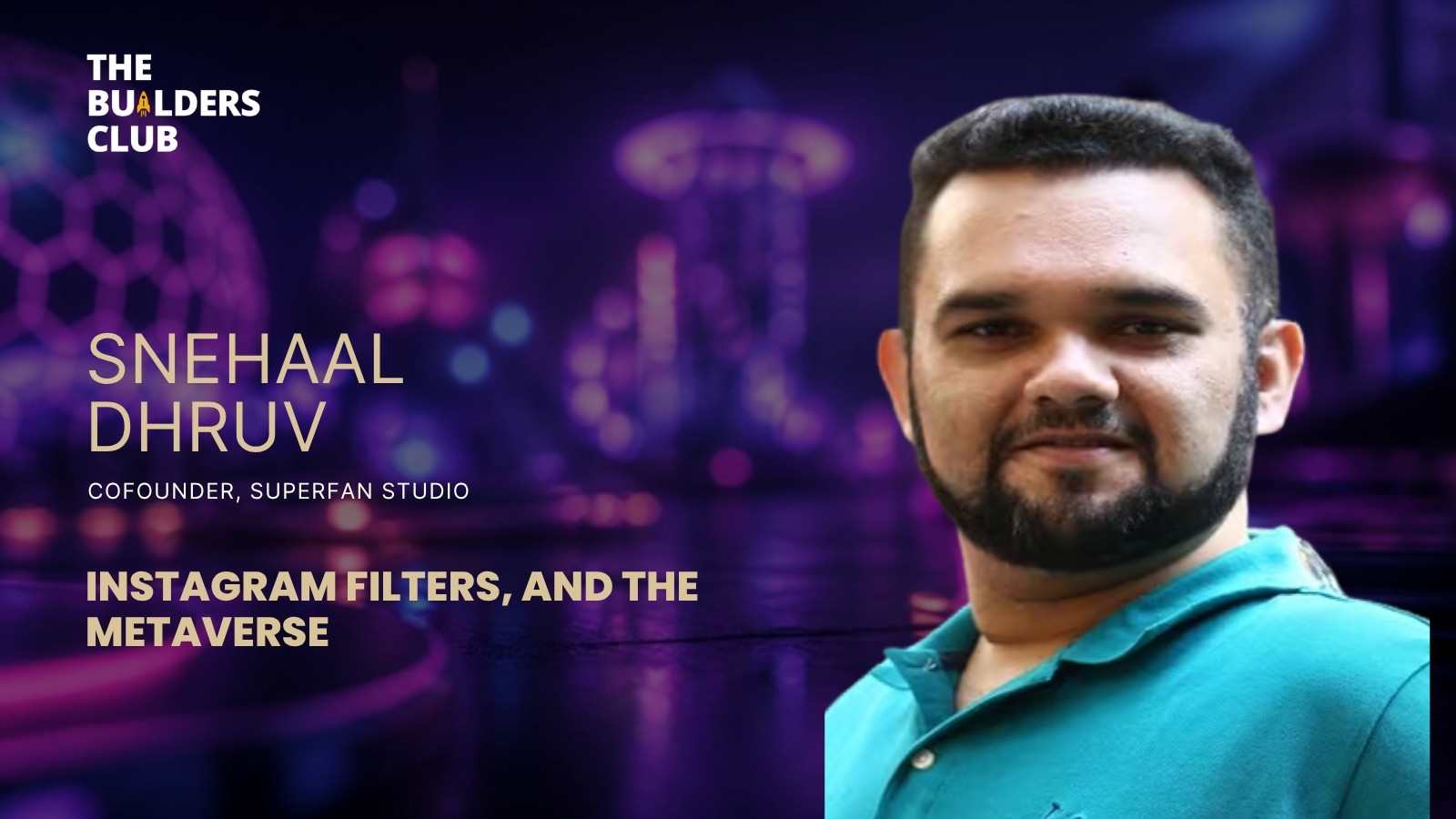
Snehaal Dhruv, co-founder of Superfan Studio, has done exactly that, building AR experiences for campaigns around films such as Sanju and Fukrey Returns. In this episode of The Builders Club Startup Founders Podcast he explains how to build an AR business, from pricing and ROI to hiring and the metaverse.
How do you build an AR business? Snehaal Dhruv’s core thesis
Snehaal’s view is that AR succeeds when it solves a real marketing or customer problem rather than showcasing new technology. His studio grew by pairing creative ideas with distribution on social platforms, then widening from film marketing into sports and brands.
He also argues that revenue should come first. Without money to pivot, the team built solutions customers were willing to pay for, and he advises founders to find a paying customer early.
- Start with a problem. Ask whether you are solving a need or just using cool technology.
- Ride platform distribution. AR on social platforms made reach accessible and affordable.
- Budget for marketing. Creation fees alone do not deliver results; promotion and creators amplify the experience.
- Follow revenue. A paying customer is a clearer signal than installs or vanity metrics.
How did Superfan Studio get started in AR?
Snehaal says the early challenge was finding people, because even experienced 3D artists were new to AR and had to be reskilled. The team learned by reading, writing its own tutorials and working within strict platform limits such as file size.
Partnerships with platforms helped. The studio built early experiences for Facebook, worked on film campaigns, and was recognised on a global stage as an underdog creative studio from Asia.
- Hire for the ability to learn, not only existing skills.
- Educate customers as well as the team.
- Use platform limits as a design constraint.
How does AR work in movie and product marketing?
Snehaal explains that a film’s marketing runs on a roughly six-week cycle, from poster and teaser to trailer, songs and release. AR experiences are planned for each stage, with the goal of building awareness first and then driving ticket sales.
For products, the sequence is similar: virtual unboxing or try-on before launch, then gamified experiences and offers closer to purchase.
- Motion poster stage: let people try on the look.
- Trailer and music stage: gamify the story and offer a tool people can create content with.
- Release week: link the experience to ticket booking or offers.
- Second-view push: re-engage people who already watched.
What formats does AR use?
He lists front-camera and back-camera experiences, portals that act like a virtual pop-up store, and virtual try-on. Access is typically through a link, QR code or a social profile.
How much does an AR experience cost and what ROI can you expect?
Snehaal says the studio has built more than 1,500 experiences for over 250 customers since 2017. Typical AR experiences now start at about 1.5 lakh rupees in India, or 2,500 to 3,000 dollars internationally.
He says simple filters can reach tens of millions of views, which can make the cost per view far lower than standard advertising. He adds that a marketing budget should accompany the creation budget, with creators and AR ad formats to amplify reach.
- Creation fees buy the experience; promotion buys the reach.
- Randomizer-style filters have reached 10 to 50 million views.
- The studio’s own Snap handle acts as an R&D showcase that brings in customers.
Is the metaverse worth building for?
Snehaal calls the metaverse hype premature: people jumped in without foundations, and quality headsets remain expensive. He sees the metaverse as a virtual space for potential commerce, but only if it offers more than existing media.
He cites an esports event built with the Global Esports Federation that ran in a browser without app downloads. By his account, around 7,000 users stayed an average of 22 minutes because access was easy.
He also notes that combining unrelated technologies, such as NFTs with immersive worlds, did not work, and he expects mixed reality headsets to improve access over time.
How should founders handle teams, hiring and tough times?
During COVID, when media work dried up and the nine-person team had about three months of cash, Snehaal chose to protect salaries and look for the next opportunity. He says leading by example set the culture.
His hiring rule is to hire fast and part ways fast, with culture fit and learning ability valued over past credentials. He also says it is better to have one strong person than several weak hires.
- Look for people who can learn.
- Be honest about startup realities in interviews.
- Keep emotion separate from decisions about fit.
What advice does he give to AR, VR and AI founders?
Snehaal says to focus on a niche with a real problem, aim for an MVP in about four weeks, and find a paying customer even if it takes 100 conversations. He adds that digital products need storytelling so buyers can visualise the outcome.
He also recommends funding yourself as long as you can and failing fast on process rather than slowly on product. His own next step is moving from a service-led studio towards products with separate profit and loss accounts.
- Solve a problem; do not search for one to fit the technology.
- Break work into two-week sprints.
- Revenue first, investor money second.
Further reading and sources
Frequently asked questions
How much does it cost to build an AR experience for a brand?
According to Snehaal Dhruv, AR experiences from Superfan Studio start at around 1.5 lakh rupees for the domestic market and 2,500 to 3,000 dollars internationally. He recommends also setting a marketing budget to promote the experience through creators and ad formats.
Can anyone start creating AR filters?
Yes. Snehaal says platforms offer creator tools such as Meta Spark and Snapchat Lens Studio, with templates, courses and certifications. Specialised studios differentiate through experience, reliable performance and impact.
Is the metaverse a good business opportunity right now?
Snehaal believes the metaverse was over-hyped and arrived too early, given expensive hardware and weak foundations. He still expects it to grow over time, but advises founders to focus on real value and easy access rather than the label.
Conclusion
Snehaal Dhruv’s story shows that immersive tech businesses are built on customer problems, smart distribution and disciplined teams, not on novelty alone.
If you are exploring AR or AI, define a niche problem, get to a four-week MVP and look for a paying customer before chasing funding.
Want more conversations like this? Join The Builders Club, our community of 35,000+ founders and CXOs, and explore more episodes of the Startup Founders Podcast.