Every founder can build a polished spreadsheet. Very few can show an investor why their startup will last.
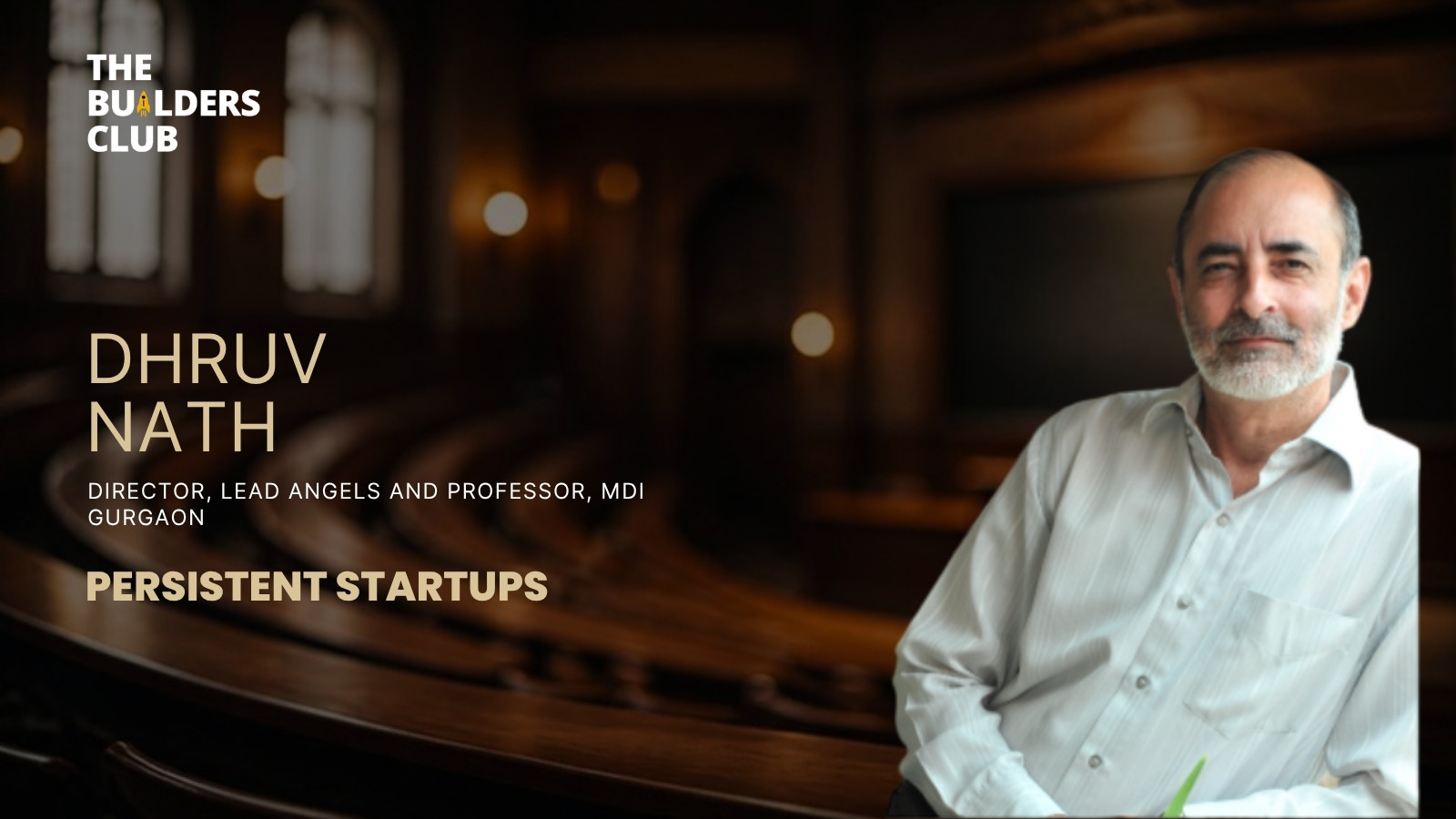
Dhruv Nath, angel investor at Lead Angels, former professor at MDI Gurgaon and author of Funding Your Startup and Other Nightmares, joins The Builders Club Startup Founders Podcast to explain what makes persistent startups and how angels decide where to put their money.
What makes persistent startups? Dhruv Nath’s PERSISTENT framework
Dhruv and his co-author Shanto Mitra, CEO of Lead Angels, studied founders who succeeded and failed and distilled the pattern into a ten-part acronym, PERSISTENT. It is meant for founders and investors alike, because both want a startup that grows and keeps competitors out.
His investor view is simple: at the early stage, the founding team matters most, because nobody knows which direction the business will take. Passion, flexibility and deep knowledge of the business are what he looks for.
- Use a framework, not just projections. Anyone can model numbers, so investors look at assumptions and fundamentals.
- Pick a niche in a crowded market. Find a segment that is large enough but not crowded.
- Founders come first. Passion, flexibility and knowledge of the business matter most early on.
- Show traction before asking for money. Investors now want proof, not just a bright idea.
What is the PERSISTENT framework for startups?
Each letter of PERSISTENT stands for a factor that investors and founders should test. Dhruv says the same ideas appear under other names, such as total addressable market or revenue growth, but the concepts are the same.
He also points out that the book includes failures as well as successes, because founders can learn a great deal from startups that did not make it.
- Problem: you must be solving a real problem for someone.
- Earnings model: someone must be willing to pay, otherwise it is a charity.
- Risks: especially the risk of competitors taking your market.
- Size of market: a small market will eventually stagnate your growth.
- Innovation: a patent, hard-to-build product or other differentiator.
- Scalability: growth of several hundred percent a year without adding people and infrastructure in proportion.
- Team: a great founding team can pivot an average model into a working one.
- Entry barrier: something that stops competitors from copying you, sometimes called a moat.
- Niche: a large, uncrowded segment inside a crowded market.
- Traction: customers, repeat usage and growing revenue month on month.
How do you compete in a crowded market?
Dhruv’s advice is to look for a niche that is both large enough and not crowded. His example is online stock trading, where established brokers target higher-value customers, leaving young college students as a segment that others ignore.
On scalability, he contrasts a software services company, where revenue growth needs proportionate hiring, with platform businesses that can scale mostly through marketing spend.
- Crowded but large: find the subset that incumbents ignore.
- Moat: build one through technology, patents or rapid scaling that creates a trusted brand.
- Check the waves: even in a busy sector such as edtech, he says open areas remain, and he names health tech and agri-tech as big open opportunities.
What do angel investors look for in founders?
Dhruv says the biggest factor at an early stage is the founding team. Projections can be made by anyone, so he prefers to look at the assumptions behind them and at the people making the pitch.
He lists a few traits: passion, flexibility to listen and change direction, and deep knowledge of their own business. He adds that a pitch is usually heard by many investors, some of whom know the founder’s industry well, so bluffing quickly hurts credibility.
Can you give an example of a flexible founder team?
Dhruv points to Planet Spark, a company he invested in. He says the founders moved from physical tuition centres to online classes when the pandemic hit, then pivoted several times before settling on public speaking and creative writing for children. He says they raised four rounds in about three and a half years.
How does angel due diligence work?
Dhruv describes a process of screening, a pitch to the wider investor group and then a deal lead who studies the business, talks to customers and reviews the product. Only after a commitment do the accounting, statutory and legal checks start, led by company secretaries.
The whole process normally takes about three months, which he says is enough time for a founder’s positive and negative traits to show.
- First: evaluation of the company, market and competitors, typically one to two weeks.
- Then: a pitch and a deal lead who goes deep on the business.
- Finally: accounting, statutory and legal due diligence.
What is the difference between an angel investor and a VC?
An angel invests their own money, while a VC invests other people’s money from a fund. Dhruv says that makes VCs less able to take early risks, so they generally invest later, often one to two years after a startup begins.
He advises founders against taking money from a neighbour or relative who does not understand a startup, because they may pressure you for profits. He suggests approaching an angel network, where many investors write smaller cheques and treat it as long-term, risk capital.
What should you do if you are stuck in validation?
Dhruv says investors are more demanding than they were ten years ago. Many now want proof and traction before considering a deal, and Lead Angels, he notes, typically looks for revenue of around a crore with decent margins.
He suggests using family and friends for the first money, joining an incubator for space and peer feedback, and landing two or three paid pilots with customers. He also recommends variable cost marketing, such as paying commission only on converted leads, instead of fixed stipends.
Further reading and sources
- Angel investor on Wikipedia
- Venture capital on Wikipedia
- Management Development Institute Gurgaon on Wikipedia
Frequently asked questions
What is the PERSISTENT startup framework?
It is a ten-part acronym created by Dhruv Nath and Shanto Mitra covering problem, earnings model, risks, size of market, innovation, scalability, team, entry barrier, niche and traction. Founders can use it to test their business, and angels use it to judge whether it is worth backing.
Should I raise money from an angel network or a single investor?
Dhruv suggests angel networks, where many investors each write a smaller cheque and understand that growth takes time. A single investor without startup experience may push for profits too early.
How much traction do startups need before raising angel funding?
Dhruv says investors are asking for more proof than before. He mentions that Lead Angels typically looks for around a crore in revenue with decent gross margins, and says founders should aim to show paid pilots and growing customers first.
Conclusion
Dhruv Nath’s lesson is that lasting startups are built on fundamentals: a real problem, a paying customer, a defensible niche and a team that adapts. Investors back founders first and models second.
Before you pitch, score yourself against the PERSISTENT list, find your weakest letter and fix it with real customer evidence.
Want more conversations like this? Join The Builders Club, our community of 35,000+ founders and CXOs, and explore more episodes of the Startup Founders Podcast.