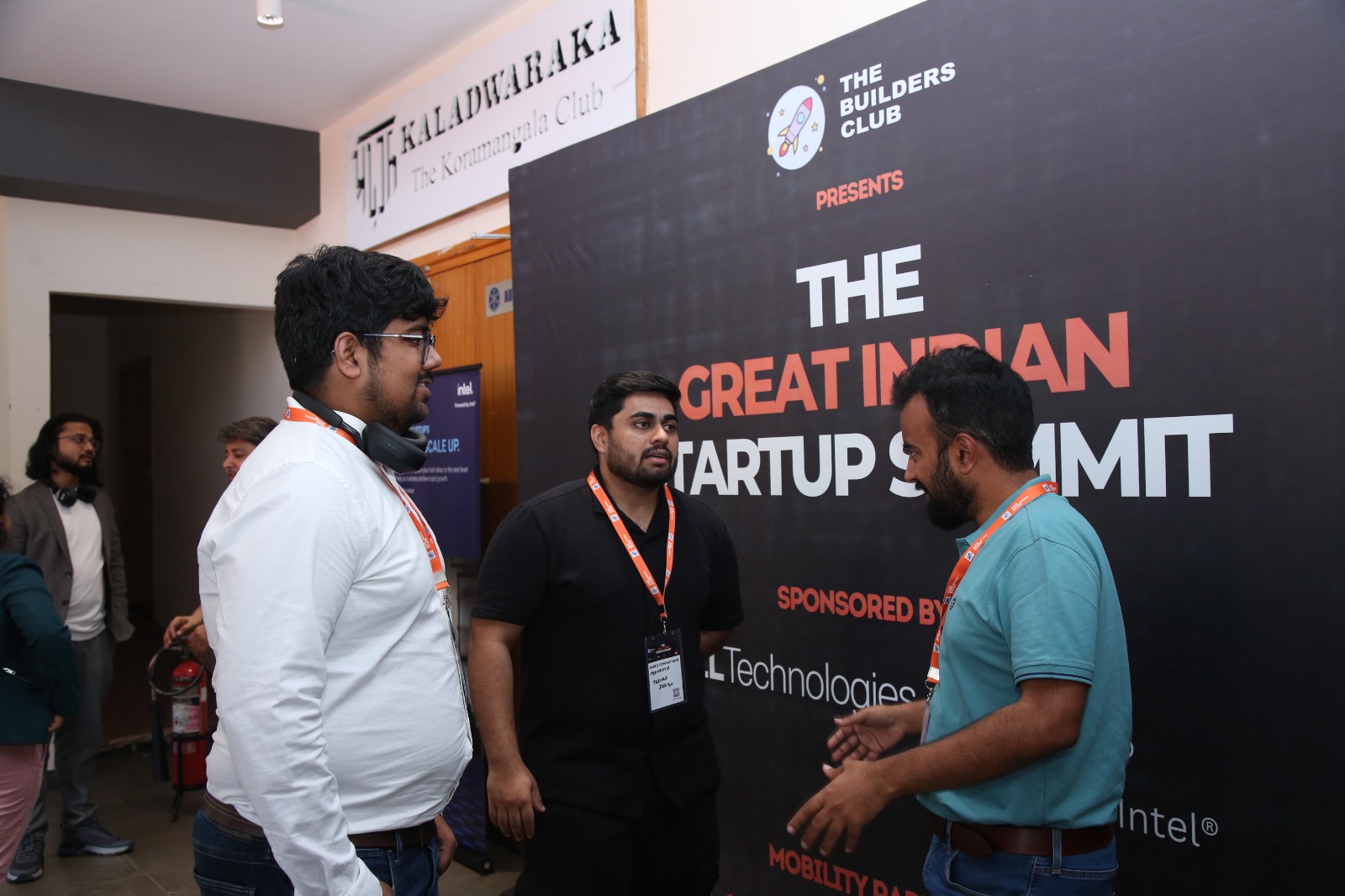
// ARTICLE

The Great Indian Startup Summit – Highlights

Advertisement
The Great Indian Startup Summit 2024 — The Builders Club
The Great Indian Startup Summit, 13th September 2024 | 500+ Founders · 100+ Investors · 50+ CXOs

India’s Startup Ecosystem Got a Room — And Then Got Honest

By The Builders Club  |  September 2024  |  8 min read


There are events, and then there are conversations. Most events are polished panels with rehearsed answers and decks that nobody will read again. Occasionally, you get a room where the questions are real, the speakers haven’t been briefed on what to say, and the person sitting next to you turns out to be exactly who you needed to meet.

The Great Indian Startup Summit, held on 13th September 2024, tried hard to be the second kind. By most measures — and certainly by the people who were in the room — it succeeded.

Over the course of a single day at one of Bengaluru’s most energetic venues, The Builders Club brought together over 500 founders, 100+ investors, and 50+ CXOs — without spending a single rupee on paid marketing. Not a Google Ad. Not a sponsored LinkedIn post. The entire event was filled through the trust and reach of community partnerships — a fact that quietly made its own statement about how relationships still outperform retargeting in a world drowning in content.

What followed was a day of conversations that India’s startup ecosystem needed to have — about content, community, D2C, AI, EV mobility, and the stubborn, unglamorous business of building something offline in a country obsessed with apps.


The Creator Economy Has a Shelf Life Problem — And Brands Are Paying the Price

Abhishek Asthana — Gabbbar Singh at the Content Panel
Abhishek Asthana — the brain behind Gabbbar Singh — on the Content Panel

The first hard conversation of the day came from an unexpected place: a man who built one of India’s most recognisable internet personas and then had to reckon with what it meant to sustain it.

Abhishek Asthana, the creator behind Gabbbar Singh — a social media account that became a cultural reference point for an entire generation of Indian internet users — didn’t come to the stage to celebrate viral success. He came to interrogate it.

His central argument: influencers have a shelf life, and most brands that partner with them don’t account for it. The internet’s attention economy rewards novelty. The moment a creator’s content becomes predictable — even if that predictability is high-quality and consistent — the algorithm and the audience begin to drift. What looked like brand equity was often just borrowed attention, and brands writing six-figure cheques for influencer campaigns rarely asked what happened in 18 months when the creator’s reach had peaked and started its slow decline.

Asthana’s broader point, which landed harder in the room, was about what brands should actually be building instead: their own content identity. The brands that would outlast influencer cycles were the ones creating content that stood on its own — not just amplifying someone else’s audience, but building one. He dissected how brands should think about social media not as a distribution channel but as a relationship infrastructure, where the investment is in producing content that earns repeated engagement from the same person, rather than a single spike of borrowed visibility.

For founders who had been throwing money at influencer collaborations and seeing diminishing returns, this was both a diagnosis and a direction.


Content Isn’t a Marketing Function — It’s the Product of a Great Community

Udayan Walvekar — GrowthX at the Content Panel
Udayan Walvekar from GrowthX on why content is the soul of community

If Asthana addressed brands, Udayan Walvekar from GrowthX addressed community builders — and his thesis was equally uncomfortable for the room.

GrowthX has built one of India’s most respected communities for growth professionals, and Walvekar has observed first-hand what separates communities that compound in value from ones that plateau after their initial enthusiasm. His answer, stated with the confidence of someone who has tested it: content.

Not content as newsletters sent to a subscriber list. Not content as a LinkedIn post announcing the next event. Content as the living memory of a community — the documentation of every insight shared, every debate had, every pattern observed by the people inside. When a community consistently surfaces and articulates the thinking of its best members, it creates something far more valuable than access: it creates a body of knowledge that makes membership feel necessary.

Communities that don’t invest in content production, Walvekar argued, inevitably become WhatsApp groups — where conversations happen and then disappear. Every insight is lost the moment it scrolls out of view. The communities worth belonging to are the ones that treat their members’ knowledge as an asset worth capturing.

For the founders in the room building community-led businesses, this reframed the content question entirely. Content isn’t something you do for marketing. It’s the proof that your community produces value — and the mechanism through which that value compounds over time.


Don’t Charge Too Early — How Premature Monetization Kills the Communities With the Most Potential

Samit Khanna — Signal Ventures at the Community Panel
Samit Khanna, Signal Ventures — on the trap of early monetization

Following naturally from Walvekar’s framework was a panel that addressed the question every community founder eventually faces: when do you start charging?

Samit Khanna from Signal Ventures — who has seen hundreds of community-led startups from the investor side of the table — offered a counterintuitive position: the communities most likely to destroy themselves are the ones that find revenue early.

The logic is straightforward once you hear it. In the early stages of a community, the social contract between members is built on value exchange — not financial transaction. People show up, contribute, refer others, and evangelise because they believe they’re part of something worth believing in. The moment a paywall enters that relationship, the nature of the contract changes. Members begin to evaluate: is this worth the money? The emotional investment shifts to a rational calculus. And communities, Khanna argued, cannot survive rational calculus in their early stages.

The communities that win — the ones that eventually command premium membership fees and strong retention — spend their first phase obsessively focused on the quality of connections and the usefulness of conversations. Monetisation is a consequence of trust, not a driver of it. Founders who reverse the order, who see early member growth and reach for the revenue lever too quickly, often find that the very people who made the community worth monetising are the first ones to leave.


D2C Grew Up — And the Brands That Don’t Realise It Are About to Get Left Behind

Arjun Vaidya — D2C Panel at the Great Indian Startup Summit
Arjun Vaidya on the evolution of India’s D2C ecosystem

The D2C panel brought together two sharp perspectives on where India’s consumer brand ecosystem actually stands — and where it is going.

Arjun Vaidya — who has lived D2C as a founder with Dr. Vaidya’s and now views it as an investor — was direct about what the first wave of Indian D2C got wrong. The early playbook was essentially a performance marketing arbitrage: find a product with reasonable margins, pour money into Facebook and Google ads, grow GMV, raise at a multiple of revenue, and repeat. It worked, until it didn’t.

CAC crept up as every brand discovered the same audience on the same platforms. Retention remained weak because few brands had built any reason beyond convenience for a customer to come back. Gross margins that looked healthy on paper collapsed under the weight of logistics, returns, and platform fees that the original pitch decks hadn’t modelled.

The next generation of D2C, Vaidya argued, looks very different. The winners are brands with genuine product differentiation — not marketing differentiation. Brands that have invested in the depth of their customer relationship rather than the width of their funnel. Brands that can hold a conversation with a customer offline, not just online. The playbook has matured, and so has the bar.

Rishi Batra from TWID added a dimension that D2C brands consistently undervalue: loyalty. In a world where acquisition costs make second-time buyers significantly more valuable than first-time ones, the infrastructure of how you reward and retain a customer matters enormously. TWID has built a platform that allows brands to let customers spend their reward points from banks and loyalty programs on purchases — effectively turning dormant points into real consumer demand. Batra’s point was that loyalty infrastructure isn’t a nice-to-have for a D2C brand at scale; it’s a structural advantage that compounds.

Rishi Batra — TWID on loyalty platforms
Rishi Batra, TWID — on building loyalty infrastructure that actually works

The Offline Opportunity Nobody Is Talking About

Ravi Raghav — Laundrokart at the Great Indian Startup Summit
Ravi Raghav, Laundrokart — building a scalable offline business in India

One of the more grounding conversations of the day came from Ravi Raghav, founder of Laundrokart, who is building a franchise-based laundry business in a market that most venture-funded founders wouldn’t touch.

India’s laundry market is valued at approximately $4.7 billion — a number large enough to command attention, and yet almost entirely unorganised. Most of the country’s laundry still happens through the local dhobi or an unreliable neighbourhood service. The consumer experience is inconsistent, the pricing is opaque, and the quality varies wildly. Raghav saw all of this as a systems problem — not a market problem.

His argument on stage was a useful corrective for a room that tends to default to digital-first thinking. The hardest and most defensible businesses in India are often the ones that require the most operational discipline at the local level. Building a scalable offline franchise model demands solving for unit economics, quality consistency, franchisee training, local operations management, and customer trust — all simultaneously. It doesn’t move as fast as a SaaS company. It doesn’t raise at the same multiples. But the moat it builds, once the operations are proven, is extraordinarily difficult to replicate.

For the investors in the room, Raghav’s session was a reminder that the most interesting Indian businesses may not always be the most algorithmically legible ones.


How Enterprises Actually Think About AI — and What That Means for Startups Trying to Sell to Them

Tejas Pandit — Dell Technologies on AI Panel
Tejas Pandit, Dell Technologies — the enterprise view on AI adoption

The AI panel could easily have been a showcase of enthusiasm. It wasn’t. Tejas Pandit from Dell Technologies — representing the infrastructure and enterprise side of the AI conversation — brought a rigour to the discussion that the room needed.

Large enterprises, Pandit explained, approach AI adoption with a very different psychology than the startup ecosystem imagines. The question in a boardroom isn’t “isn’t this incredible?” The questions are: what is the total cost of ownership? How do we secure the data? Where does liability sit when the model gets it wrong? How does this integrate with systems that were built 15 years ago and are not going anywhere? Who owns the governance?

For startups trying to sell AI solutions into enterprise, this is essential intelligence. The founders who close enterprise AI deals are not the ones with the most technically impressive demos. They are the ones who have mapped the buying journey — who sits on the procurement committee, what compliance requirements need to be cleared, what the IT team’s objections will be, and how the business case gets presented to a CFO who is managing cost pressure at the same time as being told AI is mandatory.

Pandit’s session was one of the more practically useful of the day for anyone navigating B2B sales into large organisations — which, given the mix of founders in the room, was a significant portion of the audience.


Building BluSmart: The Long Game on EV Mobility

Punit Goyal — BluSmart Fireside Chat
Punit Goyal, Co-Founder BluSmart — on the EV industry and the infrastructure bet

The day’s most watched conversation may have been the fireside chat with Punit Goyal, co-founder of BluSmart — India’s largest fully-electric ride-hailing platform.

BluSmart’s story is, at its core, a story about conviction over convenience. When Goyal and his co-founders decided to build a ride-hailing company that exclusively operated EVs, the ecosystem was not ready. Charging infrastructure was sparse. The range anxiety was real. Driver adoption required active evangelism. And the capital required to build a fleet before the unit economics were proven was significant.

What makes the BluSmart model interesting — and what Goyal unpacked on stage — is that they bet on the infrastructure layer, not just the product. Rather than aggregating third-party vehicle owners (as Ola and Uber do), BluSmart owns its fleet and its charging infrastructure. This creates a fundamentally different cost and quality curve. Every car is maintained to the same standard. Every charge is controlled. The customer experience is predictable in a way that aggregator models structurally cannot guarantee.

The broader thesis Goyal articulated is one that the room found worth sitting with: in categories where the infrastructure doesn’t yet exist, the company willing to build it — not just ride it — captures a structural advantage that is extremely difficult to compete against once it’s established. That’s not a thesis unique to EVs. It applies to cold chain logistics, rural fintech, offline healthcare, and a dozen other sectors where India’s infrastructure gap is also its opportunity.

BluSmart also served as the event’s official sponsor for speaker transportation on the day — a fitting detail that underlined the alignment between the company’s values and the community it chose to show up for.


The Great Indian Startup Pitch: 250 Applicants, 10 Finalists, One Winner
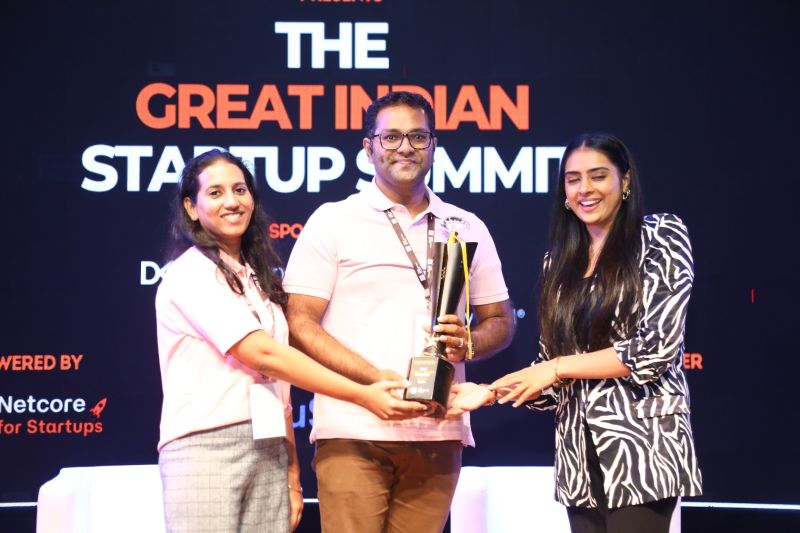
Ariro Toys wins the Great Indian Startup Pitch 2024
Vasanth Tamilselvan and Nisha Ramasamy from Ariro Toys — Champions of the Great Indian Startup Pitch 2024

Alongside the panels, the Summit hosted one of India’s most competitive early-stage pitch competitions of the year. Over 250 startups applied. Ten were selected — with the help of over 30 investment partners who reviewed applications and shortlisted founders they believed deserved the spotlight.

Each of the ten pitched on the main stage in front of over 100 investors. The atmosphere was closer to a real investor meeting than a performance event: pointed questions, follow-ups, and the kind of scrutiny that reveals exactly how well a founder knows their own business.

The ten finalists were Ariro Toys, FlexyPe, Find Your Kicks India, The Folding Company, Prodancy, WINhealth, AIOTEL, GoPllay, PRESET Building Systems, and Doodley — a diverse set of businesses spanning edtech, fintech, D2C, construction, and consumer platforms.

At the end of the day, the trophy went to Ariro Toys — the Bengaluru-based startup founded by Vasanth Tamilselvan and Nisha Ramasamy, which designs sustainable, culturally rooted wooden toys for children. Their win was more than symbolic: every startup that participated in the Pitch is being actively connected to the investment partners who evaluated them — turning the competition into a sustained relationship-building exercise rather than a one-day event.


The $0 Marketing Story — and Why It Matters More Than Any Panel
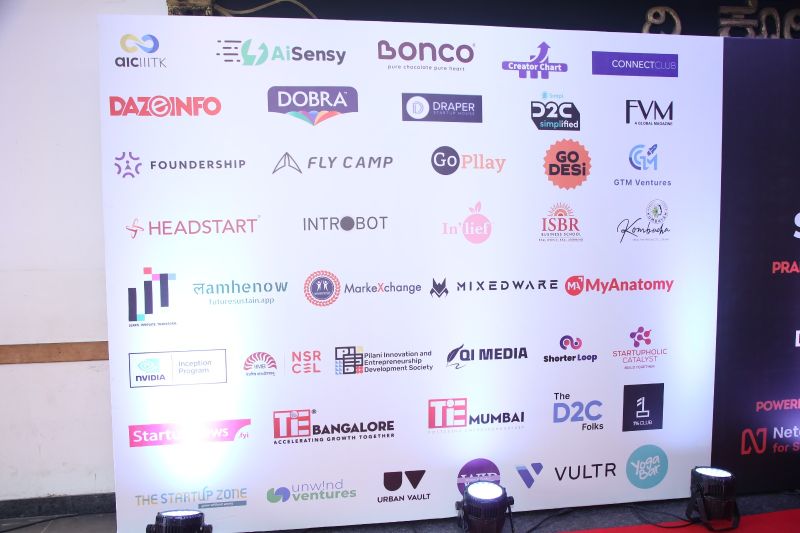
Ecosystem partners at the Great Indian Startup Summit
The ecosystem partners who made it possible — without a single rupee in paid marketing

Perhaps the most telling story of the day was one that happened before the event even began.

The Builders Club did not buy a single ad to fill 500+ seats. No paid influencer. No sponsored email blast. The event was seeded entirely through ecosystem partners — communities, accelerators, investor networks, and institutions who believed enough in the quality of what was being built to put their own reputation behind it and invite their members.

These included TiE Mumbai and TiE Bangalore, Headstart Network Foundation, NVIDIA, NSRCEL, The D2C Folks, GrowthX, Draper Startup House, BITS Pilani’s entrepreneurship society, ISBR Business School, Unwind Ventures, Introbot AI, Urban Vault, Women in Product India, and over a dozen others — each of whom brought their communities into a room that rewarded them with genuine conversations.

This is worth pausing on. In an industry that measures event success by headcount and measures marketing success by cost-per-registration, The Builders Club built something that ran entirely on trust and reciprocity. The result was not just a sold-out event. It was a room where almost everyone knew why they were there — and who else they wanted to meet.

That is significantly harder to manufacture than reach. And it is precisely what made the conversations worth having.


The Partners Who Made It Happen
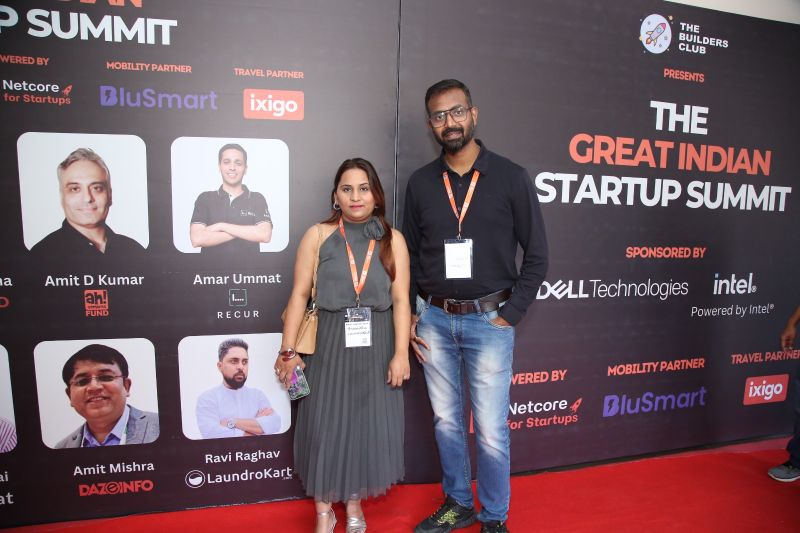
Corporate Partners — Dell, Intel, Netcore, BluSmart, ixigo
Title Partners: Dell Technologies, Intel, Netcore for Startups, BluSmart, ixigo

The Summit’s title partners — Dell Technologies, Intel Corporation, Netcore for Startups, BluSmart, and ixigo — each brought something beyond a logo placement. Dell and Intel anchored the conversation on enterprise technology. Netcore brought its startup programme. BluSmart handled speaker logistics on the day, ensuring the experience of attending began before anyone walked through the door. ixigo — one of India’s most enduring travel tech stories — lent credibility to the ecosystem’s enterprise tier.

Exhibiting on the floor were Mixedware, Fly Camp, Vultr, and The Startup Zone — companies that put products in front of the most relevant possible audience without a single wasted impression.


What the Room Said Afterwards

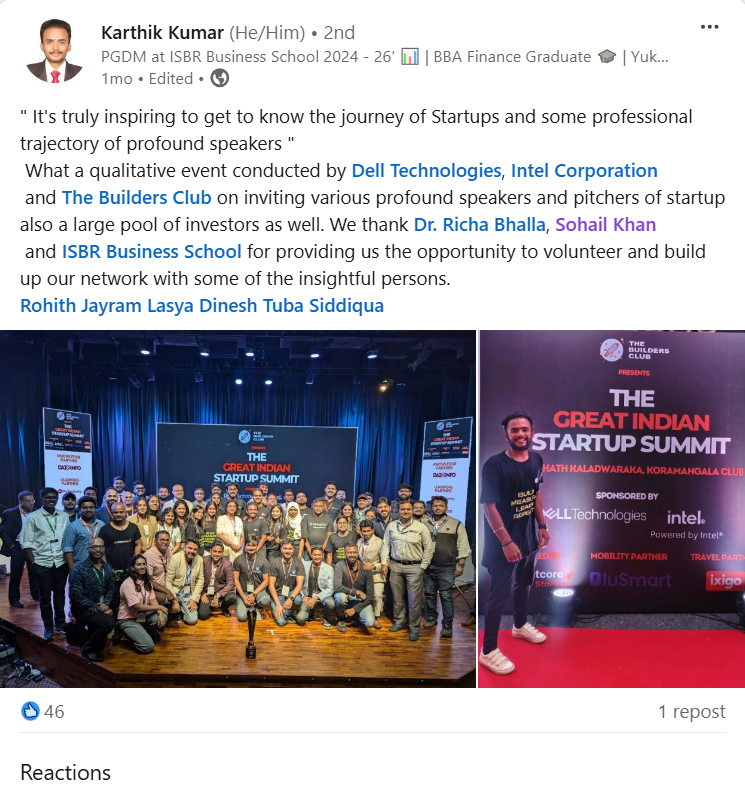
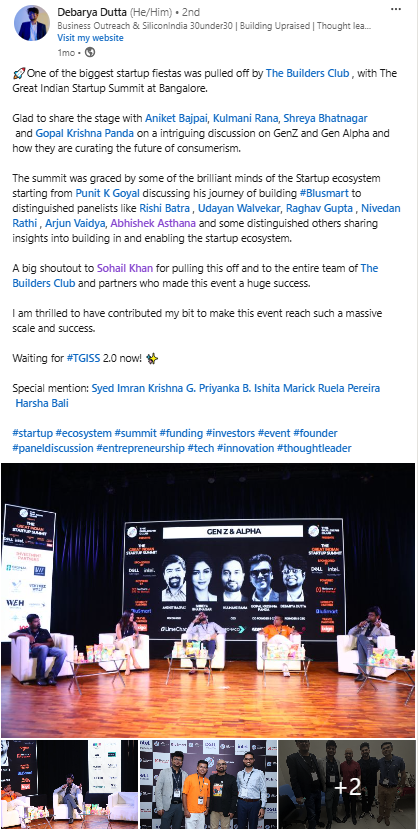
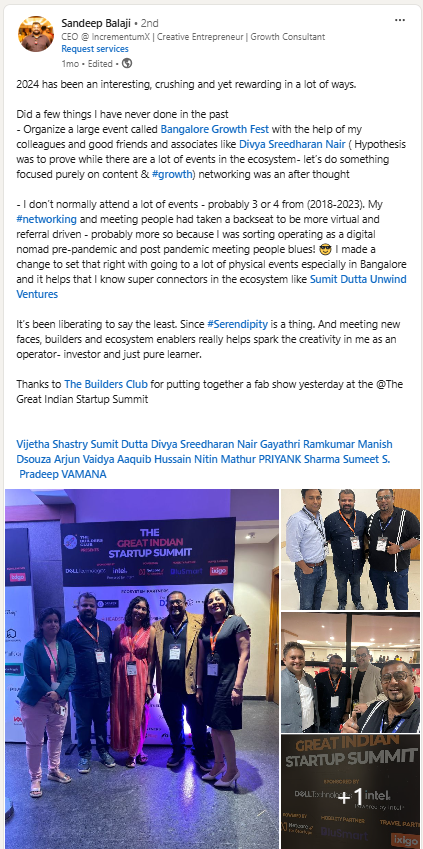
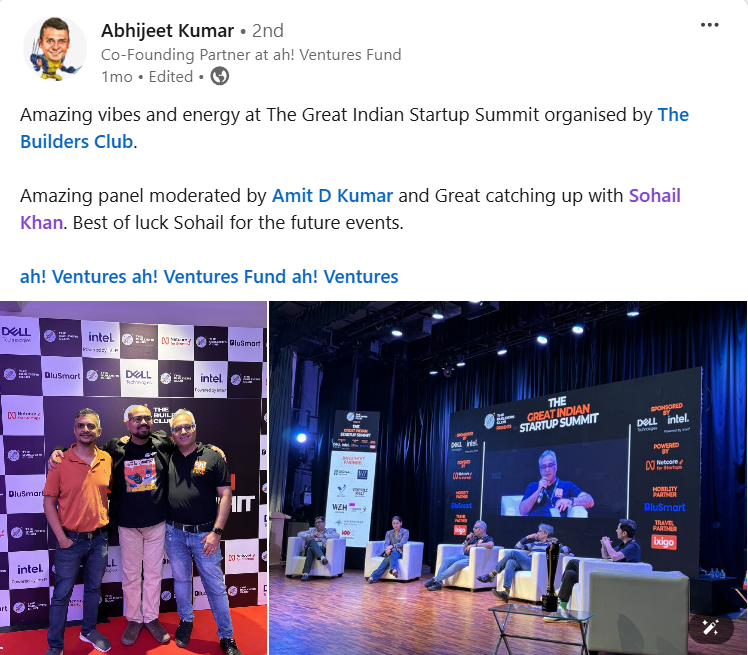
The real measure of an event is not the panels — it’s the energy that follows. In the days and weeks after the Summit, founders, investors, and attendees took to LinkedIn to share what the day meant for them. The posts ranged from tactical takeaways to something rarer: a sense of having been in a room that reminded them why they were building in the first place.

A selection of those voices is documented below.

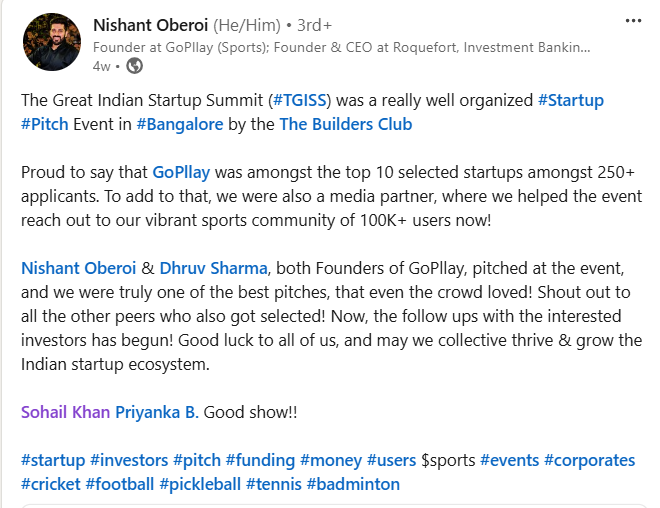
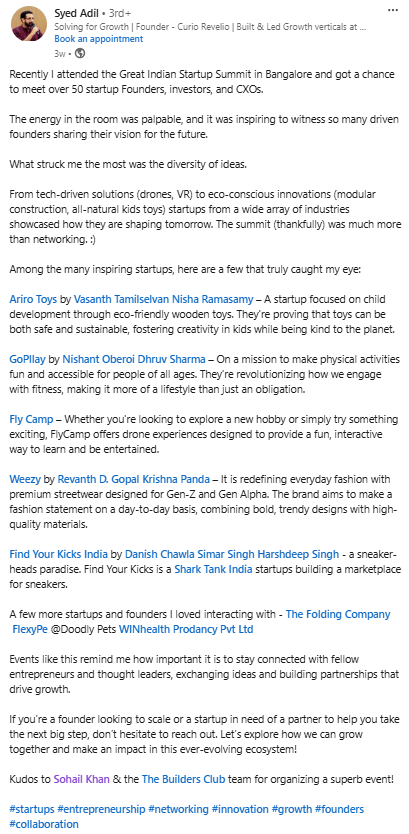
Attendee post on LinkedIn
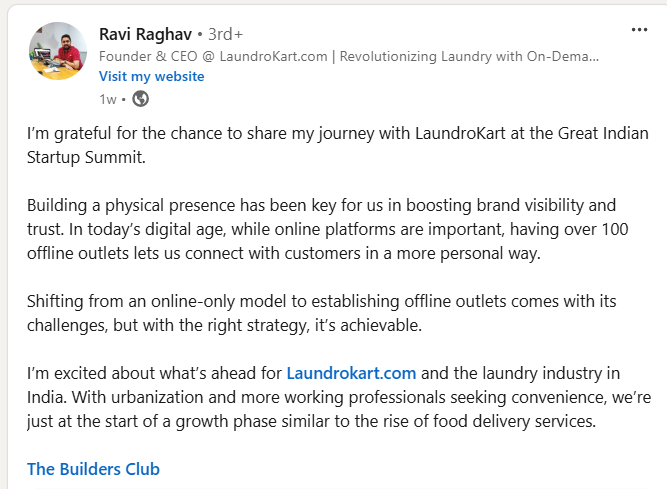
Ravi Raghav post on LinkedIn
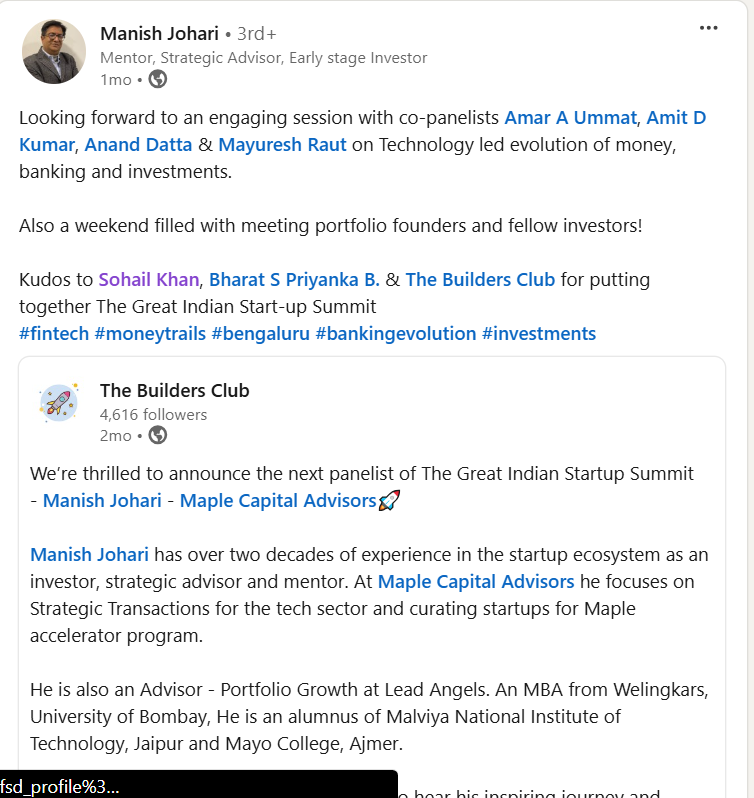
Attendee post on LinkedIn

Session Recordings — Watch the Panels in Full

All panel conversations have been documented on LinkedIn. Watch each session in full below.

Abhishek Asthana — How Brands Should Leverage Social Media

https://www.linkedin.com/embed/feed/update/urn:li:ugcPost:7249584330044289024

Gabbbar Singh — The Shelf Life of Influencers

https://www.linkedin.com/embed/feed/update/urn:li:ugcPost:7249581839735009281

Udayan Walvekar, GrowthX — Content in Communities

https://www.linkedin.com/embed/feed/update/urn:li:ugcPost:7249588563032301568

Samit Khanna, Signal Ventures — Why Early Monetization Backfires

https://www.linkedin.com/embed/feed/update/urn:li:ugcPost:7249591524714291200

Arjun Vaidya — D2C Ecosystem Evolution

https://www.linkedin.com/embed/feed/update/urn:li:ugcPost:7249592583222403073

Rishi Batra, TWID — Loyalty Platforms & D2C

https://www.linkedin.com/embed/feed/update/urn:li:ugcPost:7249598648865464321

Ravi Raghav, Laundrokart — Building a Scalable Offline Business

https://www.linkedin.com/embed/feed/update/urn:li:ugcPost:7249597208562393088

Tejas Pandit, Dell — How Corporates Think About AI

https://www.linkedin.com/embed/feed/update/urn:li:ugcPost:7249607862480482304

Punit Goyal, BluSmart — The EV Industry in India

https://www.linkedin.com/embed/feed/update/urn:li:ugcPost:7253449241539293186

The Great Indian Startup Summit is an annual event by The Builders Club — a global community of founders and CXOs. To learn more about the community or attend the next event, visit thebuildersclub.me.

Advertisement
Advertisement
Facebook
X
LinkedIn

[WEBINAR] The Cost of not Knowing

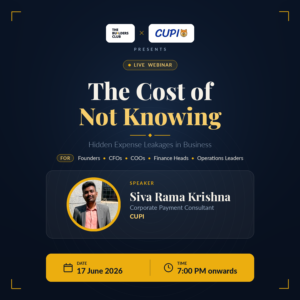
The Cost of Not Knowing – Live Webinar | The Builders Club × CUPI The Builders Club × CUPI🦁 Presents Live Webinar The Cost ofNot Knowing Hidden Expense Leakages in Business Founders CFOs COOs Finance Heads Operations Leaders 📅 Date 17 June 2026 🕖 Time 7:00 PM onwards 💻 Format Online · Free Register for Free Seats are limited · 17 June · 7 PM IST About the Event Most businesses don’t lose money in big, obvious ways. They lose it in small, invisible leaks — duplicate subscriptions, untracked reimbursements, vendor overpayments, missed GST credits, petty cash that never reconciles. Individually they look like rounding errors. Added up over a year, they’re lakhs walking out the door. This session is about finding that money before it disappears. Speaker S Siva Rama Krishna Corporate Payment Consultant CUPI Siva works with growth-stage businesses to diagnose and close expense leakages — helping finance teams move from manual reconciliation to real-time spend visibility using UPI-native infrastructure. What You’ll Learn The most common places expense leakage hides in a growing business — and why finance teams routinely miss them How to read your own spend data to catch leaks early, before they compound A simple framework to put spend controls in place without slowing your team down The true cost of manual reimbursements and reconciliation, measured in both rupees and hours How modern UPI-based corporate payments close these gaps in real time Live Q&A with Siva to pressure-test your own numbers Who Should Attend Founders & Co-founders Who approve spends but don’t have full visibility into where the money actually goes. CFOs & Finance Heads Trying to tighten unit economics and extend runway. Finance & Accounts Managers Handling reimbursements, vendor payments, and reconciliation day-to-day. COOs & Operations Leaders Who own budgets across teams and need spend accountability. Scaling Leaders Any leader whose company is growing faster than the systems tracking its expenses. About CUPI CUPI 🦁 ISO 27001 Certified CUPI is a corporate expense-management platform built on UPI. Each employee gets a UPI-enabled app linked to the company’s current account, so they pay business expenses directly from a shared corporate wallet — no cards, no cash advances, no reimbursement cycles. Admins set per-user spend limits, track every transaction live, upload receipts on the spot, and get audit-ready, GAAP-aligned reports from a single dashboard. getcupi.com → Stop the leak.Start the session. 17 June 2026 · 7:00 PM IST · Free to attend Register for Free Organised by The Builders Club · thebuildersclub.me thebuildersclub.me  ·  getcupi.com  ·  All TBC Events

Read More »

Virtual Roundtable series

The Global Tech Roundtable: Where the World’s Tech & GTM Leaders Sit at One Table The Builders Club · Virtual Event Series The world’s most interesting conversations about technology rarely happen in one place — they happen across time zones, ecosystems and markets. The Global Tech Roundtable, The Builders Club’s flagship virtual event series, was built to close that gap: a single, open forum where CXOs and founders from the US, UK, Europe, Dubai and beyond come together to talk candidly about tech, go-to-market and the opportunities hiding inside every domain. Each session zooms in on one theme — a trend, a shift, or a market — and brings the people actually building inside it into the same room. No surface-level panels. Just real operators sharing what’s working, what’s changing, and where the next opening is. One Global Forum, Many Time Zones The premise is simple but rare to execute: get leaders from across the globe onto one common forum and let them think out loud together. Across editions we’ve hosted voices from the US, the UK, Europe, Dubai and India — each bringing the texture of their own market to a shared conversation. The result is a roundtable that feels less like a webinar and more like a working session between peers who happen to live on different continents. View this reel on Instagram Conversations on Tech & GTM Technology and go-to-market are two sides of the same growth story, and the series treats them that way. One conversation might unpack an emerging engineering trend; the next digs into how teams actually take a product to a new market. By keeping both threads in the room — the builders and the go-to-market leaders — the discussions stay grounded in how decisions really get made: from architecture to pipeline, from product to positioning. View this reel on Instagram Voices From Across the World A roundtable is only as good as the people around it. What makes this series distinct is the range of ecosystems represented in a single conversation — a leader scaling in the US, an operator navigating Europe’s regulatory landscape, a founder building out of Dubai, a CXO from the UK. Those different vantage points turn a familiar topic into a genuinely global one, surfacing perspectives you simply can’t get from a single-market discussion. View this reel on Instagram Trends, Signals & What’s Next Every edition is anchored to a theme that matters right now — the trends reshaping a domain, the signals worth watching, and the shifts leaders are quietly preparing for. Instead of recycled predictions, the value comes from people who are living the change and willing to say what they’re actually seeing on the ground. It’s a fast, honest read on where a domain is heading, straight from the operators steering it. View this post on Instagram Opportunities Inside Every Domain Trends are interesting; opportunities are actionable. A recurring thread across the series is turning “what’s happening” into “what can we do about it” — the white spaces opening up in a domain, the gaps incumbents are too slow to fill, and the moves that give challengers an edge. For founders and CXOs, these are the moments worth leaning into, mapped out by people who’ve already spotted them. View this post on Instagram A Launchpad for Market Expansion At its core, the Global Tech Roundtable exists to help businesses grow into new geographies. If you’re looking to expand into a new market, there’s no substitute for hearing directly from the CXOs who already operate there — what the ecosystem rewards, where the friction lives, and what a credible entry actually looks like. The series gives expansion-minded leaders a place to pressure-test their thinking before they commit budget and headcount. View this post on Instagram Direct Access to the Ecosystem’s CXOs Beyond the insight, the real currency is access. The roundtable puts founders and business leaders in front of CXOs from the ecosystems they want to enter — to share a thought, exchange perspective, understand what those markets need, and build the relationships that make expansion possible. It’s the kind of room where a single conversation can shorten months of trial and error. View this post on Instagram Pull Up a Chair The Global Tech Roundtable keeps growing because the format works: one domain, the right people, an open forum, and a global set of perspectives in every session. Whether you’re scaling a tech business, sharpening your go-to-market, or planning your next geography, there’s a seat for you at the table. View this post on Instagram Want to join the next Global Tech Roundtable? Connect with CXOs and founders from across the globe — explore the community.

Read More »

Bangalore Tech Symposium

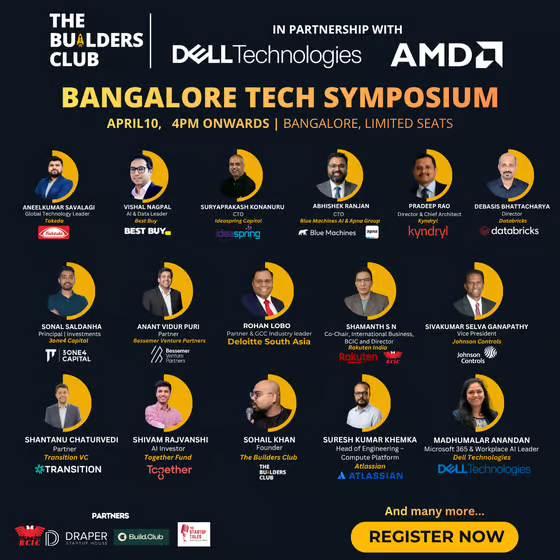
Bangalore Tech Symposium: AI & the Future of Working in Tech We just wrapped the Bangalore Tech Symposium — one of the most grounded conversations on AI in tech we’ve hosted so far. Organised by The Builders Club in association with Dell Technologies and AMD, the day brought together the people leading the curve — CTOs, GCC leaders, founders, operators and investors — for a focused, no-fluff look at how AI is reshaping the way tech businesses operate, compete and grow. As the industry moves past experimentation, the discussion centred on what it actually takes to build, operate and scale in an AI-first world — from infrastructure and engineering systems, to enterprise-scale deployment inside GCCs, to how capital is flowing across the AI ecosystem. The day was built for depth, not breadth: a keynote fireside, three practitioner panels, and a networking dinner to close. 100+ attendees, 15 speakers. A glimpse of the day What a room. Beyond the stage, the real energy was in the conversations between sessions — the debates, introductions and perspectives exchanged in real time. Here’s the highlight reel. View this reel on Instagram The keynote fireside, with Dell The day opened with a fireside featuring Madhumalar Anandan, Microsoft 365 & Workplace AI Leader at Dell Technologies, on “Rethinking Workplace Computing: What Modern Tech Teams Actually Need from Their Devices.” AI workloads aren’t what legacy infrastructure was built to handle — the conversation dug into the hidden performance ceilings created by legacy device setups, and what genuinely AI-ready infrastructure looks like for high-performance teams. Tech Panel — Building an AI-First Workplace The CTO perspective: rearchitecting infrastructure, overhauling engineering processes, and making the hard calls on where to invest and what to leave behind. Abhishek Ranjan (Blue Machines AI & Apna Group), Debasis Bhattacharya (Databricks), Sivakumar Selva Ganapathy (Johnson Controls) and Suresh Kumar Khemka (Atlassian), moderated by Shamanth S N (Rakuten India | BCIC). GCC Panel — The AI Productivity Multiplier GCC leaders aren’t just adopting AI — they’re defining what enterprise-grade deployment looks like for the rest of the industry, setting requirements and making the talent and infrastructure calls. Vishal Nagpal (Best Buy), Pradeep Rao (Kyndryl), Aneel Kumar Savalagi (Takeda) and Rohan Lobo (Deloitte), moderated by Sohail Khan (Founder, The Builders Club). Investor Panel — Investing in the AI Era A rare, unfiltered view of how investors are reading the landscape — what’s getting funded, and where durable value is actually being created. Anant Vidur Puri (Bessemer Venture Partners), Shivam Rajvanshi (Together Fund), Sonal Saldanha (3one4 Capital) and Suryaprakash Konanuru (Ideaspring Capital), moderated by Shantanu Chaturvedi (Transition VC). What the room actually took away Across the fireside and the panels, a few themes kept surfacing — the kind of signal you only get when CTOs, GCC heads and investors are honest in the same room. AI is no longer a layer; it’s becoming the operating model. Infrastructure and data readiness are the real bottlenecks to scale. Productivity gains are real, but capturing them as advantage is still uneven. And the gap between companies moving fast and those waiting is widening rapidly. Moments from the room View this post on Instagram Who was in the room The Symposium was built for the leaders already in the arena — IT and technology leaders rebuilding from the inside, GCC and enterprise tech heads deploying at scale, founders and business heads across IT and SaaS, and investors looking for ground-level signal. That mix is exactly what The Builders Club is built around. Not just events — rooms for real conversations. More to come.

Read More »

#HIRING : Global Sales Lead

#HIRING : Global Sales Lead 📍 Koramangala, Bangalore (Work from Office)  🧳 2–4 Years Experience About the Role We’re looking for a sharp, energetic B2B Sales Lead who can represent our brand on the global stage. This is a field-heavy, relationship-first role. If you love meeting people, attending events, sniffing out opportunities, and closing deals — this one’s for you. What You’ll Be Doing What We’re Looking For Nice to Have Why Join Us Loading…

Read More »

A New Road Ahead.

5 years ago, I started The Builders Club with a simple belief –builders need builders. Not cold intros.Real conversations. Real context. Real trust. Over time, something became very clear to me. While D2C founders have plenty of networks, playbooks, and distribution paths, B2B companies selling to mid-market and enterprise struggle quietly. Great products.Strong teams.But no real access to decision-makers. Enterprise GTM is not a lead problem.It’s a connection problem. That insight is shaping the next chapter of The Builders Club. Today, we’re evolving our identity – new logo, clearer focus – and launching TBC GTM Services. TBC B2B GTM Services This is our consulting and execution arm for B2B companies selling to mid-market and enterprise clients. What we help with: No spray-and-pray.Only relevance, relationships, and repeatability. You can explore this here:https://thebuildersclub.me/services/ TBC Councils Alongside this, we’re also launching two focused leadership communities: TBC CTO CouncilFor enterprise CTOs to exchange real-world insights, not theory. TBC GTM CouncilFor CMOs and business heads navigating complex enterprise sales cycles. These councils are intentionally small and high-trust, with access to: And to be clear – we haven’t forgotten startups. The Startups Club remains open to the global community.We’ll continue running sessions, connections, and programs to support founders early in their journey. https://thebuildersclub.me/membership The Builders Club has always been about one thing:Helping serious builders move forward – faster, together. This is just the next, more focused version of that mission. Onward. SohailChief Builder, TBC

Read More »

The AI Inflection Point: Reshaping the Life Sciences Ecosystem

The AI Inflection Point: Reshaping the Life Sciences Ecosystem In a recent Life Sciences boardroom hosted by The Builder Club in partnership with Nagarro and Atlassian, a group of industry leaders convened to cut through the hype surrounding artificial intelligence. The session’s purpose was to foster a real conversation about how AI is tangibly reshaping discovery, delivery, and the operational rhythm of the life sciences, pharma, and healthcare industries. Against a backdrop of accelerating drug R&D, rising regulatory demands, and an intensifying drive for personalized patient care, this dialogue explored what is actually changing inside the labs, data centers, and boardrooms. The insights shared by this panel provide a high-fidelity map of an industry at a critical inflection point, moving beyond hype to execution where the convergence of human and artificial intelligence is now the primary force multiplier for innovation. The Panel of Experts: Voices from the Forefront The discussion was enriched by a diverse panel of experts, each pushing the boundaries of technology and science within their respective domains. Expert & Affiliation Domain of Expertise Ashwin Chandramouli, Portfolio Growth, Baxter Driving the integration of AI and digital health to connect clinical needs with technical innovation. Asha Mahesh, Senior Director of R&D Data Science, J&J Innovative Medicine Leading the deployment of AI to convert biological insight into predictive models for discovery and clinical trials. Kumudha Narayan, Director of IT, Thermo Fisher Scientific Overseeing the digital platforms and infrastructure that underpin R&D, ensuring IT systems enable agility and compliance. Vinod Das, Associate Director, Bayer Healthcare Pharmaceuticals Driving an “AI literacy” movement within Bayer R&D to augment human expertise with digital and scientific transformation. Arun Changamveetil, Head of Partner Solutions, Americas, Atlassian Strategizing how platform technologies can be extended through partnerships to solve complex team collaboration challenges. Vlad Neste, Director, Life Sciences & Healthcare Practice, Nagarro Leading Nagarro’s strategy to help pharma, biotech, and med-tech clients adopt AI and digital engineering. Vivek Bhide, Director & Co-head, Global Atlassian Practice, Nagarro Leading global delivery and partnerships to help enterprises achieve digital transformation through the Atlassian ecosystem. The Market at a Tipping Point: Quantifying the Opportunity The strategic conversations taking place across the industry are substantiated by powerful market indicators. In the United States, the AI and life sciences analytics market was estimated to be approximately 600 million in 2024**. It is projected to surge to almost **1.7 billion by 2034, reflecting a compound annual growth rate (CAGR) of 11.3%. The global picture is even more dramatic; the worldwide AI in life sciences market is forecasted to reach nearly $14.2 billion by 2024, expanding at a remarkable CAGR of 20.2%. These statistics provide undeniable evidence that the industry is at a significant inflection point where the tools are maturing and adoption is accelerating rapidly, moving AI from a theoretical advantage to a core competitive necessity. AI in Action: From Strategic Imperative to Tangible Impact While many organizations remain mired in AI theory, a clear pattern of practical application is emerging among industry leaders. The following examples are not isolated pilots but strategic deployments targeting the industry’s most persistent pain points: workforce strain, clinical trial inefficiency, and a sluggish innovation culture. These initiatives showcase how leading organizations are translating AI potential into operational reality, moving from experimentation to enterprise-scale impact. Augmenting the Human Element: Alleviating Staff Burdens A primary front for AI adoption is in alleviating workforce burdens, a theme echoed across different operational domains. At Baxter, for instance, the focus is on deploying voice technology in clinical settings to combat the cognitive overload, staff shortages, and burnout straining healthcare staff. In parallel, Thermo Fisher Scientific is applying AI to its internal IT organization, using it to streamline change management and guide users through complex systems—proving that augmenting the human element is as critical in the back office as it is at the patient’s bedside. Accelerating Clinical Pathways: Precision in Patient and Site Selection Johnson & Johnson Innovative Medicine has successfully operationalized AI for over five years to fundamentally enhance its clinical trial processes. As described by Asha Mahesh, J&J developed a sophisticated model that analyzes vast datasets, including real-world data and historical study performance, to identify specific patient populations and recommend the most optimal clinical sites and countries for a given trial. This AI-driven approach has a proven track record, having been instrumental in relaunching trials that were put on hold during the pandemic. By improving the probability of enrollment success, this initiative directly tackles one of the most significant challenges in drug development, demonstrating AI’s power to bring treatments to patients faster. Fostering an Innovation Culture: The Power of Enterprise-Wide AI Access In a bold move to embed an AI-native culture, Bayer rolled out its “myGenAI assist” platform in early 2023, as detailed by Vinod Das. This initiative provides all employees with direct access to a range of powerful Large Language Models (LLMs) like Gemini and Anthropic. The strategic rationale was to prioritize ease of use and accelerate experimentation across the entire organization, deliberately avoiding the delays associated with traditional, siloed pilot programs. By democratizing access to cutting-edge AI tools, Bayer is fostering a ground-up innovation movement, enabling teams across the business to discover and implement AI-driven efficiencies. This enterprise-wide cultural shift is creating the fertile ground needed to tackle AI’s most ambitious application: redefining the frontier of Research and Development itself. The New R&D Frontier: Reimagining Discovery and Development Research & Development stands as one of the most promising and complex arenas for AI-led transformation in the life sciences. The journey from a promising molecule to a market-ready therapeutic is fraught with challenges that AI is uniquely positioned to address. This section explores how AI is being deployed to augment the work of scientists, unify siloed institutional knowledge, and help organizations navigate the critical tension between the speed of innovation and the rigors of regulatory compliance. The insights from the panel reveal a new frontier where data-driven intelligence is becoming an indispensable partner in scientific discovery. From Wet Lab to “Lab

Read More »