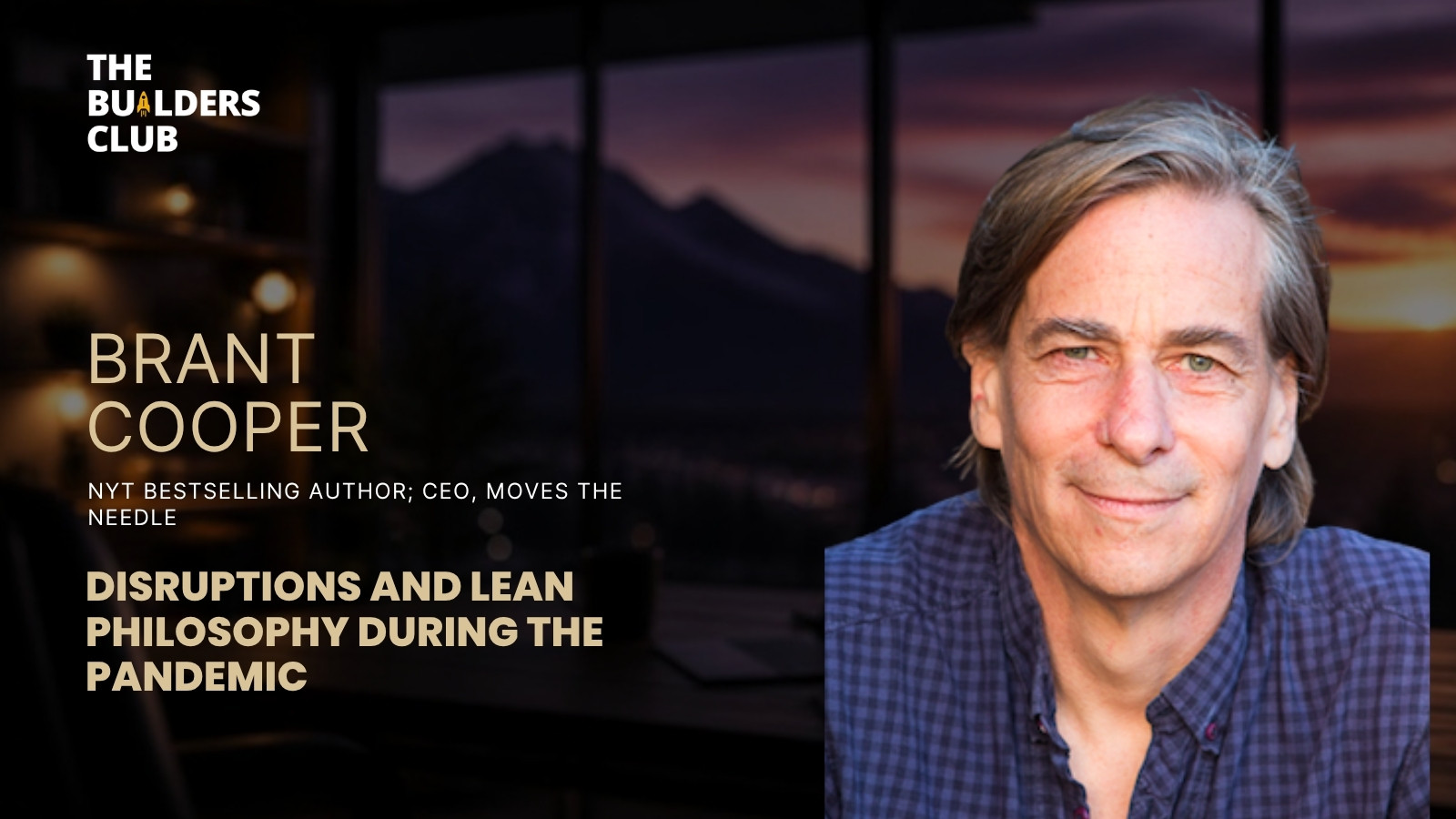
Most founders spend months building a product nobody asked for. Brant Cooper, New York Times best-selling author of The Lean Entrepreneur and CEO of Move the Needle, has a blunt fix: stop building and start learning from your customers.
In this episode of The Builders Club Startup Founders Podcast, recorded as part of our Watercooler Conversations community AMA, Brant explains how the lean startup philosophy works in practice, why customer insight is a founder’s real competitive advantage, and how to test an idea without a big budget.
What is the lean startup philosophy? Brant Cooper’s core thesis
Every new product asks people to change their behavior. The lean startup approach is about proving that people are willing to make that change before you spend time and money building. “Lean” simply means reducing waste: not burning your time, money and energy on something nobody wants.
Brant’s advice to early-stage founders is direct: stop building your product, go talk to the customer, and treat insight about that customer as your only durable edge.
- Validate behavior, not opinions. Test whether customers will actually change what they do before you build.
- Insights are your competitive advantage. Most startups use off-the-shelf tech, so knowing something about your customer that no one else knows is what sets you apart.
- Do not scale prematurely. Premature scaling and lack of a real market are the two biggest reasons startups fail.
How do you validate a startup idea before building a product?
Brant says the toughest thing for entrepreneurs to do is stop building. He recalls a startup that shipped a far better product at a lower price and still could not win customers, because the buyer feared risking their job by switching from a big brand to a startup.
The lesson: product quality and price are only part of the story. You must understand the buyer’s fear, aspirations and objections.
Why are in-person interviews better than surveys?
Surveys often prescribe the answers and pull people out of their real context. Brant prefers in-person (or video) interviews grounded in human-centered design, where you learn what is going on inside your customer’s head.
What is the Concierge MVP and other lean experiments?
Brant describes several low-cost ways to test demand without writing code. Each one is a way to get customers to behave in a way that proves they want the value:
- Concierge MVP: deliver the value by hand, without technology.
- Wizard of Oz: the customer interacts with what looks like a product while you do the work behind the scenes.
- Dry wallet test: see whether people reach for their wallet, even if you never take the money.
- High-hurdle test: put a wall in front of the value (such as a long form) to see who is committed enough to climb it.
How do you know if you have found product-market fit?
Brant suggests defining very precisely what a customer must do with your product to receive the value you promise. Then segment your users by behavior, not by sign-ups.
Someone who uploads and shares content is a different segment from someone who only watches. Find the high-value segment, grow it, and then talk to those users directly: ask why they use the product and how it changes their life.
How will the pandemic change startups and work?
Brant is cautious about claims that “everything has changed forever”. After 9/11, governments and large companies pushed hard to return to normal, and he expects the same now. Still, he sees lasting shifts: more flexibility in remote work, more telemedicine, and better virtual events.
His advice to founders is to “zag when everybody else is zigging”. While competitors rush to go purely digital, there is room to offer human connection, which is where real loyalty lives.
How can a platform founder solve the chicken-and-egg problem?
A founder building a ticket-booking platform asked how to attract theaters before having customers. Brant does not believe in a true chicken-and-egg problem: one side of a marketplace is usually always willing to show up, and you must focus on generating demand.
His suggestion: do not ask venues to join a platform. Offer to bring 100 customers for a fee, and fulfil it manually. Test the value proposition first; the platform comes later.
What mental models and team structures help early-stage founders?
Brant’s core principle is to consciously separate the known from the unknown. Execute on what is known, and spend your own time on the unknown through experiments and evidence.
He also recommends an opportunity matrix: list market segments as rows, and criteria such as budget, ease of reach, sales cycle and MVP effort as columns. Rank each as high, medium or low to see which segment to pursue first.
On teams, the more uncertain the problem, the more cross-functional the team should be. With five people, stay interdisciplinary; as you grow, split teams along the spectrum of uncertainty.
What is Brant Cooper’s new book about?
Brant shared that he was working on Disruption for All (working title), built on five principles: empathy, exploration, evidence, equilibrium and ethics. The idea is that disruption is happening regardless, so society should shape it so that technology creates more well-paid jobs rather than only eliminating work.
Further reading and sources
- Lean startup (Wikipedia)
- Minimum viable product (Wikipedia)
- Why the Lean Start-Up Changes Everything (Harvard Business Review)
Frequently asked questions
What does “lean” mean in the lean startup philosophy?
Lean means reducing waste. It is about not spending your time, money and energy building something nobody wants, and instead validating that customers are willing to change their behavior first.
How can I test a startup idea without building a product?
Run low-cost experiments such as a concierge MVP, a Wizard of Oz test, a dry wallet test or a high-hurdle test. Each lets you observe real customer behavior before you invest in technology.
Why do most startups fail, according to Brant Cooper?
Brant points to two big reasons: premature scaling and not actually having a market for the product. His advice is to get one paying customer, then ten, then a hundred, before scaling.
Conclusion
Brant Cooper’s message is simple and practical: start with the customer, validate behavior before building, treat insight as your edge, and scale only when real customers are passionate about the value you deliver.
If you are an early-stage founder, take one idea this week and test it with a concierge MVP before writing a single line of code.
Want more conversations like this? Join The Builders Club, our community of 35,000+ founders and CXOs, and explore more episodes of the Startup Founders Podcast.