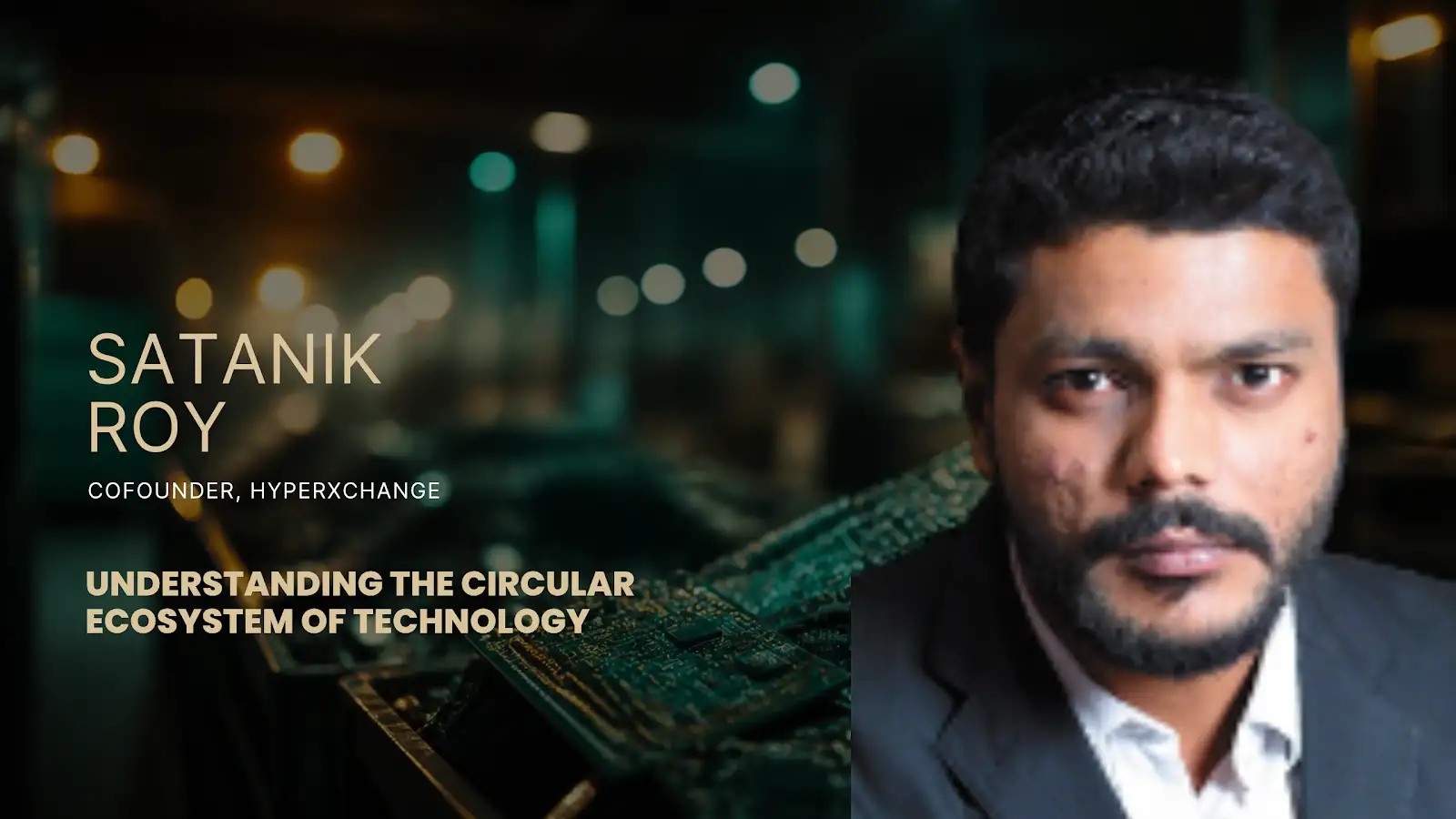
Most people have a spare phone in a drawer that they will never sell, because nobody can tell them what it is worth. Satanik Roy built a company around that exact problem.
The founder of HyperXchange joined The Builders Club to explain how a trust-first refurbished electronics brand can organise a fragmented market and make circular technology a real business.
How do you build a refurbished electronics business in India? Satanik Roy’s thesis
Satanik argues that the second-hand electronics market is large but mostly unstructured, because trust is low and the value of a used device is rarely known. His answer was to attack both problems with an industry-first replacement warranty and technology that grades devices consistently.
He sees the opportunity as an asset-led model rather than a capital-heavy one, with sustainability as a built-in tailwind. The circular economy angle also attracts attention from ESG-minded funds.
- Solve trust first. A 12-month replacement warranty removes the fear of buying refurbished.
- Make value measurable. Automated grading tells you what a device is worth and what condition it is in.
- Source from businesses and consumers. Procurement needs both channels to build real distribution.
- Do not bolt sustainability on. A tree is planted for every product sold, and the model rests on a circular economy.
How did Satanik Roy start HyperXchange?
Satanik began his entrepreneurial journey at around 18 or 19 with a B2B fintech idea that sped up bank-to-bank verifications. Some of the technology was taken forward by a financial institution, but he felt it was too early and that he had not built a brand.
He then looked at consumer needs. As a student he wanted premium devices without deep pockets, and the options were grey markets where trust was a major issue. That gap became HyperXchange, a refurbished electronics brand.
Why is the refurbished electronics market so attractive?
Satanik estimated that the market was around 25 billion dollars when he started in 2016 and grew sharply after 2020, as work and study from home made households need several devices. He described most of it as unorganised, and pointed to a French competitor that raised a large round as a sign of global interest.
He also sees room for many players. Cashify and others are active, he noted, and none had reached billion-dollar scale in India.
- Work from home and study from home increased device demand per household.
- Affordable options become more attractive when incomes are under pressure.
- He frames refurbished as an asset-led, not capital-intensive, model.
How do you earn trust in refurbished products?
Buying refurbished already carries a question mark, and a repair-centre visit makes it worse. HyperXchange introduced a 12-month replacement warranty: if a device fails, the customer does not visit a service centre, and the company replaces it with an equivalent refurbished unit.
He compared the idea to cash on delivery in early Indian e-commerce, a bold step that changed customer behaviour.
- Remove the buyer’s biggest fear with a simple promise.
- Replace instead of repair, so the customer is not left waiting.
- Use the promise as the story that earns press and credibility.
How does device grading and sourcing work?
Satanik said the core problem is that the value of a used product is unknown, so sellers distrust offers. HyperXchange built a kiosk-like system called Faraday that combines three technologies.
On sourcing, he said it must be both B2B and B2C. Sellers have little loyalty when getting rid of a device, whereas buyers do, so a consumer-only model cannot build proper distribution.
What does the grading system check?
- Image processing assesses physical condition, such as scratches and dents.
- Machine learning checks which sensors and components work.
- AI estimates the current market value and demand for the device.
What does the business sell?
The focus is smartphones, laptops, televisions, accessories and tablets, with about 85 percent of the business in smartphones. Faulty parts are handled as part of that process rather than discarding the whole unit.
What about e-waste, student founders and social enterprises?
On sustainability, the company plants a tree for every product sold, which he said adds up to a forest across roughly 20,000 to 25,000 devices a month. He sees recycling as more of a B2B business and refurbishment as more B2C, and both need to grow.
For student founders, he said starting young allows higher risk and repeated failure, though experience is a real limitation. The key traits are persistence and clarity of vision, which build over time. On social enterprises, he believes ventures should generate their own revenue rather than depend on donations.
Further reading and sources
Frequently asked questions
Is buying refurbished electronics in India safe?
It depends on the seller. Look for a clear warranty, transparent device grading and an easy replacement policy. Satanik Roy argues that a replacement guarantee is the strongest trust signal a refurbished brand can offer.
How do refurbished device companies decide the price?
They need a reliable assessment of condition and market demand. HyperXchange describes using image processing, machine learning and AI to inspect the device and estimate its current value.
Is refurbished electronics a good startup idea?
It can be, if you solve trust and valuation. Satanik sees it as an asset-led model with strong demand drivers and a sustainability story, but it needs reliable sourcing from both businesses and consumers.
Conclusion
Satanik Roy’s story shows that a messy market becomes a company when someone supplies trust and measurement. A warranty and a grading system turned doubt into a reason to buy.
If you are eyeing an unorganised market, ask what the single fear is that stops customers from buying, and design a promise that removes it.
Want more conversations like this? Join The Builders Club, our community of 35,000+ founders and CXOs, and explore more episodes of the Startup Founders Podcast.