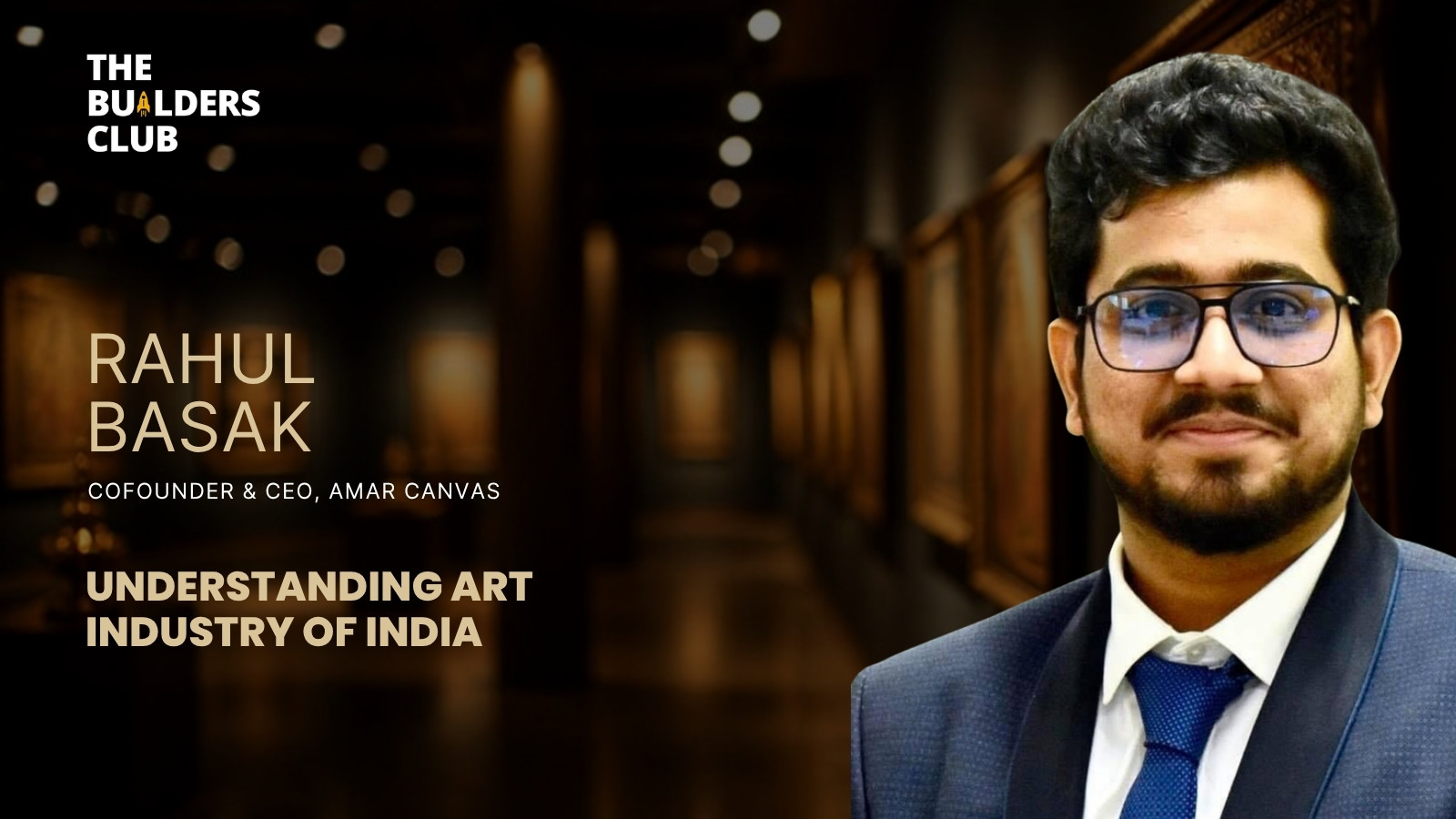
Most Indians have never bought an original painting, and Rahul Basak thinks that is the opportunity. An artist, TEDx speaker and entrepreneur from Kolkata, he co-founded Amar Canvas to help artists sell directly and keep what they earn.
In this episode he explains the problems artists face, who might buy their work and how founders can build a business in a market most people overlook.
How can artists and founders sell art online in India? Rahul Basak’s approach
Rahul’s thesis is that India has plenty of artists and a growing art market, but no good bridge between them and everyday buyers. Amar Canvas is a web-based platform where artists can showcase and sell directly, earning full profit from their work.
His learning is that supply alone does not work. Open registration brought in many artists but the quality fell, so the team now curates a smaller group and sells through catalogs aimed at specific buyers.
- Start from an artist’s pain. Middlemen, unclear pricing and few buyers hold artists back.
- Target the middle market. Original work in the tens of thousands of rupees, not crore-level pieces.
- Curate before you scale. A small, high-quality group of artists beat open sign-ups.
- Brand matters. An artist’s personal story and style drive value.
Why did Rahul Basak start Amar Canvas?
Rahul was already an award-winning photographer while studying software engineering and later an M.Tech. At a film festival in Hong Kong he noticed how confidently other artists called themselves artists, something he had never felt able to do.
He came home, spoke to a friend of ten years, and they started the company. They funded it with roughly two lakh rupees, partly from selling his cameras, and lost much of it to an unreliable website developer before restarting.
- Many talented painters drift into IT jobs and stop painting.
- Selling still depends on old-style galleries.
- The founders had no business plan at first, only a clear motivation.
What problems do Indian artists face when selling their work?
Rahul spoke to artists who hold full-time jobs and paint on the side. Many create excellent work but struggle to find buyers.
Middlemen were another pain point. In his example, a painting could sell abroad for around a thousand dollars while the artist received a few thousand rupees, and some artists were told their work was damaged in transit.
Who buys original art in India, and how do you reach them?
Rahul ran a quick LinkedIn poll asking whether people had ever bought an Indian painting. Almost everyone said no, which he sees as proof the market is untapped.
His target is the middle segment: urban couples buying homes who want original work, rather than collectors spending crores. He cites Indian art market estimates of about 1,700 crore in 2020 growing around 20 percent a year.
- Interior decorators and builders as channel partners.
- Original pieces in the range of roughly 15,000 to 30,000 rupees.
- Art as something that may also hold or grow in value.
How does Amar Canvas balance artist supply and buyer demand?
The first model was open registration, which attracted around forty to fifty artists a day but lowered quality. Showing weak work to clients hurt trust.
The second model works with fifty to sixty hand-picked artists in one city, photographs or scans their work and builds a catalog. The team distributes it by phone and email to people in construction and design, then repeats the playbook city by city.
- Pick a small set of strong artists.
- Digitise their work into a catalog.
- Reach design and construction professionals.
- Expand to a new city once the loop works.
How is art valued, and how does branding help an artist?
Rahul says there is no formula for valuing creativity. Price depends heavily on the artist’s recognition and story, which is why a newcomer often prices below a better-known peer.
His advice is to build a personal brand and a recognisable style. He gave his own example, where national awards made people take his photography seriously.
What should a new artist do first?
Learn how others sell, and look beyond the first pages of Google results where most people stop.
- Survive and build a name before trying to rule the market.
- Treat art like a business, because selling yourself matters.
What role could NFTs and blockchain play in the art market?
Rahul sees blockchain as a way to track ownership data and prove who owns a work. He also described fractional ownership, where many people buy shares in one expensive painting.
He compared digital art to digital movie rentals and music, suggesting people will keep paying for digital ownership as virtual spaces grow. He called this an early-stage trend still unfolding in India.
Further reading and sources
Frequently asked questions
How can an artist start selling paintings online in India?
Rahul Basak suggests first studying how other artists sell, then building a personal brand and a recognisable style. Platforms such as Amar Canvas let artists showcase and sell directly, but he stresses that quality and presentation matter.
Is original art a good thing to buy for a home?
Rahul argues that original paintings in the middle price range can appeal to urban homeowners, and that art may also hold value over time. He notes this is his view and that valuation is subjective.
What are NFTs and how do they relate to art?
Rahul describes NFTs as tokens built on blockchain that record who owns a digital work. He sees them as one way to track and prove ownership, though he says the market in India is still at an early stage.
Conclusion
Rahul’s story shows that a neglected market can be a real opening if you start from the supplier’s pain. Curating a small, high-quality group and reaching the right buyers worked better than open sign-ups.
If you are building a marketplace, test with a small set of suppliers first, then repeat the model city by city.
Want more conversations like this? Join The Builders Club, our community of 35,000+ founders and CXOs, and explore more episodes of the Startup Founders Podcast.