

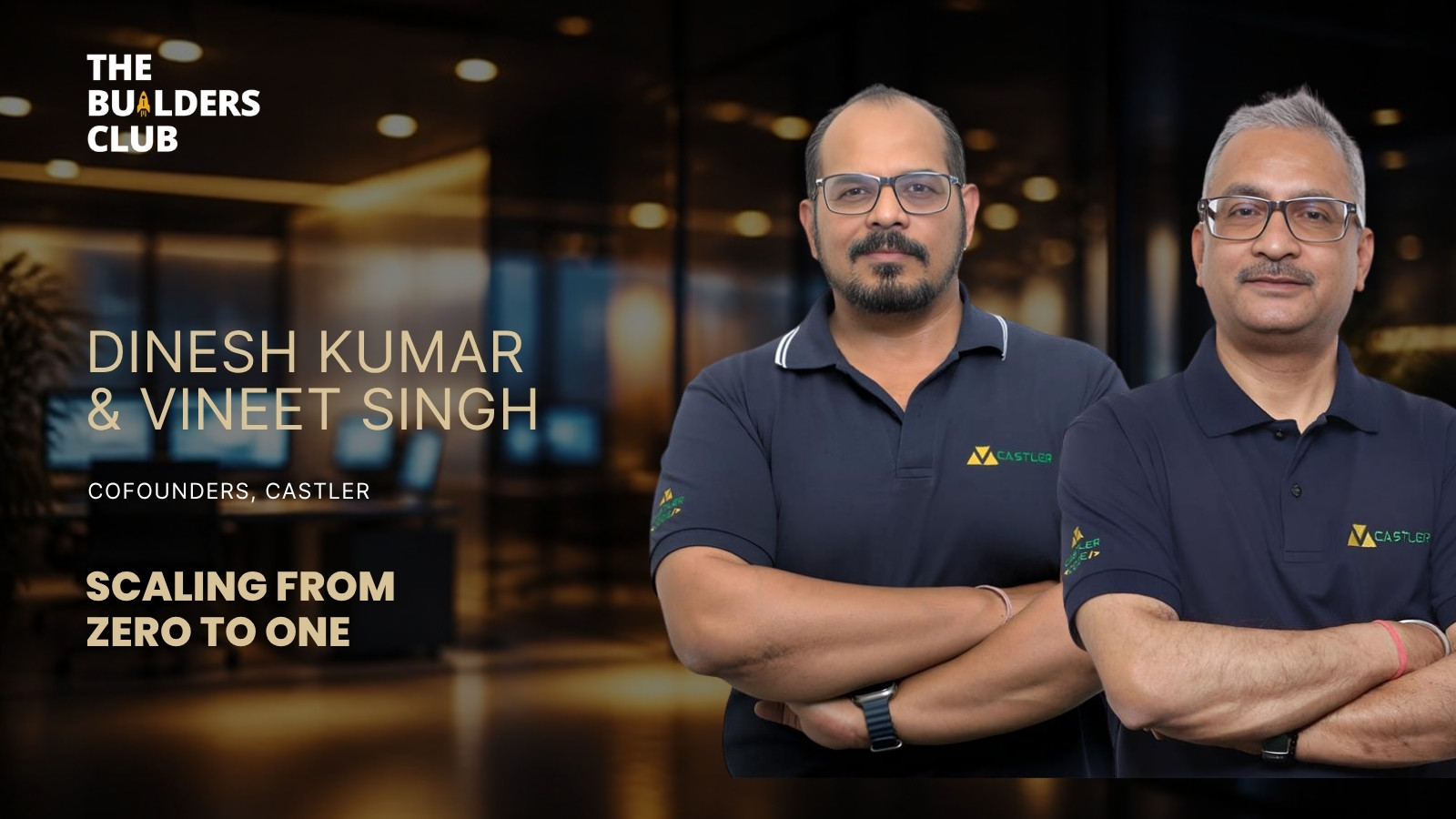
Selling a car should not mean waiting ten days for money that was promised in thirty minutes. That experience nudged Vineet Singh toward building Castler, a digital escrow platform he now runs with long-time colleague Dinesh Kumar.
In this Builders Club Water Cooler conversation, the two co-founders explain escrow as a service and share what two decades of building sales-led businesses taught them about teams, competition and customers.
What is escrow as a service? Castler’s core thesis
Castler is a SaaS-based digital escrow solution built on top of partner banks’ core banking services. Money sits in an escrow account until both sides of a transaction meet their obligations. Dinesh said the traditional process is paper-heavy, slow and costly, so Castler digitises onboarding and account creation.
Vineet’s wider view is that execution beats strategy. The founders built Naukri and 99acres on young talent, constant customer contact and a focus on targets, and they apply the same discipline at Castler.
- Trust through structure. A bank holds the money and a trusteeship company approves payouts, while Castler has no access to the funds.
- B2B first. The founders pivoted from consumers to enterprises, where the need is larger and marketing costs are lower.
- Execution over strategy. Targets, discipline and customer meetings drive results.
- Team is the business early on. Chemistry and shared commitment matter most in the first years.
How did Castler get started?
Vineet traced the idea to a bad experience selling a car to an online buying platform. The promised payout in 30 minutes took nine or ten days, with no communication from the company. Around the same time, friends were caught in payment scams, and he learned from a cyber police station that a large share of daily cyber complaints involved payment fraud.
His research led him to peer-to-peer escrow platforms abroad. He spoke to several banks, took about five or six months to find a partner and a similar period to integrate with ICICI Bank, and went live in January 2021.
Why did Castler pivot from consumers to enterprises?
The first product protected peer-to-peer transactions between individuals. Vineet said corporates then began approaching them, and they learned that around a lakh companies in India use escrow accounts and face problems with the process. On and off lockdowns also slowed consumer transactions.
Dinesh added that Castler is small and humbly funded, and a consumer trust business needs heavy advertising. They plan to build the B2B brand first and consider consumers later.
How does a digital escrow account work with Castler?
Dinesh said opening a traditional escrow account can take from about ten days up to five weeks because of offline paperwork, and the cost can be around two and a half lakh rupees. When Castler went to raise funding, even their own escrow account took nearly five weeks.
Castler offers a virtual escrow account that can be opened in about a minute after onboarding, with its own account ID and IFSC code, and a banking dashboard for payouts and beneficiaries.
- Online onboarding and verification.
- Virtual escrow accounts, with account opening in T plus one day after client onboarding.
- Use cases in fintech, marketplaces, the gig economy, real estate and cross-border trade.
- A white-label option for platforms that want to offer secure payments.
How does Castler build trust?
Three parties are involved: a partner bank acts as the escrow bank, Castler is the platform and a trusteeship company is the escrow agent. Only the trustee approves payouts and Castler has no withdrawal rights. Castler does not resolve disputes, and the money stays in the account until the parties settle.
What should first-time founders keep in mind?
Vineet said founders should be mentally, financially and family-ready. He suggested expecting to do everything yourself at first and to give an idea enough time, because good ideas take time to gain traction. He also advised researching the subject, since someone has probably tried something similar.
Dinesh emphasised team chemistry and a core team ready to leave their careers to join the journey.
- Prepare mentally, financially and with your family.
- Do not give up in three to six months.
- Research widely and ask for help on LinkedIn.
- Choose co-founders and early hires carefully.
How should a founder handle bigger competitors?
Vineet recalled a lesson from Naukri’s founder Sanjeev Bikhchandani: keep hitting your targets and you will survive. Competition cuts both ways, he said, as it adds credibility but also threat. Castler tracks targets weekly and focuses on being ahead on thought leadership.
He also said not to attend events just for PR. His rule was to focus on where target customers are.
What did they learn from hiring and scaling at Naukri and 99acres?
The pair hired many freshers from campuses, at a time when competitors hired lateral managers. They argued that well-trained young people deliver a much better return than a costly lateral team, and they apply a similar approach at Castler by hiring people with hunger.
Vineet cautioned against scaling too fast, citing a startup that opened branches every fifteen days but could not train or retain people. He also urged founders to pick their home market first, and shared a lesson on pricing in Dubai: low prices were read as low quality.
- Hire for hunger and train people well.
- Do not scale faster than management bandwidth allows.
- Win your home market before going global.
- Ask customers for feedback and references.
How can a founder with a small budget get the first sales?
Dinesh said everybody in the company sells, and the founders should make the first ten to fifteen sales themselves. They understand the product best and the team learns from them. Both founders still make about half a dozen calls a day.
Vineet added that customer conversations should shape the product, and he advised meeting a couple of customers every day.
Further reading and sources
Frequently asked questions
What is Castler?
Castler is a SaaS-based digital escrow platform built on partner banks’ services. It lets businesses open virtual escrow accounts online and run secure transactions between parties. According to the founders, it went live in January 2021 and focuses on enterprise clients.
How long does it take to open an escrow account?
Dinesh said the traditional route takes from about ten days to five weeks because of paper-based documentation. Castler says it can open a virtual escrow account in T plus one day after onboarding a client, with online verification.
Can Castler access the money in escrow?
No. The founders explained that a bank holds the funds and a trusteeship company approves payouts, and Castler has no withdrawal rights. Castler also does not mediate disputes, so funds stay in the account until the parties resolve them.
Conclusion
Vineet and Dinesh show how long experience in sales-led businesses translates into a new category: solve a clear trust problem, start where the need is biggest and measure yourself weekly against targets.
If you are building in fintech, expect to depend on bank partners and plan for that. Meet customers often, hire for hunger and put execution ahead of strategy.
Want more conversations like this? Join The Builders Club, our community of 35,000+ founders and CXOs, and explore more episodes of the Startup Founders Podcast.