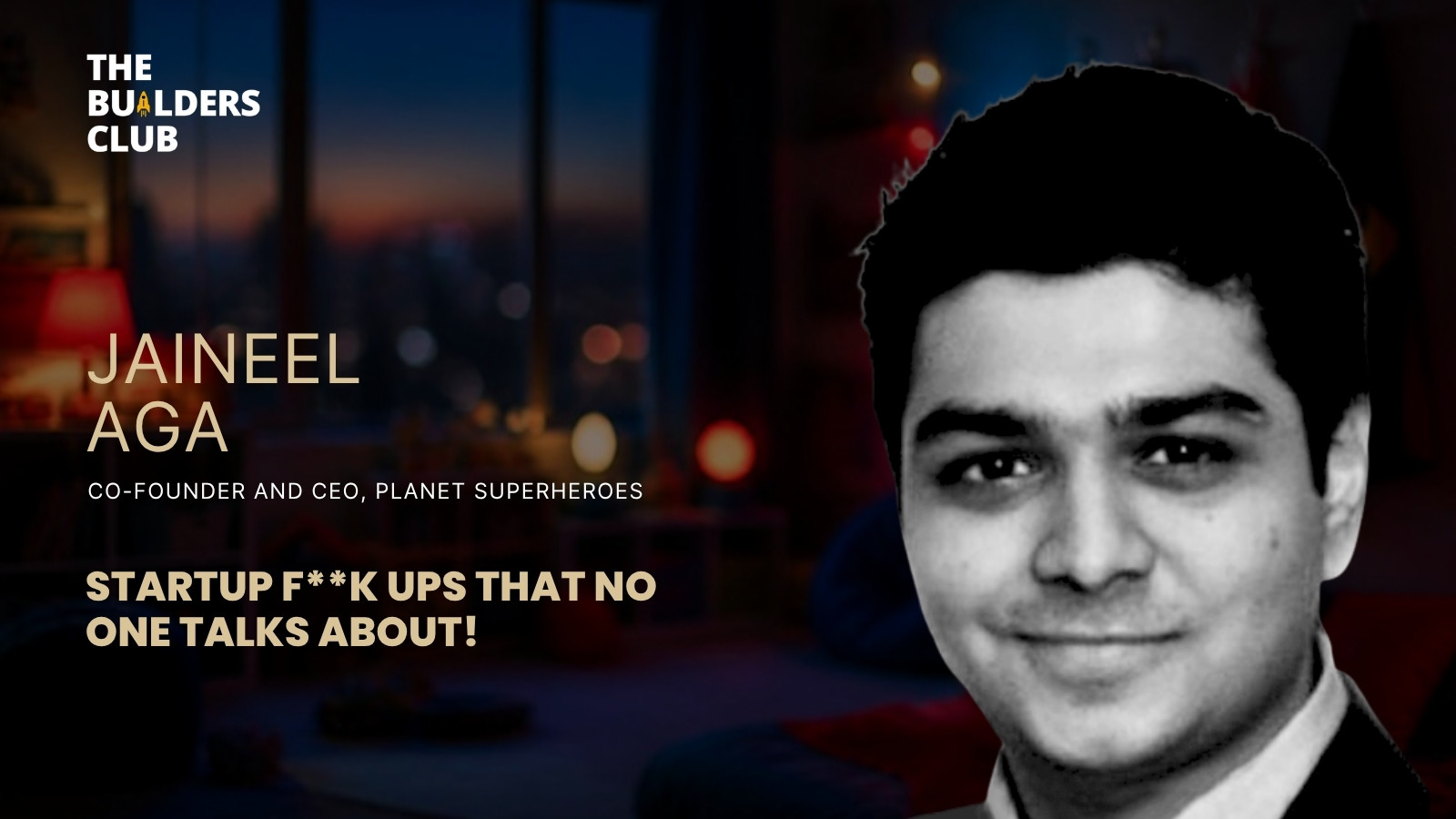
Most founder stories are polished after the fact. In Part 1 of this two-part conversation, Jaineel Aga drops the polish and talks about the mistakes nobody posts about.
Jaineel is co-founder and CEO of Planet Superheroes, an omnichannel brand for licensed character merchandise in India. He covers a term sheet that evaporated, broken vendor software, thin brand loyalty and two policy shocks.
What startup mistakes do founders rarely talk about? Jaineel Aga’s honest list
Jaineel’s central message is that the costly mistakes are rarely strategy errors. They are usually about cash, trust and dependency: counting on money that is not yet in the bank, relying on vendors you have not tested, and building a business on assets you do not control.
He tags each story as either within the founder’s control or outside it, so listeners can separate lessons from bad luck. His advice is to be realistic about your own business model and your real differentiator.
- Money in the bank is the only commitment. A verbal or soft commitment from an investor is not funding.
- Reference-check your investors. Founders vet everyone else, but few speak to founders an investor has backed.
- Test vendors before you sign. Insist on a sandbox that demonstrates every promised feature.
- Know your real moat. Licensing alone did not give customers a reason to stay loyal to the brand.
What is Planet Superheroes and how did it start?
The idea began in 2013, when vertical e-commerce was heating up and Jaineel’s team wanted a niche community to serve. They noticed that Indian fans of global entertainment franchises had to rely on relatives abroad to get official merchandise.
They launched a scrappy Shopify site around 2014 from a small warehouse in Andheri, with a few imported products to test demand. Their differentiator was selling only authentic products and paying royalties to licensors, with no fakes.
Over roughly six and a half years, the company grew from an online store into an omnichannel business with 20-plus stores, marketplace presence and offline distribution. It also moved into co-manufacturing and product development.
Why is the licensing business so cash flow heavy?
Jaineel explains that licensing requires cash upfront: you pay minimum guarantees to secure a licence, then fund inventory, then sell. Unlike software, every incremental sale also means making another product.
He argues the model can become a moat if you can fund it, because not everyone can acquire licences. But unless the licences are exclusive, he says founders should think hard before entering the model.
- Pay for the licence before you earn from it
- Fund inventory after that
- Complete the cash cycle only once the product sells
What should founders know about fundraising pitfalls?
His biggest fundraising lesson came from turning down a term sheet from investors who were ready, in favour of a higher valuation from another party. Weeks of detailed discussions followed, only for that party to walk away abruptly on a Saturday while the company’s bank balance was already negative.
The setback cost about nine months, and the team had to restart with angel networks. The original investors eventually came back on board.
He also described another corporate investor who took a detailed look at the business and then backed a competitor without telling him. His takeaway is to share what is needed, hold back sensitive margin data until deep due diligence, and be aware that this happens often.
How can founders vet investors?
Jaineel notes that investors run reference checks on founders, but founders rarely return the favour. He recommends speaking to at least three founders an investor has backed and asking for both pros and cons.
- Take one-on-one calls, not public posts
- Ask for honest pros and cons
- Treat an investor on your cap table as a long-term relationship
Should you chase the highest valuation?
Not if it is soft. He says there is no such thing as a soft commitment, and survival matters more than a headline valuation that exists only in conversation.
How should founders evaluate vendors and software providers?
Operations at Planet Superheroes are complex, spanning design, factories, warehouse, marketplaces and stores. The team also built a true omnichannel set-up where a web order can be fulfilled from any store in the network based on proximity and stock levels.
Jaineel says vendor software repeatedly failed on basics. One warehouse system needed the team to explain GST calculations, and the company changed its operations stack several times before building the central logic in-house, with its own alerts for broken inventory sync.
His advice is to be suspicious of sales stories, particularly from other startups, and to test first.
- List the core functions you cannot do without
- Ask for a sandbox, even a paid one
- Do not sign until each promised feature works
- Keep the critical logic in-house if switching costs are high
Is a licence enough to build customer loyalty?
In the Q&A, Jaineel was blunt that customers rarely care whether a merchandiser pays royalties. They care about quality and price, and fakes sell widely for less. Authenticity matters more in categories like collectibles than in t-shirts.
He also said licensors in India have sometimes granted many narrow licences, which turns official products into commodities. After about seven years, he considers the brand’s own USP not strong enough and urges founders to build a brand customers choose by name.
Asked about creating original characters, he said it is a different business that takes a decade or more and needs a creator’s DNA.
- Customers compare on quality and price
- Exclusivity makes community plays possible
- Building your own brand creates lasting ownership of the customer
How do policy changes and tax rules hit a young business?
He described the government’s steep rise in customs duty on imported toys and a requirement for Bureau of Indian Standards certification on imports, which he says hurt about a third of his business.
He also warned about GST: loss-making businesses that pay GST on expenses accumulate credits that sit unused, tying up cash. In his case it was around a crore of rupees.
He closes with receivables risk, citing distributor payments and an export order that never got paid. His point is to price in collection risk when margins are thin.
Further reading and sources
- Licensing (merchandising) on Wikipedia
- Goods and Services Tax in India on Wikipedia)
- Bureau of Indian Standards on Wikipedia
Frequently asked questions
Should founders accept a soft investor commitment?
Jaineel says no. He treats funding as real only when money is in the bank, because even signed paperwork can fall through. Keep other options alive until the funds arrive.
How do I check an investor before taking their money?
Speak one-on-one to at least three founders the investor has backed and ask for honest pros and cons. Jaineel says founders will usually be candid in private calls. This matters because an investor on your cap table stays for years.
How can I avoid buying faulty software for my startup?
Do not rely on demos. Write down your must-have functions and ask for a sandbox that proves each one before you sign. Jaineel’s team paid for sandbox access and refused to commit until promised features worked.
Conclusion
Jaineel Aga’s session is a reminder that resilience in a startup is mostly about cash discipline, vendor diligence and honesty about your differentiation.
Before your next raise or vendor contract, list what you are assuming, then verify each item. Part 2 continues the conversation.
Want more conversations like this? Join The Builders Club, our community of 35,000+ founders and CXOs, and explore more episodes of the Startup Founders Podcast.