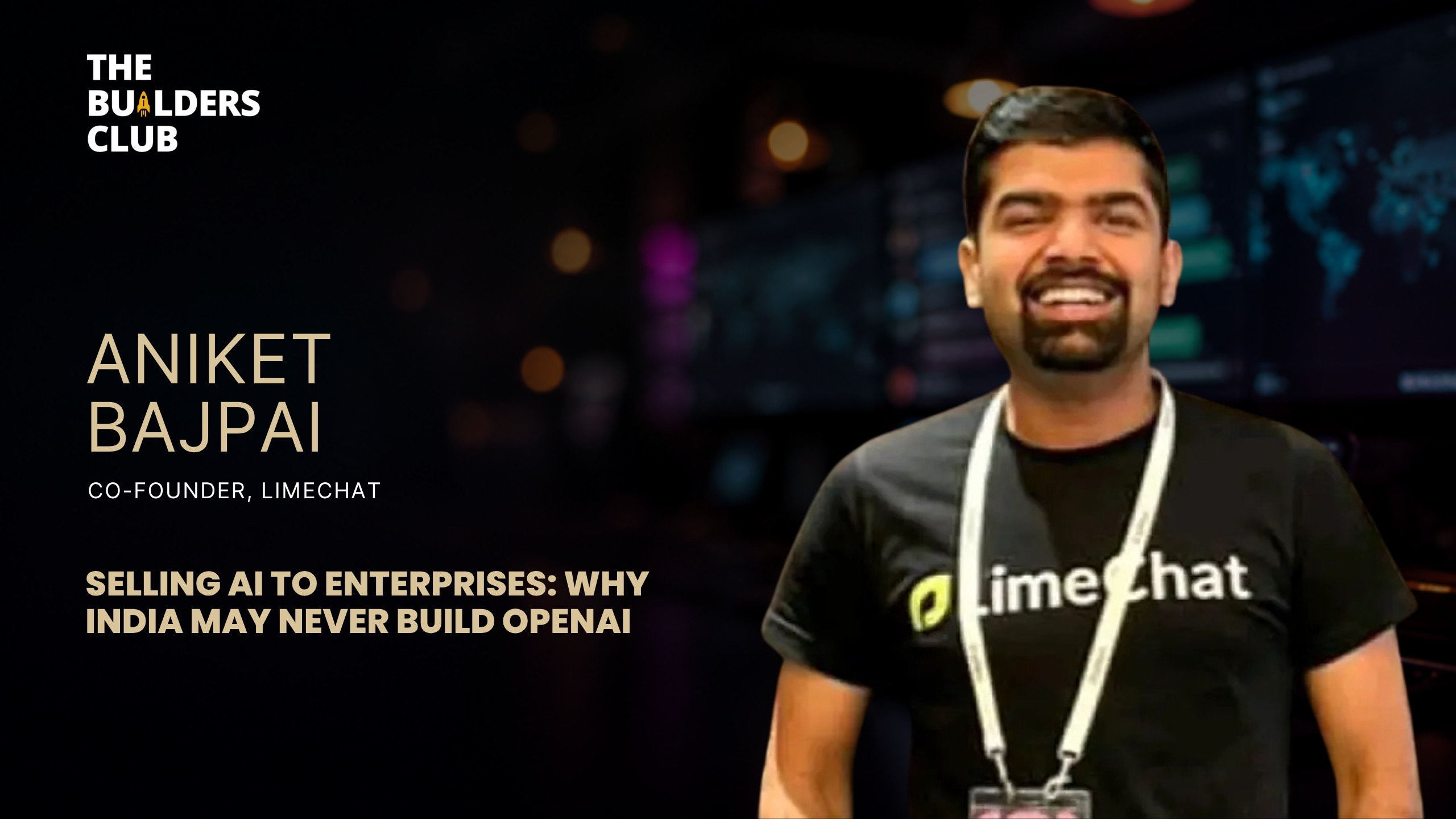
Aniket Bajpai placed an early bet on conversational AI in 2020, rebuilt his company when large language models arrived, survived the 2023 funding freeze, and now sells AI agents to some of India’s largest enterprises.
Aniket is the co-founder of LimeChat, a platform that helps enterprises build AI agents for chat and voice across sales and support. On The Builders Club Podcast: B2B Founder Stories, host Sohail Khan speaks with him about enterprise sales with zero logos, the economics of AI services, and why he thinks India does not need its own OpenAI.
How do you sell AI to large enterprises when you have no logos?
Aniket says the biggest factor in enterprise sales is trust. Large companies tend to think in ten-year horizons and want a vendor who will solve the problem end to end over that period, so a stranger who arrives alone has a hard time being taken seriously.
His advice to young founders is to lean on trust that already exists:
- Partner ecosystems. He pointed to startups such as Yellow.ai, which began as a Microsoft Azure partner and went to market through that network. Meta, large consultancies and cloud partner programmes can play the same role.
- Your buyer’s existing vendors. Ask which other large software your target already buys, and consider partnering with those vendors.
- Investor networks. Many VCs already talk to enterprises. He cited ICICI Bank’s dedicated venture team, which runs demo days for startups.
- Industry events. Executives and partners gather there, which makes meeting a few decision-makers much easier.
There is no formula, he says. Each founder has to find a route through past experience, network or partners. The one idea to keep in mind: you are not selling to a company, you are selling to a person.
How long do enterprise AI deals really take?
Even after one person decides to place a bet, Aniket describes two to three months of procurement, information security, legal and vendor registration. From the yes to go-live, he says, three to six months is common. Typically only one in ten people you pitch will take the bet.
His practical tip is to break those months into two-week blocks of workshops, new stakeholder meetings and legal steps, and to check that there is incremental progress in each. If you perform well after go-live, accounts tend to grow, because the buyer expects you to handle that problem for the next decade.
LimeChat’s own path helped. It started with mid-market e-commerce brands, which built a track record with enterprise e-commerce names such as ITC and Aditya Birla Fashion, and Mahindra was among the early enterprise wins.
How did LimeChat pivot from e-commerce support bots to enterprise AI agents?
Aniket and co-founder Nikhil started LimeChat in 2020. They spent two to three months on research, reaching out to about 100 e-commerce founders and speaking to 30 to 40 of them. The thesis was that fast-scaling D2C brands could not scale customer support at the same pace.
When large language models arrived, the small language model they had been building for e-commerce lost much of its value. They then worked with three or four enterprises to see what broke when teams tried to build agents on commodity models.
- Instruction overload. Enterprises hand call-centre agents thousands of SOP instructions. Give an AI that much and it can hallucinate or even forget the customer’s name.
- Orchestration. Large agents need to be split into smaller agents (sales, order tracking, refunds) with a layer that decides which one runs and when.
- Memory and routing. The system must decide what to store, when to call an API, and when to answer from a knowledge base or the internet.
- Traceability. When something goes wrong, you need a trace showing why, so it can be fixed.
LimeChat built that orchestration layer and now focuses on enterprises rather than SMBs. His reasoning is that SMBs worry less about a few wrong answers, operate at smaller scale and rarely have time to fine-tune each agent.
How has conversational AI changed since the intent-recognition days?
Aniket has worked in AI since his college research days at IIT Delhi and MIT. He explains that older systems relied on intent recognition: you showed a model around 10,000 examples each of order tracking, refunds and cancellations, and it learned the patterns. Building a bot for one brand took three to four months.
Today, he says, an enterprise can build a human-level AI agent on a platform like LimeChat in a day or two. He links the leap to roughly a decade of research across computer vision and language that sits behind the GPT models.
What do enterprises actually understand about AI today?
Aniket estimates that at least 30 to 40 percent of organisations have tried to upskill their top executives for an AI-first world, often out of fear that an AI-first competitor will disrupt them. Early expectations were unrealistic. After running a few projects, many teams learned that only some pilots reach production and what fine-tuning and guardrails involve.
Attitudes still vary. Some leaders expect AI to replace 100 people next month, while others have seen a failure or two and assume nothing works. His approach is to ignore the sceptics and focus on buyers who are genuinely interested.
Can a founder build a ₹1 crore business with AI services?
For a founder starting today, Aniket sees AI services as the lowest-barrier route to revenue, because companies pay when they can see the outcome in cost or revenue. The best targets are firms without strong tech teams but with large budgets, such as manufacturing and retail. BFSI also pays, but compliance and trust slow it down.
His back-of-the-envelope maths: India has many manufacturers with ₹500 crore or more in revenue and hundreds of employees. Improving their processes could show ₹5 to ₹10 crore of impact in a year, for which they might pay ₹20 to ₹30 lakh. Two or three such projects could add up to ₹1 crore. This is his own illustrative estimate, not a benchmark.
Is AI becoming a commodity, and where is the moat?
Aniket calls “commoditisation” a high-level VC term. Customers want an outcome, such as automated support or lead qualification, and getting there still takes real services effort. His analogy is a website: anyone can build one, yet you still look for an experienced person who delivers at the right price and time.
He believes foundation model companies will own the rails, and everyone else will build services and products on top. In products, the moat is the number of iterations and the user feedback behind them, much of it invisible from the front end. He adds that opportunities are deeper but less obvious than they look, for example a chat or voice agent built only for healthcare.
On investors, he sees VCs holding back in crowded markets until the top three to five players emerge. By then, he says, the valuations are unaffordable, so real returns come from spotting the non-obvious pick early.
Why does Aniket say India should not build its own LLM?
Asked about Sam Altman’s remark that India cannot build its own LLM, Aniket says building one mainly takes money, since India has no shortage of data. In his view, though, it is now a waste for most teams, because open-source models cover roughly 90 to 95 percent of the work at lower compute and without country restrictions.
The game, he argues, is which country uses AI to lift productivity, and AI services will bridge that gap. India has a clear edge, with a services playbook it has run for around 25 years. He sees room in government touchpoints such as passports and scheme eligibility, healthcare in tier-3 towns, and education delivered over WhatsApp. Execution, he adds, is the open question.
How did LimeChat fund itself, and how is the team built?
- Funding. About ₹60 crore raised across three rounds: angel, pre-seed and seed. The first angel cheque came from Titan Capital’s Kunal Bahl and Rohit Bansal, who backed the founders with no clear product yet. The seed round was around $5 million, and LimeChat was selected for Y Combinator.
- Growth. Within a year of that funding they had closed close to 200 brands.
- The reset. In 2023 the e-commerce market froze and the US motion showed weaker demand for support automation than expected. Talking to 15 to 20 investors did not produce good terms for the pivot, so the team made hard calls, let some people go, focused on the right customers, became profitable within six months and reached a very low burn. The enterprise business has since grown on its own capital.
- Team. Around 90 people, including roughly 10 in sales, 15 to 20 in customer success and 5 to 10 in implementation and onboarding, with a lean marketing team of three to four.
On marketing, enterprise buyers respond to events, PR and case studies, so LimeChat turns its biggest customer wins into testimonials and puts prospects in touch with live customers.
What does firefighting look like at LimeChat?
Aniket shared a recent episode. A third-party database vendor that powered LimeChat’s analytics shut down, taking enterprise reporting offline overnight, a top-priority issue across all customers. Four or five people worked through the night and built the data migration layer in-house in about a week, work he says normally takes around six months, while the success team managed customer escalations.
Asked about the most critical hires, he named sales and customer success, followed by product and tech leaders. On co-founders, he calls the choice the highest-leverage decision a founder makes, and says he has seen businesses shut down because the founders could not find the right fit. He met Nikhil in their first year at IIT Delhi, and the two bonded through an earlier startup that did not work out.
What is next for LimeChat?
Aniket says the aim is to be the market leader in complex chat and voice use cases and already sees LimeChat among the top three companies operating in this space in India. The next step is to expand again into emerging markets in Southeast Asia, the Middle East and Africa, but not the US or UK, which he considers crowded with heavily funded players. He also sees depth in India, with many enterprises large enough to make venture-scale outcomes possible. On voice, LimeChat integrates third-party voice layers rather than building its own, because voice is only the mouth and the agent still needs a brain.
What did he say on personal branding, Gen Z and AI replacing jobs?
- Personal brand. He built his around 2023 as an e-commerce expert, drawing on work with about 500 brands. A personal brand has value, he says, when you bring a perspective people cannot hear elsewhere.
- Gen Z. If you can sell the mission and vision, he finds Gen Z hires work with high ownership, and if they feel disconnected they do the minimum.
- Freshers. LimeChat hires through internships and pre-placement offers; of five interns, around two do very well.
- AI and jobs. Purely operational back-end roles, such as data processing, answering support queries and filling forms, are most exposed, and tech has seen heavy replacement. Sales and account management are harder to automate, though fewer entry-level roles could create an experience gap.
In the rapid-fire round, he called Perplexity the most overrated AI tool and Wispr Flow the most underrated, and his bet for 2027 is AI services.
Further reading and sources
Frequently asked questions
How do you sell AI to large enterprises when you have no logos?
Aniket Bajpai advises borrowing trust that already exists. Go to market through partner ecosystems such as Microsoft Azure, Meta or large consultancies, work with the vendors your buyer already uses, and meet enterprises through VC networks and industry events. In his words, you are selling to a person, not a company.
How long does an enterprise AI deal take to close and go live?
According to Aniket, once a buyer decides to bet on you, procurement, information security, legal and vendor registration can take two to three months, and the gap from a yes to go-live is often three to six months. He suggests breaking the journey into two-week steps so you can see incremental progress.
Does India need to build its own LLM, according to Aniket Bajpai?
No. He argues that open-source models already handle most use cases at lower compute, so building a new foundation model is not where the opportunity lies. He believes the real contest is which country uses AI to raise productivity, and that India’s long experience with services gives it a strong edge.
Conclusion
Aniket Bajpai’s message is that enterprise AI is won on trust, patience and iteration. Borrow credibility through partners and networks, expect long cycles, sell to a person, and keep building until the outcome speaks for itself.
As a next step, list the large software your target buyers already use and find one partner or investor network that already has their trust.
Want more conversations like this? Join The Builders Club, our community of 35,000+ founders and CXOs, and explore more episodes of The Builders Club Podcast.