// PODCAST

Crypto in India: Building the First Bitcoin Exchange | Sathvik Vishwanath, Unocoin

Unocoin co-founder Sathvik Vishwanath explains how he built India's first bitcoin exchange, how the company survived the banking restriction, and where volatility, regulation, DeFi and NFTs are heading.
Sathvik Vishwanath, Unocoin on The Builders Club Startup Founders Podcast
Advertisement

Selling bitcoin in India in 2013 meant explaining it to people who walked away after two minutes. Sathvik Vishwanath did it anyway, and co-founded Unocoin, which grew into one of the country’s best-known crypto platforms.

He joined The Builders Club to talk through the early years, the banking restriction that nearly starved the company of revenue, and where crypto in India goes next.

How did Unocoin build crypto in India from scratch? Sathvik Vishwanath’s story

Sathvik’s story starts with a personal pain point. Earning money in a virtual world called Second Life, he lost roughly seven percent to conversion and transfer fees and waited over a week for payments, which pushed him toward bitcoin and then to a Bangalore meetup where he met his future co-founders.

Unocoin launched in December 2013 as a platform for Indians to buy and sell bitcoin. It later added a merchant gateway, an exchange with around forty tokens and a lending platform, and serves about fifteen lakh Indians with a team of about forty-five.

  • Solve your own problem. High fees and slow transfers led to the idea.
  • Education is the first job. Most people had never heard of bitcoin.
  • Regulation can freeze a business. The company ran on almost no revenue for 22 to 23 months.
  • Be cautious with customers’ money. Unocoin lists new tokens carefully.

How did Sathvik Vishwanath get into bitcoin?

Sathvik studied engineering, did side jobs such as building websites for call centres, worked as a programmer analyst at Cognizant and then completed an MBA at Melbourne Business School. While there he wrote custom scripts in Second Life and earned its in-world currency.

Converting that money to dollars and then to rupees cost him around seven percent every month. Looking for a cheaper and faster route, he found bitcoin.

  • He met Unocoin’s other founders at a Bangalore bitcoin meetup in 2012-13.
  • Global peers such as Coinbase, Bitstamp and Mt. Gox showed there was a gap in India.
  • Unocoin launched in December 2013.

What were the biggest challenges of starting a crypto exchange in India?

Education came first. About ninety percent of people did not know what bitcoin was, and if the team could not explain it in a short pitch, they lost the prospect.

There was also no precedent. The founders had to guess how to run KYC, what security to build and how the platform should work, while officials were still working out how to categorise and tax crypto.

  1. Explaining bitcoin to a mass audience.
  2. Unclear rules on tax and classification.
  3. Building security and compliance without a template.
  4. Surviving the banking restriction between 2018 and 2020.

How did Unocoin survive the banking restriction?

Between 2018 and 2020, a restriction on banks serving crypto companies meant Unocoin struggled for about 22 to 23 months with almost no revenue. The team kept energy and resources aside to fight the case at the Supreme Court and then return to business.

Sathvik says officials now understand the sector far better, and regulators, from tax to enforcement, deal with it openly.

Will bitcoin ever become less volatile?

Sathvik says volatility has already fallen. In 2014 a single piece of news from China could drop the price by half in minutes, while today the move is closer to five percent, and daily swings of two to three percent are normal.

He estimates it could take another six to eight years to reach swings of around half a percent a day, as the market grows larger and deeper. He expects bitcoin to behave more like gold, a store of value, and other coins to handle daily payments.

Why does a bigger market mean steadier prices?

More participants and a larger market cap make it harder for any single player with deep pockets to move the price.

How safe are crypto exchanges, DeFi and NFTs?

Sathvik admits another Mt. Gox-style failure can happen, since exchanges are attractive hacking targets. He notes that today’s exchanges use cold storage, have in-house security teams and hold a much smaller share of global volume.

On DeFi, he calls smart-contract platforms risky because few users read the contracts, and hacks yield money directly. He is also doubtful about NFTs, saying there may not be enough end buyers, though Unocoin may add a marketplace for swaps.

  • Diversification idea: about half in bitcoin, a quarter in tokens with a year of real use, and a quarter for high-risk bets.
  • Only a few NFT and DeFi projects are likely to last.

What does the future of crypto regulation and Unocoin look like?

Sathvik expects regulation to arrive because exchanges today set their own KYC and tax handling. Without rules, he warns that exchanges could list any coin, and ordinary investors would lose out.

Unocoin has been cautious about aggressively marketing to the middle class and about which tokens it lists. It runs an education portal called Unoversity and plans to add features such as lending and wealth management once rules are firmer. For background on the technology, see Bitcoin on Wikipedia.

Further reading and sources

Frequently asked questions

What is Unocoin?

Unocoin is an Indian crypto platform co-founded by Sathvik Vishwanath that launched in December 2013 to let Indians buy and sell bitcoin. It has since added an exchange, a merchant gateway and a lending platform.

Will crypto prices stay volatile?

Sathvik says volatility is already lower than in the early days and expects it to keep falling as the market grows. He thinks it could take six to eight years to reach a much calmer range, though sentiment shocks will still occur.

How should a beginner split money across crypto assets?

Sathvik’s rough suggestion was about half in bitcoin, a quarter in tokens with real use cases built over a year, and a quarter for risky bets. This is his personal view, not financial advice, and you should do your own research.

Conclusion

Sathvik’s journey shows how a founder can build in a market with no rules and little awareness: educate patiently, be careful with customer money and be ready to survive long regulatory delays.

If you are building in an emerging category, budget for education and for months of uncertainty, and treat compliance as part of the product.

Want more conversations like this? Join The Builders Club, our community of 35,000+ founders and CXOs, and explore more episodes of the Startup Founders Podcast.


Never miss an episode

Join 35,000+ founders and CXOs in The Builders Club community.

Join the Community
Advertisement
Advertisement
Facebook
X
LinkedIn

[WEBINAR] The Cost of not Knowing

The Cost of Not Knowing – Live Webinar | The Builders Club × CUPI The Builders Club × CUPI🦁 Presents Live Webinar The Cost ofNot Knowing Hidden Expense Leakages in Business Founders CFOs COOs Finance Heads Operations Leaders 📅 Date 17 June 2026 🕖 Time 7:00 PM onwards 💻 Format Online · Free Register for Free Seats are limited · 17 June · 7 PM IST About the Event Most businesses don’t lose money in big, obvious ways. They lose it in small, invisible leaks — duplicate subscriptions, untracked reimbursements, vendor overpayments, missed GST credits, petty cash that never reconciles. Individually they look like rounding errors. Added up over a year, they’re lakhs walking out the door. This session is about finding that money before it disappears. Speaker S Siva Rama Krishna Corporate Payment Consultant CUPI Siva works with growth-stage businesses to diagnose and close expense leakages — helping finance teams move from manual reconciliation to real-time spend visibility using UPI-native infrastructure. What You’ll Learn The most common places expense leakage hides in a growing business — and why finance teams routinely miss them How to read your own spend data to catch leaks early, before they compound A simple framework to put spend controls in place without slowing your team down The true cost of manual reimbursements and reconciliation, measured in both rupees and hours How modern UPI-based corporate payments close these gaps in real time Live Q&A with Siva to pressure-test your own numbers Who Should Attend Founders & Co-founders Who approve spends but don’t have full visibility into where the money actually goes. CFOs & Finance Heads Trying to tighten unit economics and extend runway. Finance & Accounts Managers Handling reimbursements, vendor payments, and reconciliation day-to-day. COOs & Operations Leaders Who own budgets across teams and need spend accountability. Scaling Leaders Any leader whose company is growing faster than the systems tracking its expenses. About CUPI CUPI 🦁 ISO 27001 Certified CUPI is a corporate expense-management platform built on UPI. Each employee gets a UPI-enabled app linked to the company’s current account, so they pay business expenses directly from a shared corporate wallet — no cards, no cash advances, no reimbursement cycles. Admins set per-user spend limits, track every transaction live, upload receipts on the spot, and get audit-ready, GAAP-aligned reports from a single dashboard. getcupi.com → Stop the leak.Start the session. 17 June 2026 · 7:00 PM IST · Free to attend Register for Free Organised by The Builders Club · thebuildersclub.me thebuildersclub.me  ·  getcupi.com  ·  All TBC Events

Read More »

Virtual Roundtable series

The Global Tech Roundtable: Where the World’s Tech & GTM Leaders Sit at One Table The Builders Club · Virtual Event Series The world’s most interesting conversations about technology rarely happen in one place — they happen across time zones, ecosystems and markets. The Global Tech Roundtable, The Builders Club’s flagship virtual event series, was built to close that gap: a single, open forum where CXOs and founders from the US, UK, Europe, Dubai and beyond come together to talk candidly about tech, go-to-market and the opportunities hiding inside every domain. Each session zooms in on one theme — a trend, a shift, or a market — and brings the people actually building inside it into the same room. No surface-level panels. Just real operators sharing what’s working, what’s changing, and where the next opening is. One Global Forum, Many Time Zones The premise is simple but rare to execute: get leaders from across the globe onto one common forum and let them think out loud together. Across editions we’ve hosted voices from the US, the UK, Europe, Dubai and India — each bringing the texture of their own market to a shared conversation. The result is a roundtable that feels less like a webinar and more like a working session between peers who happen to live on different continents. View this reel on Instagram Conversations on Tech & GTM Technology and go-to-market are two sides of the same growth story, and the series treats them that way. One conversation might unpack an emerging engineering trend; the next digs into how teams actually take a product to a new market. By keeping both threads in the room — the builders and the go-to-market leaders — the discussions stay grounded in how decisions really get made: from architecture to pipeline, from product to positioning. View this reel on Instagram Voices From Across the World A roundtable is only as good as the people around it. What makes this series distinct is the range of ecosystems represented in a single conversation — a leader scaling in the US, an operator navigating Europe’s regulatory landscape, a founder building out of Dubai, a CXO from the UK. Those different vantage points turn a familiar topic into a genuinely global one, surfacing perspectives you simply can’t get from a single-market discussion. View this reel on Instagram Trends, Signals & What’s Next Every edition is anchored to a theme that matters right now — the trends reshaping a domain, the signals worth watching, and the shifts leaders are quietly preparing for. Instead of recycled predictions, the value comes from people who are living the change and willing to say what they’re actually seeing on the ground. It’s a fast, honest read on where a domain is heading, straight from the operators steering it. View this post on Instagram Opportunities Inside Every Domain Trends are interesting; opportunities are actionable. A recurring thread across the series is turning “what’s happening” into “what can we do about it” — the white spaces opening up in a domain, the gaps incumbents are too slow to fill, and the moves that give challengers an edge. For founders and CXOs, these are the moments worth leaning into, mapped out by people who’ve already spotted them. View this post on Instagram A Launchpad for Market Expansion At its core, the Global Tech Roundtable exists to help businesses grow into new geographies. If you’re looking to expand into a new market, there’s no substitute for hearing directly from the CXOs who already operate there — what the ecosystem rewards, where the friction lives, and what a credible entry actually looks like. The series gives expansion-minded leaders a place to pressure-test their thinking before they commit budget and headcount. View this post on Instagram Direct Access to the Ecosystem’s CXOs Beyond the insight, the real currency is access. The roundtable puts founders and business leaders in front of CXOs from the ecosystems they want to enter — to share a thought, exchange perspective, understand what those markets need, and build the relationships that make expansion possible. It’s the kind of room where a single conversation can shorten months of trial and error. View this post on Instagram Pull Up a Chair The Global Tech Roundtable keeps growing because the format works: one domain, the right people, an open forum, and a global set of perspectives in every session. Whether you’re scaling a tech business, sharpening your go-to-market, or planning your next geography, there’s a seat for you at the table. View this post on Instagram Want to join the next Global Tech Roundtable? Connect with CXOs and founders from across the globe — explore the community.

Read More »

Bangalore Tech Symposium

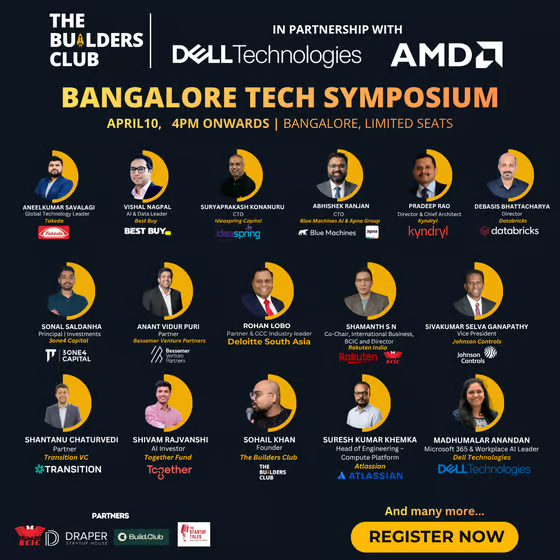
Bangalore Tech Symposium: AI & the Future of Working in Tech We just wrapped the Bangalore Tech Symposium — one of the most grounded conversations on AI in tech we’ve hosted so far. Organised by The Builders Club in association with Dell Technologies and AMD, the day brought together the people leading the curve — CTOs, GCC leaders, founders, operators and investors — for a focused, no-fluff look at how AI is reshaping the way tech businesses operate, compete and grow. As the industry moves past experimentation, the discussion centred on what it actually takes to build, operate and scale in an AI-first world — from infrastructure and engineering systems, to enterprise-scale deployment inside GCCs, to how capital is flowing across the AI ecosystem. The day was built for depth, not breadth: a keynote fireside, three practitioner panels, and a networking dinner to close. 100+ attendees, 15 speakers. A glimpse of the day What a room. Beyond the stage, the real energy was in the conversations between sessions — the debates, introductions and perspectives exchanged in real time. Here’s the highlight reel. View this reel on Instagram The keynote fireside, with Dell The day opened with a fireside featuring Madhumalar Anandan, Microsoft 365 & Workplace AI Leader at Dell Technologies, on “Rethinking Workplace Computing: What Modern Tech Teams Actually Need from Their Devices.” AI workloads aren’t what legacy infrastructure was built to handle — the conversation dug into the hidden performance ceilings created by legacy device setups, and what genuinely AI-ready infrastructure looks like for high-performance teams. Tech Panel — Building an AI-First Workplace The CTO perspective: rearchitecting infrastructure, overhauling engineering processes, and making the hard calls on where to invest and what to leave behind. Abhishek Ranjan (Blue Machines AI & Apna Group), Debasis Bhattacharya (Databricks), Sivakumar Selva Ganapathy (Johnson Controls) and Suresh Kumar Khemka (Atlassian), moderated by Shamanth S N (Rakuten India | BCIC). GCC Panel — The AI Productivity Multiplier GCC leaders aren’t just adopting AI — they’re defining what enterprise-grade deployment looks like for the rest of the industry, setting requirements and making the talent and infrastructure calls. Vishal Nagpal (Best Buy), Pradeep Rao (Kyndryl), Aneel Kumar Savalagi (Takeda) and Rohan Lobo (Deloitte), moderated by Sohail Khan (Founder, The Builders Club). Investor Panel — Investing in the AI Era A rare, unfiltered view of how investors are reading the landscape — what’s getting funded, and where durable value is actually being created. Anant Vidur Puri (Bessemer Venture Partners), Shivam Rajvanshi (Together Fund), Sonal Saldanha (3one4 Capital) and Suryaprakash Konanuru (Ideaspring Capital), moderated by Shantanu Chaturvedi (Transition VC). What the room actually took away Across the fireside and the panels, a few themes kept surfacing — the kind of signal you only get when CTOs, GCC heads and investors are honest in the same room. AI is no longer a layer; it’s becoming the operating model. Infrastructure and data readiness are the real bottlenecks to scale. Productivity gains are real, but capturing them as advantage is still uneven. And the gap between companies moving fast and those waiting is widening rapidly. Moments from the room View this post on Instagram Who was in the room The Symposium was built for the leaders already in the arena — IT and technology leaders rebuilding from the inside, GCC and enterprise tech heads deploying at scale, founders and business heads across IT and SaaS, and investors looking for ground-level signal. That mix is exactly what The Builders Club is built around. Not just events — rooms for real conversations. More to come.

Read More »