// PODCAST

Digital Health Investing in India: What VCs Look For | Namit Chugh, W Health Ventures

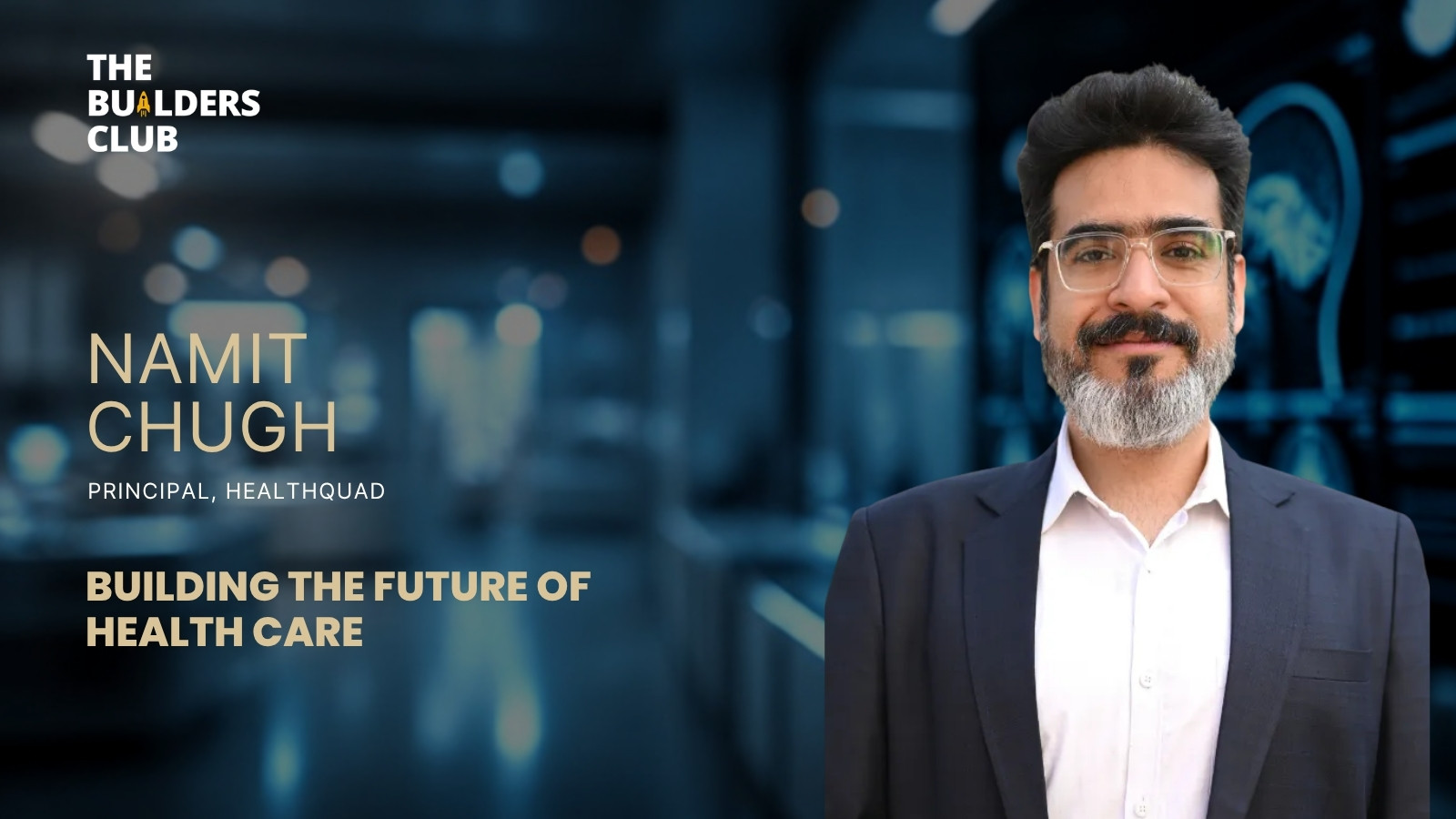
Namit Chugh of W Health Ventures explains how he evaluates digital health startups in India, which waves have shaped the sector, and where the next white spaces are.
Namit Chugh, W Health Ventures on The Builders Club Startup Founders Podcast
Advertisement

Most people assume healthcare money flows only to hospitals. Namit Chugh sees 60 to 70 digital health companies a month and invests in fewer than one in a hundred.

In this episode of The Builders Club Startup Founders Podcast, the W Health Ventures investor breaks down digital health investing in India, from market waves and TAM to the metrics that decide a cheque.

How do VCs approach digital health investing in India? Namit Chugh’s thesis

Namit’s view is that healthcare in India and the US is broken on access, affordability and quality, and that technology is the only lever that can change it at scale. W Health Ventures backs early-stage, tech-enabled healthcare companies in both markets.

He groups the fund’s interests into three areas: vertical care for a specific disease, D2C brands at the edge of health and wellness, and enablers such as lending, insurance, AI and SaaS.

  • Money still sits with hospitals. Out-of-pocket spending makes providers the main revenue pool, but digital niches are opening up.
  • Venture-backable means exponential. If a market only supports linear growth, Namit suggests bootstrapping instead.
  • Healthcare adds its own metrics. Patient feedback, retention and clinical outcomes sit beside CAC, LTV and gross margin.
  • Trust drives go-to-market. Digital health is moving toward omni-channel models with a physical presence.

What is W Health Ventures and what does it invest in?

W Health Ventures is a Boston-based venture firm founded by the Wadhwani family, focused on healthcare companies in the US and India. Namit has spent about two years looking at early-stage digital health there, after roughly six years in healthcare consulting and a stint at another fund.

Beyond venture investing, the firm runs a venture studio in India. It incubates companies from scratch where founders are not chasing complex problems, bringing clinical models from the West and adapting them locally.

  • Verticalised care: going deep on one disease area, such as diabetes, mental health or cancer care.
  • D2C health and wellness: product-led brands with service layers.
  • Enablers: lending, health insurance, AI and SaaS.

What waves has Indian healthtech gone through?

Namit describes the first wave, from around 2013 to 2014, as horizontal models in pharmacy and teleconsultation. The bet was a low acquisition cost against a high lifetime value, which turned out to be mostly a distribution play.

From about 2019 to 2020, vertical plays took over, led by chronic conditions with huge addressable markets. He points to diabetes and mental health, each now attracting many startups, as the obvious spaces.

What does he expect next?

He expects founders to look for spaces with no innovation yet. Pain management is his example, since India has very few dedicated pain doctors for its population.

  • Niche white spaces that do not yet exist as specialities.
  • Omni-channel models, such as small clinics or shop-in-shop formats.
  • Models proven in the US, adapted for an out-of-pocket market.

When is a healthcare startup not venture-backable?

Namit says TAM looks large for almost anything in a country of India’s size, so the real question is whether growth can be exponential. VCs have a fiduciary duty to their investors, so a business that grows only two or three times does not justify the risk.

For such businesses he advises friends-and-family money or bootstrapping and building a small profitable company. He adds that TAM is usually a straightforward exercise of population, prevalence and adoption cuts.

What metrics do healthcare investors check before investing?

Namit lists the standard set: revenue growth, CAC, LTV, gross margin, path to profitability, unit economics and product-market fit. He urges founders to track them for their own sake, not just for investors.

Healthcare adds three more, which he treats as a special category.

  1. Patient feedback. The team speaks to 50 to 100 patients during diligence to understand their experience.
  2. Retention and repeat usage. Love for the product is what lets a company charge more and protect margins.
  3. Clinical outcomes. In diabetes, for instance, a reduction in HbA1c should show up in the data.

How does an investor’s day actually work?

Namit says it is less glamorous than writing cheques. Roughly 35 to 40 percent of his time goes to evaluating new deals, 30 to 40 percent to supporting portfolio companies, and the rest to tracking trends in other sectors and countries.

The firm sees about 70 to 80 deals a month, and he says only around 0.9 percent are funded. Cheques run from seed to Series A, with an average first ticket of around 3.5 million dollars, typically at seed-plus stage with an MVP and early traction.

Can healthtech make money in tier-two and tier-three India?

Namit challenges the assumption that smaller towns will not pay. In his portfolio, 60 to 65 percent of users of a diabetes company come from tier two and beyond, and a pregnancy-care company sees order values similar to metros.

He also cites an obesity clinic in Aurangabad where customers pay up to 12,000 rupees for a three-month plan. He is talking about the middle class and above, not the bottom of the pyramid, where healthcare remains a public good.

  • Build the right solution and people will pay.
  • Expect first-time users who need education about the condition.
  • Digital identity under the Ayushman Bharat Digital Mission could improve the sector’s data layer.

Further reading and sources

Frequently asked questions

What stage does W Health Ventures invest at?

According to Namit Chugh, the firm invests from seed to Series A, usually at seed-plus when there is an MVP and early traction. The average first cheque is around 3.5 to 4 million dollars.

What should a healthtech founder research before building?

Talk to patients, doctors and hospitals to confirm the problem is real and large. Check that your solution is clearly better than the status quo, and study how similar models worked abroad, remembering that India is largely out-of-pocket while the US is payer-driven.

When will Indian digital health startups see exits?

Namit said digital health in India is at a nascent stage and that eventual exits such as IPOs are likely five to seven years away. So far there have been few exits beyond some secondary transactions in e-pharmacy.

Conclusion

Namit Chugh’s message to healthtech founders is to pick a problem that is both large and under-served, stay close to patients, and think about margins and clinical outcomes from day one.

If you are building in health, use his checklist before pitching: is the growth exponential, do patients love it, and does it measurably improve outcomes?

Want more conversations like this? Join The Builders Club, our community of 35,000+ founders and CXOs, and explore more episodes of the Startup Founders Podcast.

Never miss an episode

Join 35,000+ founders and CXOs in The Builders Club community.

Join the Community
Advertisement
Advertisement
Facebook
X
LinkedIn
Silicon Valley VPs vs. Indian Family Business Promoters

The Executive Sponsor Trap: Selling to Silicon Valley VPs vs. Securing Commitments from Indian Family Business Promoters

A Silicon Valley VP can usually sign inside a budget they own. An Indian family business promoter often holds the final say but delegates the evaluation, and that gap is where deals stall. Treating a friendly mid-level sponsor as the decision-maker is the most common mistake in cross-border enterprise sales. Here is how the two models differ and how to secure a commitment that survives promoter review. What is the executive sponsor trap? It is the assumption that the person championing your product has the authority to buy it. In US enterprise sales, a VP or director often does hold budget. In many Indian family-run groups, authority sits with the promoter or family council, while managers and professional CEOs run evaluations. How do US VPs make buying decisions? Delegated authority. A VP typically owns a departmental budget with a defined spending limit. Process-led approval. Procurement and legal run a standard path once a business case is approved. Rep-free research. Buyers do much of their research independently, as shown in Gartner’s 2026 sales survey, so your first call is rarely the start of their evaluation. How do Indian family business promoters make buying decisions? Final say at the top. The promoter or a small family circle may approve significant spend, even when a professional CEO handles daily operations. For context, see Business Today on professional CEOs in Indian business families. Trust over process. A recommendation from a known peer, advisor or existing vendor carries heavy weight. Group thinking. Decisions consider the whole group, not only one business unit, which can slow or accelerate a deal sharply. Tech caution. Research on Indian family businesses by Inc42 describes growth-driven but technology-cautious attitudes, which means proof and references matter. Academic work such as the Indian School of Business research on family business groups offers background on how these groups are structured. Sponsor authority compared: Silicon Valley vs family-run Indian groups Factor Silicon Valley VP Indian family business promoter Budget ownership Often in the VP’s own budget Often approved at group or promoter level Who evaluates The VP’s team Managers, CIO or professional CEO What builds trust Data, ROI case, peer reviews Personal credibility, references, introductions Typical blocker Competing priorities and budget timing No access to the final decision-maker Commitment signal Signed order form Promoter or senior leadership endorsement, then paperwork How do you secure a real commitment from a promoter-led company? Ask the authority question early. “Who gives the final nod on a decision of this size?” is polite and effective. Arrange a senior-to-senior meeting. Your founder or most senior leader meets the decision-maker with the sponsor’s backing. Use a trusted introducer. A mutual contact, existing client or advisor opens doors more reliably than outreach. Give the sponsor a promoter-ready summary. One page covering outcome, risk, cost, and references in plain language. Confirm the paperwork route. Once approval is verbal, ask who triggers legal, security and procurement. What if you cannot reach the promoter? Work through the professional CEO or CIO, and ask them to describe what the promoter will want to see. Prepare that material in advance. FAQ Who makes the final software buying decision in an Indian family-owned business? It varies, but for significant spend the final approval often rests with the promoter or a small family group, while managers and a professional CEO run the evaluation. Ask early who gives the final nod. How is selling to a US VP different from selling to an Indian business promoter? US VPs typically own a budget and follow a defined buying process. Promoters weigh trust, references and group-level considerations, so you need senior access and credible introductions. How do I get a meeting with a promoter or business owner? Use warm introductions from mutual contacts, existing customers, advisors or community events. Ask your internal sponsor to request the meeting and prepare a short, outcome-focused briefing. Conclusion Do not mistake enthusiasm for authority. In the US, test whether your VP owns the budget. In Indian family groups, find the person who gives the final nod, and get there through trusted introductions and a promoter-ready summary. Need warm introductions to promoter-led enterprises? Join The Builders Club. References and further reading Gartner Sales Survey: 67% of B2B buyers prefer a rep-free experience (2026) Gartner: The B2B buying journey and how to optimise it Business Today: Why Indian business families are hiring professional CEOs Inc42: Indian family businesses are growth-driven but tech-cautious Indian School of Business: Family business groups in India About the author: Sohail Khan is Founder and Director of The Builders Club, a professional community of 35,000+ founders and CXOs across India, UAE, Singapore and the US.

Read More »

Why the Self-Serve PLG Playbook Fails with Indian Enterprise CXOs (And the High-Touch Assisted Model That Actually Wins)

Self-serve PLG works when the user is also the buyer. In Indian enterprises, they almost never are. A product-led funnel can get your tool into a team’s hands, but it rarely gets a CXO to sign. The model that wins is a high-touch, assisted motion that uses product usage as proof, not as the whole sales strategy. Here is why the standard playbook stalls in India’s large organisations, and what to run instead. Why does the self-serve PLG playbook fail with Indian enterprise CXOs? Product-led growth, as described by pioneers such as OpenView, assumes that users discover, try and adopt the product themselves, and that revenue follows usage. That assumption holds for tools with low risk, low price and individual buyers. Enterprise buying in India breaks all three conditions at once. The user is not the buyer. An analyst may love your tool. The budget sits with a CIO, CFO or business head who has never opened it. Risk is organisational. A CXO signs against security, vendor-continuity and reputational risk, none of which a free trial answers. Trust is personal. Decisions often move on credibility, references and conversations with someone they respect, not on a sign-up flow. Does a free trial or freemium plan ever work in Indian enterprises? It can work for teams, departments and SMB-sized units, where one manager has a card or small discretionary budget. It rarely scales to the top accounts without a human who turns usage into a business case. What does the high-touch assisted model actually look like? Assisted does not mean old-fashioned. It means every stage of the product experience is paired with a person who removes a specific obstacle. Stage Pure self-serve PLG Assisted model for Indian enterprises Discovery Organic search, product trial Warm introduction, peer room, referral Evaluation Self-guided trial Guided pilot with named success criteria Decision User upgrades with a card Business case built for the CXO and the committee Contracting Click-through terms Negotiated MSA, security review, procurement Expansion In-app prompts Account lead plans rollout across divisions How do you turn product usage into a signed enterprise contract? Use the product as the evidence, and a person as the translator. A practical sequence: Find your champion. Identify the user who gets the most value and ask them to explain the problem in their own words. Quantify the result. Convert usage into time saved, errors avoided or revenue influenced, in a one-page summary the CXO can read in two minutes. Map the buying committee. Ask your champion who else must say yes: IT, security, finance, legal, and the business owner. Run an executive conversation. A founder or senior lead speaks to the CXO about outcomes and risk, not features. Offer a scoped commitment. A defined pilot or first-division rollout with clear exit and expansion terms reduces perceived risk. When should you still invest in self-serve? Do not abandon it. Use self-serve as the top of the funnel and as a signal engine. Track which accounts have several active users, which teams invite colleagues, and which admins explore security settings. Those are the accounts your sales team should call first. Think of it as product-qualified leads feeding a human-led close. Many global companies now run exactly this hybrid, and it fits Indian enterprise buying better than a pure self-serve approach. FAQ Is PLG dead for B2B SaaS in India? No. PLG is useful for building awareness, usage data and champions inside accounts. It fails as the only motion for large enterprises, where committees, security reviews and relationships decide the contract. A hybrid model works better. What is a product-qualified lead (PQL)? A PQL is an account or user whose in-product behaviour suggests buying intent, such as multiple active teammates or admin-level exploration. Sales teams use PQLs to prioritise who to approach with a human conversation. How many people does an assisted enterprise sale need? It depends on deal size, but you typically need one senior owner for the relationship, one technical resource for security and integration questions, and a customer success lead after signing. Founders often cover the first two roles in early deals. Conclusion PLG gets you into the room, but it does not get a CXO to sign. In Indian enterprises, winning sales pair product evidence with human trust: a champion, a business case, a guided pilot and a senior conversation. Building an assisted enterprise motion? Meet founders and CXOs who have done it at The Builders Club, and bring your toughest sales question to our next roundtable. Join The Builders Club. About the author: Sohail Khan is Founder and Director of The Builders Club, a professional community of 35,000+ founders and CXOs across India, UAE, Singapore and the US.

Read More »