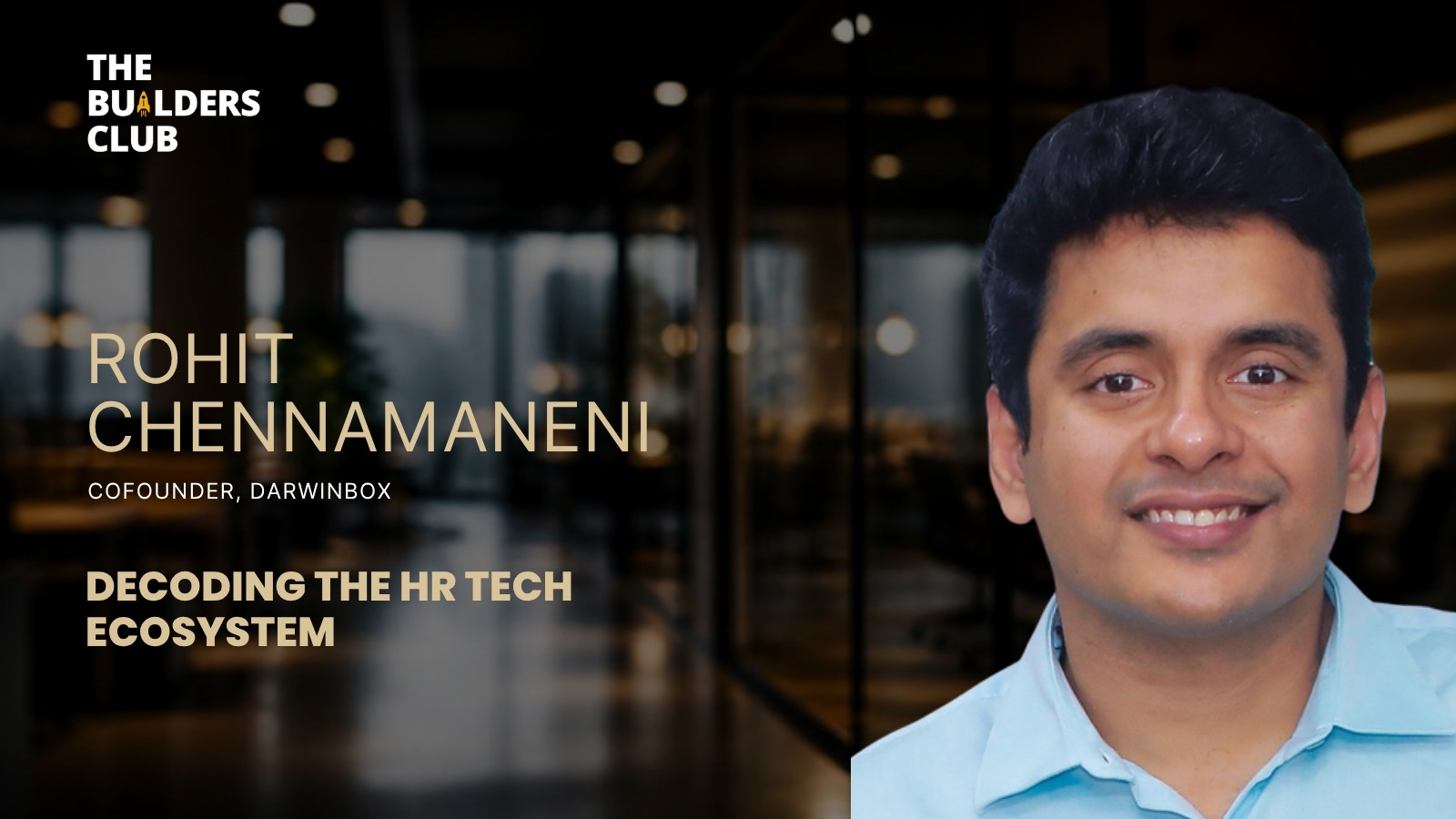
Every large company runs on three systems of record: finance, customers and people. Rohit Chennamaneni noticed that the people system was used by everyone, yet rarely loved.
He left consulting to build Darwinbox, now an enterprise HR platform. In this episode he explains how a young startup competed with giants and what it means for HR tech in India.
How did Darwinbox compete with SAP, Oracle and Workday? Rohit Chennamaneni’s answer
Rohit’s answer is adoption. Incumbent HR systems were bought because they were the safe choice, yet few people were happy using them. Darwinbox set out to make everyday tasks feel like a consumer app, work on mobile and bend to each company’s processes.
The team also changed the story. Instead of arguing over feature lists, it positioned the product as technology for employees and sold the outcome: people actually using it.
- Adoption over features. Simple self-service tasks that need no training.
- Mobile first. Many workers have no laptop or email address.
- Configurable by design. Workflows adapt instead of forcing best-practice processes.
- Trust compounds. Early customers came from networks, then wins against incumbents followed.
How did Rohit Chennamaneni come up with Darwinbox?
Rohit grew up in Hyderabad, studied mechanical engineering at VIT Vellore and spent about three years at Google, followed by an MBA and three and a half to four years at McKinsey. There he worked on digital transformation and saw how large enterprises buy software.
He started Darwinbox in 2015 with two co-founders from banking and HR consulting. As enterprise-facing people, they spoke to HR heads before building.
What does Darwinbox do?
It is an enterprise HR SaaS product covering the employee lifecycle. At the time of the conversation, Rohit said it had about 650 customers and roughly 1.3 million end users, with India and Southeast Asia as its main markets.
- Recruitment and onboarding.
- Leave, attendance and payroll.
- Performance management and employee engagement.
Why do enterprises hesitate to switch HR systems, and how did Darwinbox win trust?
An HR system is a core record, so buyers fear a young vendor failing, and the HR head owns that risk. Incumbents also have far larger teams and budgets.
Darwinbox won early customers through personal networks, then outside funding added credibility, and then it began beating and replacing incumbents. Rohit says the winning pattern is consistency over time.
What were the three points of differentiation?
The team went after the reasons existing systems went unused.
- Consumer-like experience that needs no training.
- Mobile access, since many workers lack laptops and email.
- Flexible workflows instead of one rigid best practice.
How did Darwinbox handle the pandemic?
Rohit says the team first expected the worst and froze hiring. It then called customers one by one to ask how it could help.
Pharma customers had strict entry forms, visitor management and virtual ID cards. The team packaged similar features and offered them to run on top of other HR systems. Usage then rose and new customers signed up.
How does HR SaaS grow in India, and how should it be priced?
Rohit said cloud penetration was under 20 percent in India against around 70 percent in the US and Europe, so much of the market is moving from on-premise to cloud.
Darwinbox broke its suite into modules so buyers could try something low-risk, such as performance reviews, before committing. Enterprise revenue is lumpy and arrives late, and pricing per employee per month is already an established norm.
How should a founder research a B2B problem before building?
Rohit recommends primary research first. Ask about problems and never pitch the solution in the first conversation. If buyers describe a painful problem unprompted, there is demand.
He advises scripting the questions: is the problem real, how does it affect you, and what happens if it is not solved. He also stresses staying close to customers and asking for feedback on everything from copy to features.
Further reading and sources
- Darwinbox official website
- Human resource management system on Wikipedia
- Software as a service on Wikipedia
Frequently asked questions
What is Darwinbox?
Darwinbox is an enterprise HR software platform founded in 2015 by Rohit Chennamaneni and two co-founders. It automates the employee lifecycle, including recruitment, onboarding, leave, payroll and performance management.
How can a startup compete with SAP, Oracle or Workday?
Rohit says to find the pain incumbents do not solve, in his case low adoption, and to position on that. Build for ease of use and flexibility, then earn trust through consistent delivery and early customers.
How long does it take to implement an enterprise HRMS?
Rohit said Darwinbox’s average onboarding takes about three months, because the team configures processes and trains the customer. Customers are usually companies with 500 employees or more.
Conclusion
Rohit’s story shows that in a crowded, trust-driven category, a clear point of view on what customers truly struggle with beats a longer feature list.
If you are building B2B software, interview buyers about their problems first, price in a way that lowers the cost of trying, and keep customers close throughout.
Want more conversations like this? Join The Builders Club, our community of 35,000+ founders and CXOs, and explore more episodes of the Startup Founders Podcast.