

// PODCAST

The Lean Startup Philosophy: How Founders Validate Before They Build | Brant Cooper, Move the Needle

Brant Cooper, author of The Lean Entrepreneur and CEO of Move the Needle, explains the lean startup philosophy: validate customer behavior before you build, run cheap MVP experiments and avoid premature scaling.
Brant Cooper, author of The Lean Entrepreneur, on The Builders Club Startup Founders Podcast
Advertisement

Most founders spend months building a product nobody asked for. Brant Cooper, New York Times best-selling author of The Lean Entrepreneur and CEO of Move the Needle, has a blunt fix: stop building and start learning from your customers.

In this episode of The Builders Club Startup Founders Podcast, recorded as part of our Watercooler Conversations community AMA, Brant explains how the lean startup philosophy works in practice, why customer insight is a founder’s real competitive advantage, and how to test an idea without a big budget.

What is the lean startup philosophy? Brant Cooper’s core thesis

Every new product asks people to change their behavior. The lean startup approach is about proving that people are willing to make that change before you spend time and money building. “Lean” simply means reducing waste: not burning your time, money and energy on something nobody wants.

Brant’s advice to early-stage founders is direct: stop building your product, go talk to the customer, and treat insight about that customer as your only durable edge.

  • Validate behavior, not opinions. Test whether customers will actually change what they do before you build.
  • Insights are your competitive advantage. Most startups use off-the-shelf tech, so knowing something about your customer that no one else knows is what sets you apart.
  • Do not scale prematurely. Premature scaling and lack of a real market are the two biggest reasons startups fail.

How do you validate a startup idea before building a product?

Brant says the toughest thing for entrepreneurs to do is stop building. He recalls a startup that shipped a far better product at a lower price and still could not win customers, because the buyer feared risking their job by switching from a big brand to a startup.

The lesson: product quality and price are only part of the story. You must understand the buyer’s fear, aspirations and objections.

Why are in-person interviews better than surveys?

Surveys often prescribe the answers and pull people out of their real context. Brant prefers in-person (or video) interviews grounded in human-centered design, where you learn what is going on inside your customer’s head.

What is the Concierge MVP and other lean experiments?

Brant describes several low-cost ways to test demand without writing code. Each one is a way to get customers to behave in a way that proves they want the value:

  • Concierge MVP: deliver the value by hand, without technology.
  • Wizard of Oz: the customer interacts with what looks like a product while you do the work behind the scenes.
  • Dry wallet test: see whether people reach for their wallet, even if you never take the money.
  • High-hurdle test: put a wall in front of the value (such as a long form) to see who is committed enough to climb it.

How do you know if you have found product-market fit?

Brant suggests defining very precisely what a customer must do with your product to receive the value you promise. Then segment your users by behavior, not by sign-ups.

Someone who uploads and shares content is a different segment from someone who only watches. Find the high-value segment, grow it, and then talk to those users directly: ask why they use the product and how it changes their life.

How will the pandemic change startups and work?

Brant is cautious about claims that “everything has changed forever”. After 9/11, governments and large companies pushed hard to return to normal, and he expects the same now. Still, he sees lasting shifts: more flexibility in remote work, more telemedicine, and better virtual events.

His advice to founders is to “zag when everybody else is zigging”. While competitors rush to go purely digital, there is room to offer human connection, which is where real loyalty lives.

How can a platform founder solve the chicken-and-egg problem?

A founder building a ticket-booking platform asked how to attract theaters before having customers. Brant does not believe in a true chicken-and-egg problem: one side of a marketplace is usually always willing to show up, and you must focus on generating demand.

His suggestion: do not ask venues to join a platform. Offer to bring 100 customers for a fee, and fulfil it manually. Test the value proposition first; the platform comes later.

What mental models and team structures help early-stage founders?

Brant’s core principle is to consciously separate the known from the unknown. Execute on what is known, and spend your own time on the unknown through experiments and evidence.

He also recommends an opportunity matrix: list market segments as rows, and criteria such as budget, ease of reach, sales cycle and MVP effort as columns. Rank each as high, medium or low to see which segment to pursue first.

On teams, the more uncertain the problem, the more cross-functional the team should be. With five people, stay interdisciplinary; as you grow, split teams along the spectrum of uncertainty.

What is Brant Cooper’s new book about?

Brant shared that he was working on Disruption for All (working title), built on five principles: empathy, exploration, evidence, equilibrium and ethics. The idea is that disruption is happening regardless, so society should shape it so that technology creates more well-paid jobs rather than only eliminating work.

Further reading and sources

Frequently asked questions

What does “lean” mean in the lean startup philosophy?

Lean means reducing waste. It is about not spending your time, money and energy building something nobody wants, and instead validating that customers are willing to change their behavior first.

How can I test a startup idea without building a product?

Run low-cost experiments such as a concierge MVP, a Wizard of Oz test, a dry wallet test or a high-hurdle test. Each lets you observe real customer behavior before you invest in technology.

Why do most startups fail, according to Brant Cooper?

Brant points to two big reasons: premature scaling and not actually having a market for the product. His advice is to get one paying customer, then ten, then a hundred, before scaling.

Conclusion

Brant Cooper’s message is simple and practical: start with the customer, validate behavior before building, treat insight as your edge, and scale only when real customers are passionate about the value you deliver.

If you are an early-stage founder, take one idea this week and test it with a concierge MVP before writing a single line of code.

Want more conversations like this? Join The Builders Club, our community of 35,000+ founders and CXOs, and explore more episodes of the Startup Founders Podcast.


Never miss an episode

Join 35,000+ founders and CXOs in The Builders Club community.

Join the Community
Advertisement
Advertisement
Facebook
X
LinkedIn

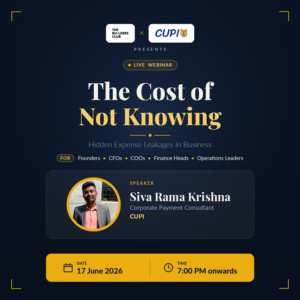
[WEBINAR] The Cost of not Knowing

The Cost of Not Knowing – Live Webinar | The Builders Club × CUPI The Builders Club × CUPI🦁 Presents Live Webinar The Cost ofNot Knowing Hidden Expense Leakages in Business Founders CFOs COOs Finance Heads Operations Leaders 📅 Date 17 June 2026 🕖 Time 7:00 PM onwards 💻 Format Online · Free Register for Free Seats are limited · 17 June · 7 PM IST About the Event Most businesses don’t lose money in big, obvious ways. They lose it in small, invisible leaks — duplicate subscriptions, untracked reimbursements, vendor overpayments, missed GST credits, petty cash that never reconciles. Individually they look like rounding errors. Added up over a year, they’re lakhs walking out the door. This session is about finding that money before it disappears. Speaker S Siva Rama Krishna Corporate Payment Consultant CUPI Siva works with growth-stage businesses to diagnose and close expense leakages — helping finance teams move from manual reconciliation to real-time spend visibility using UPI-native infrastructure. What You’ll Learn The most common places expense leakage hides in a growing business — and why finance teams routinely miss them How to read your own spend data to catch leaks early, before they compound A simple framework to put spend controls in place without slowing your team down The true cost of manual reimbursements and reconciliation, measured in both rupees and hours How modern UPI-based corporate payments close these gaps in real time Live Q&A with Siva to pressure-test your own numbers Who Should Attend Founders & Co-founders Who approve spends but don’t have full visibility into where the money actually goes. CFOs & Finance Heads Trying to tighten unit economics and extend runway. Finance & Accounts Managers Handling reimbursements, vendor payments, and reconciliation day-to-day. COOs & Operations Leaders Who own budgets across teams and need spend accountability. Scaling Leaders Any leader whose company is growing faster than the systems tracking its expenses. About CUPI CUPI 🦁 ISO 27001 Certified CUPI is a corporate expense-management platform built on UPI. Each employee gets a UPI-enabled app linked to the company’s current account, so they pay business expenses directly from a shared corporate wallet — no cards, no cash advances, no reimbursement cycles. Admins set per-user spend limits, track every transaction live, upload receipts on the spot, and get audit-ready, GAAP-aligned reports from a single dashboard. getcupi.com → Stop the leak.Start the session. 17 June 2026 · 7:00 PM IST · Free to attend Register for Free Organised by The Builders Club · thebuildersclub.me thebuildersclub.me  ·  getcupi.com  ·  All TBC Events

Read More »

Virtual Roundtable series

The Global Tech Roundtable: Where the World’s Tech & GTM Leaders Sit at One Table The Builders Club · Virtual Event Series The world’s most interesting conversations about technology rarely happen in one place — they happen across time zones, ecosystems and markets. The Global Tech Roundtable, The Builders Club’s flagship virtual event series, was built to close that gap: a single, open forum where CXOs and founders from the US, UK, Europe, Dubai and beyond come together to talk candidly about tech, go-to-market and the opportunities hiding inside every domain. Each session zooms in on one theme — a trend, a shift, or a market — and brings the people actually building inside it into the same room. No surface-level panels. Just real operators sharing what’s working, what’s changing, and where the next opening is. One Global Forum, Many Time Zones The premise is simple but rare to execute: get leaders from across the globe onto one common forum and let them think out loud together. Across editions we’ve hosted voices from the US, the UK, Europe, Dubai and India — each bringing the texture of their own market to a shared conversation. The result is a roundtable that feels less like a webinar and more like a working session between peers who happen to live on different continents. View this reel on Instagram Conversations on Tech & GTM Technology and go-to-market are two sides of the same growth story, and the series treats them that way. One conversation might unpack an emerging engineering trend; the next digs into how teams actually take a product to a new market. By keeping both threads in the room — the builders and the go-to-market leaders — the discussions stay grounded in how decisions really get made: from architecture to pipeline, from product to positioning. View this reel on Instagram Voices From Across the World A roundtable is only as good as the people around it. What makes this series distinct is the range of ecosystems represented in a single conversation — a leader scaling in the US, an operator navigating Europe’s regulatory landscape, a founder building out of Dubai, a CXO from the UK. Those different vantage points turn a familiar topic into a genuinely global one, surfacing perspectives you simply can’t get from a single-market discussion. View this reel on Instagram Trends, Signals & What’s Next Every edition is anchored to a theme that matters right now — the trends reshaping a domain, the signals worth watching, and the shifts leaders are quietly preparing for. Instead of recycled predictions, the value comes from people who are living the change and willing to say what they’re actually seeing on the ground. It’s a fast, honest read on where a domain is heading, straight from the operators steering it. View this post on Instagram Opportunities Inside Every Domain Trends are interesting; opportunities are actionable. A recurring thread across the series is turning “what’s happening” into “what can we do about it” — the white spaces opening up in a domain, the gaps incumbents are too slow to fill, and the moves that give challengers an edge. For founders and CXOs, these are the moments worth leaning into, mapped out by people who’ve already spotted them. View this post on Instagram A Launchpad for Market Expansion At its core, the Global Tech Roundtable exists to help businesses grow into new geographies. If you’re looking to expand into a new market, there’s no substitute for hearing directly from the CXOs who already operate there — what the ecosystem rewards, where the friction lives, and what a credible entry actually looks like. The series gives expansion-minded leaders a place to pressure-test their thinking before they commit budget and headcount. View this post on Instagram Direct Access to the Ecosystem’s CXOs Beyond the insight, the real currency is access. The roundtable puts founders and business leaders in front of CXOs from the ecosystems they want to enter — to share a thought, exchange perspective, understand what those markets need, and build the relationships that make expansion possible. It’s the kind of room where a single conversation can shorten months of trial and error. View this post on Instagram Pull Up a Chair The Global Tech Roundtable keeps growing because the format works: one domain, the right people, an open forum, and a global set of perspectives in every session. Whether you’re scaling a tech business, sharpening your go-to-market, or planning your next geography, there’s a seat for you at the table. View this post on Instagram Want to join the next Global Tech Roundtable? Connect with CXOs and founders from across the globe — explore the community.

Read More »