

// PODCAST

Startup Mistakes Founders Rarely Admit, Part 1: Fundraising and Ops | Jaineel Aga, Planet Superheroes

Jaineel Aga, co-founder and CEO of Planet Superheroes, candidly walks through the fundraising, operations and policy mistakes behind India's licensed character merchandise brand. A frank founder-to-founder session on what he would warn others about.
Jaineel Aga, Planet Superheroes on The Builders Club Startup Founders Podcast
Advertisement

Most founder stories are polished after the fact. In Part 1 of this two-part conversation, Jaineel Aga drops the polish and talks about the mistakes nobody posts about.

Jaineel is co-founder and CEO of Planet Superheroes, an omnichannel brand for licensed character merchandise in India. He covers a term sheet that evaporated, broken vendor software, thin brand loyalty and two policy shocks.

What startup mistakes do founders rarely talk about? Jaineel Aga’s honest list

Jaineel’s central message is that the costly mistakes are rarely strategy errors. They are usually about cash, trust and dependency: counting on money that is not yet in the bank, relying on vendors you have not tested, and building a business on assets you do not control.

He tags each story as either within the founder’s control or outside it, so listeners can separate lessons from bad luck. His advice is to be realistic about your own business model and your real differentiator.

  • Money in the bank is the only commitment. A verbal or soft commitment from an investor is not funding.
  • Reference-check your investors. Founders vet everyone else, but few speak to founders an investor has backed.
  • Test vendors before you sign. Insist on a sandbox that demonstrates every promised feature.
  • Know your real moat. Licensing alone did not give customers a reason to stay loyal to the brand.

What is Planet Superheroes and how did it start?

The idea began in 2013, when vertical e-commerce was heating up and Jaineel’s team wanted a niche community to serve. They noticed that Indian fans of global entertainment franchises had to rely on relatives abroad to get official merchandise.

They launched a scrappy Shopify site around 2014 from a small warehouse in Andheri, with a few imported products to test demand. Their differentiator was selling only authentic products and paying royalties to licensors, with no fakes.

Over roughly six and a half years, the company grew from an online store into an omnichannel business with 20-plus stores, marketplace presence and offline distribution. It also moved into co-manufacturing and product development.

Why is the licensing business so cash flow heavy?

Jaineel explains that licensing requires cash upfront: you pay minimum guarantees to secure a licence, then fund inventory, then sell. Unlike software, every incremental sale also means making another product.

He argues the model can become a moat if you can fund it, because not everyone can acquire licences. But unless the licences are exclusive, he says founders should think hard before entering the model.

  • Pay for the licence before you earn from it
  • Fund inventory after that
  • Complete the cash cycle only once the product sells

What should founders know about fundraising pitfalls?

His biggest fundraising lesson came from turning down a term sheet from investors who were ready, in favour of a higher valuation from another party. Weeks of detailed discussions followed, only for that party to walk away abruptly on a Saturday while the company’s bank balance was already negative.

The setback cost about nine months, and the team had to restart with angel networks. The original investors eventually came back on board.

He also described another corporate investor who took a detailed look at the business and then backed a competitor without telling him. His takeaway is to share what is needed, hold back sensitive margin data until deep due diligence, and be aware that this happens often.

How can founders vet investors?

Jaineel notes that investors run reference checks on founders, but founders rarely return the favour. He recommends speaking to at least three founders an investor has backed and asking for both pros and cons.

  • Take one-on-one calls, not public posts
  • Ask for honest pros and cons
  • Treat an investor on your cap table as a long-term relationship

Should you chase the highest valuation?

Not if it is soft. He says there is no such thing as a soft commitment, and survival matters more than a headline valuation that exists only in conversation.

How should founders evaluate vendors and software providers?

Operations at Planet Superheroes are complex, spanning design, factories, warehouse, marketplaces and stores. The team also built a true omnichannel set-up where a web order can be fulfilled from any store in the network based on proximity and stock levels.

Jaineel says vendor software repeatedly failed on basics. One warehouse system needed the team to explain GST calculations, and the company changed its operations stack several times before building the central logic in-house, with its own alerts for broken inventory sync.

His advice is to be suspicious of sales stories, particularly from other startups, and to test first.

  1. List the core functions you cannot do without
  2. Ask for a sandbox, even a paid one
  3. Do not sign until each promised feature works
  4. Keep the critical logic in-house if switching costs are high

Is a licence enough to build customer loyalty?

In the Q&A, Jaineel was blunt that customers rarely care whether a merchandiser pays royalties. They care about quality and price, and fakes sell widely for less. Authenticity matters more in categories like collectibles than in t-shirts.

He also said licensors in India have sometimes granted many narrow licences, which turns official products into commodities. After about seven years, he considers the brand’s own USP not strong enough and urges founders to build a brand customers choose by name.

Asked about creating original characters, he said it is a different business that takes a decade or more and needs a creator’s DNA.

  • Customers compare on quality and price
  • Exclusivity makes community plays possible
  • Building your own brand creates lasting ownership of the customer

How do policy changes and tax rules hit a young business?

He described the government’s steep rise in customs duty on imported toys and a requirement for Bureau of Indian Standards certification on imports, which he says hurt about a third of his business.

He also warned about GST: loss-making businesses that pay GST on expenses accumulate credits that sit unused, tying up cash. In his case it was around a crore of rupees.

He closes with receivables risk, citing distributor payments and an export order that never got paid. His point is to price in collection risk when margins are thin.

Further reading and sources

Frequently asked questions

Should founders accept a soft investor commitment?

Jaineel says no. He treats funding as real only when money is in the bank, because even signed paperwork can fall through. Keep other options alive until the funds arrive.

How do I check an investor before taking their money?

Speak one-on-one to at least three founders the investor has backed and ask for honest pros and cons. Jaineel says founders will usually be candid in private calls. This matters because an investor on your cap table stays for years.

How can I avoid buying faulty software for my startup?

Do not rely on demos. Write down your must-have functions and ask for a sandbox that proves each one before you sign. Jaineel’s team paid for sandbox access and refused to commit until promised features worked.

Conclusion

Jaineel Aga’s session is a reminder that resilience in a startup is mostly about cash discipline, vendor diligence and honesty about your differentiation.

Before your next raise or vendor contract, list what you are assuming, then verify each item. Part 2 continues the conversation.

Want more conversations like this? Join The Builders Club, our community of 35,000+ founders and CXOs, and explore more episodes of the Startup Founders Podcast.


Never miss an episode

Join 35,000+ founders and CXOs in The Builders Club community.

Join the Community
Advertisement
Advertisement
Facebook
X
LinkedIn

[WEBINAR] The Cost of not Knowing

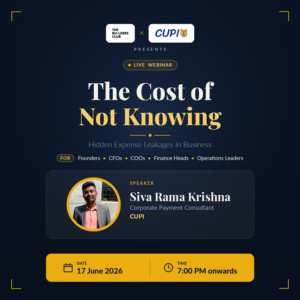
The Cost of Not Knowing – Live Webinar | The Builders Club × CUPI The Builders Club × CUPI🦁 Presents Live Webinar The Cost ofNot Knowing Hidden Expense Leakages in Business Founders CFOs COOs Finance Heads Operations Leaders 📅 Date 17 June 2026 🕖 Time 7:00 PM onwards 💻 Format Online · Free Register for Free Seats are limited · 17 June · 7 PM IST About the Event Most businesses don’t lose money in big, obvious ways. They lose it in small, invisible leaks — duplicate subscriptions, untracked reimbursements, vendor overpayments, missed GST credits, petty cash that never reconciles. Individually they look like rounding errors. Added up over a year, they’re lakhs walking out the door. This session is about finding that money before it disappears. Speaker S Siva Rama Krishna Corporate Payment Consultant CUPI Siva works with growth-stage businesses to diagnose and close expense leakages — helping finance teams move from manual reconciliation to real-time spend visibility using UPI-native infrastructure. What You’ll Learn The most common places expense leakage hides in a growing business — and why finance teams routinely miss them How to read your own spend data to catch leaks early, before they compound A simple framework to put spend controls in place without slowing your team down The true cost of manual reimbursements and reconciliation, measured in both rupees and hours How modern UPI-based corporate payments close these gaps in real time Live Q&A with Siva to pressure-test your own numbers Who Should Attend Founders & Co-founders Who approve spends but don’t have full visibility into where the money actually goes. CFOs & Finance Heads Trying to tighten unit economics and extend runway. Finance & Accounts Managers Handling reimbursements, vendor payments, and reconciliation day-to-day. COOs & Operations Leaders Who own budgets across teams and need spend accountability. Scaling Leaders Any leader whose company is growing faster than the systems tracking its expenses. About CUPI CUPI 🦁 ISO 27001 Certified CUPI is a corporate expense-management platform built on UPI. Each employee gets a UPI-enabled app linked to the company’s current account, so they pay business expenses directly from a shared corporate wallet — no cards, no cash advances, no reimbursement cycles. Admins set per-user spend limits, track every transaction live, upload receipts on the spot, and get audit-ready, GAAP-aligned reports from a single dashboard. getcupi.com → Stop the leak.Start the session. 17 June 2026 · 7:00 PM IST · Free to attend Register for Free Organised by The Builders Club · thebuildersclub.me thebuildersclub.me  ·  getcupi.com  ·  All TBC Events

Read More »

Virtual Roundtable series

The Global Tech Roundtable: Where the World’s Tech & GTM Leaders Sit at One Table The Builders Club · Virtual Event Series The world’s most interesting conversations about technology rarely happen in one place — they happen across time zones, ecosystems and markets. The Global Tech Roundtable, The Builders Club’s flagship virtual event series, was built to close that gap: a single, open forum where CXOs and founders from the US, UK, Europe, Dubai and beyond come together to talk candidly about tech, go-to-market and the opportunities hiding inside every domain. Each session zooms in on one theme — a trend, a shift, or a market — and brings the people actually building inside it into the same room. No surface-level panels. Just real operators sharing what’s working, what’s changing, and where the next opening is. One Global Forum, Many Time Zones The premise is simple but rare to execute: get leaders from across the globe onto one common forum and let them think out loud together. Across editions we’ve hosted voices from the US, the UK, Europe, Dubai and India — each bringing the texture of their own market to a shared conversation. The result is a roundtable that feels less like a webinar and more like a working session between peers who happen to live on different continents. View this reel on Instagram Conversations on Tech & GTM Technology and go-to-market are two sides of the same growth story, and the series treats them that way. One conversation might unpack an emerging engineering trend; the next digs into how teams actually take a product to a new market. By keeping both threads in the room — the builders and the go-to-market leaders — the discussions stay grounded in how decisions really get made: from architecture to pipeline, from product to positioning. View this reel on Instagram Voices From Across the World A roundtable is only as good as the people around it. What makes this series distinct is the range of ecosystems represented in a single conversation — a leader scaling in the US, an operator navigating Europe’s regulatory landscape, a founder building out of Dubai, a CXO from the UK. Those different vantage points turn a familiar topic into a genuinely global one, surfacing perspectives you simply can’t get from a single-market discussion. View this reel on Instagram Trends, Signals & What’s Next Every edition is anchored to a theme that matters right now — the trends reshaping a domain, the signals worth watching, and the shifts leaders are quietly preparing for. Instead of recycled predictions, the value comes from people who are living the change and willing to say what they’re actually seeing on the ground. It’s a fast, honest read on where a domain is heading, straight from the operators steering it. View this post on Instagram Opportunities Inside Every Domain Trends are interesting; opportunities are actionable. A recurring thread across the series is turning “what’s happening” into “what can we do about it” — the white spaces opening up in a domain, the gaps incumbents are too slow to fill, and the moves that give challengers an edge. For founders and CXOs, these are the moments worth leaning into, mapped out by people who’ve already spotted them. View this post on Instagram A Launchpad for Market Expansion At its core, the Global Tech Roundtable exists to help businesses grow into new geographies. If you’re looking to expand into a new market, there’s no substitute for hearing directly from the CXOs who already operate there — what the ecosystem rewards, where the friction lives, and what a credible entry actually looks like. The series gives expansion-minded leaders a place to pressure-test their thinking before they commit budget and headcount. View this post on Instagram Direct Access to the Ecosystem’s CXOs Beyond the insight, the real currency is access. The roundtable puts founders and business leaders in front of CXOs from the ecosystems they want to enter — to share a thought, exchange perspective, understand what those markets need, and build the relationships that make expansion possible. It’s the kind of room where a single conversation can shorten months of trial and error. View this post on Instagram Pull Up a Chair The Global Tech Roundtable keeps growing because the format works: one domain, the right people, an open forum, and a global set of perspectives in every session. Whether you’re scaling a tech business, sharpening your go-to-market, or planning your next geography, there’s a seat for you at the table. View this post on Instagram Want to join the next Global Tech Roundtable? Connect with CXOs and founders from across the globe — explore the community.

Read More »