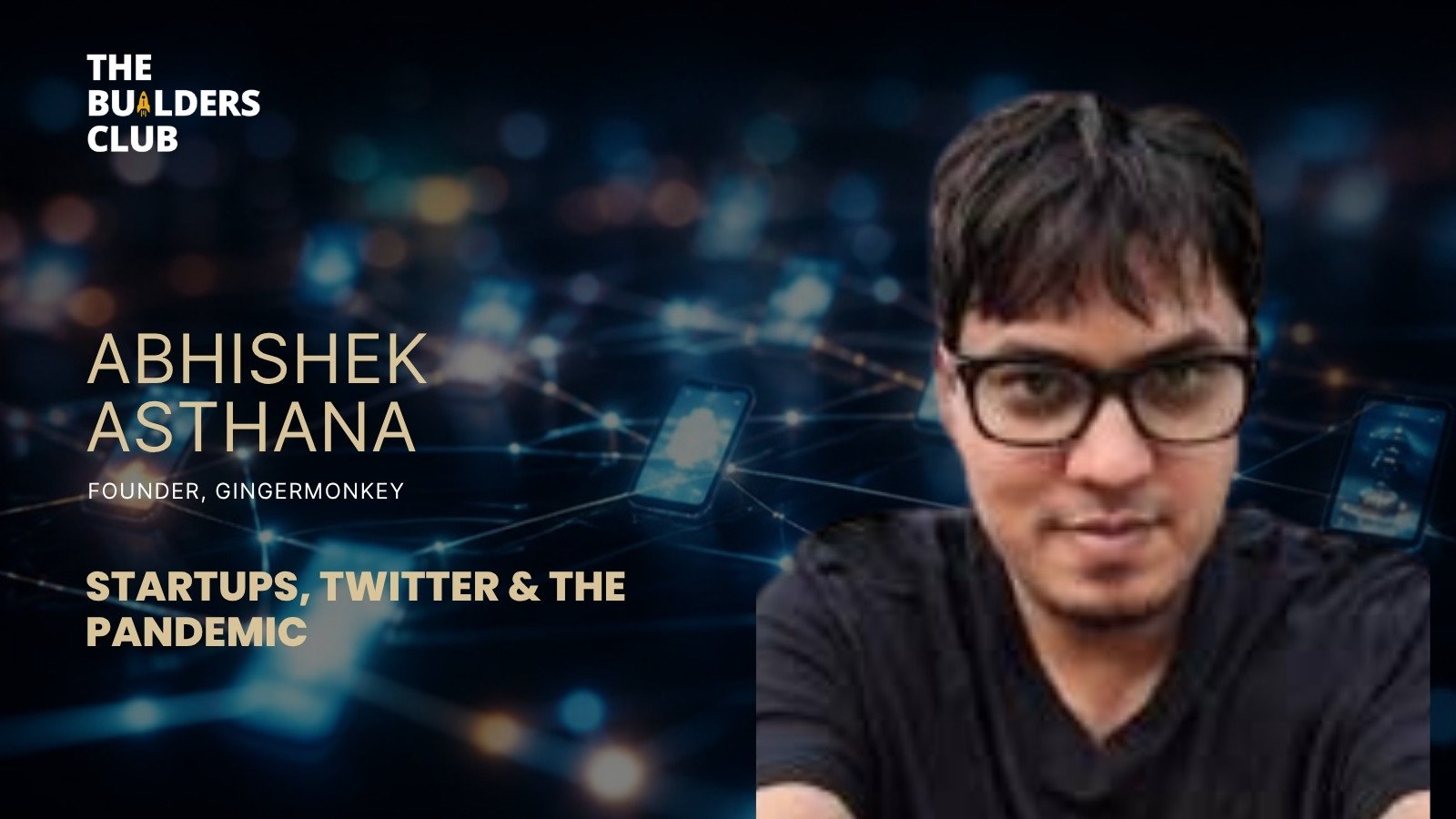
Bootstrapping a marketing agency sounds risky, and for Abhishek Asthana it felt even riskier: nobody in his family had ever been in business. Better known as @gabbbarsingh on Twitter, with around 1.3 million followers at the time, he is the founder of the marketing consultancy Ginger Monkey.
In this Water Cooler Conversation, recorded on The Builders Club Discord, he walks through how a former FMCG brand manager started with a token Rs 11,000 of share capital and built a client-funded, inbound-only agency.
How do you bootstrap a marketing agency with low risk?
Abhishek’s approach was to keep the downside small. He kept his personal risk appetite low, put in only Rs 11,000 as share capital, hired almost nobody at first, and let results with early clients bring in the next ones through word of mouth.
He says Ginger Monkey went public with its website on 26 May 2020, grew to 20-plus clients, and stayed fully bootstrapped, with a runway of about two and a half years at the time. He is clear that services businesses scale with people, so growth is slower than a product business.
- Start tiny. A token amount of capital and a very small team kept the risk low.
- Let work do the selling. Early clients referred him onward, so growth was entirely inbound.
- Protect the team. A deliberately low burn rate and a long runway meant staff felt secure.
- Use Twitter as a long game. Ten years of presence built trust and reach that later helped the business.
How did a Durex brand manager become an agency founder?
Abhishek followed the classic path of an engineer, then an MBA, then FMCG brand management. On Durex India, television advertising for condoms was restricted to a late-night window, so budgets often could not be spent and the team turned to digital.
Moment marketing and social work from that period earned media coverage and awards, and he says secondary sales moved as well. That gave him proof that digital could shift sales, plus an in-house agency-style experience, which pushed him to start his own firm.
What does a lean services-business launch look like?
He describes a gradual, low-cost start rather than a leap.
- Keep an income source, in his case a corporate role and a Twitter following, as a safety net.
- Put in a minimal amount of capital (Rs 11,000 of share capital).
- Win a first client with a one-person helper, deliver well, and let referrals follow.
- Stay in stealth mode until the work is strong enough to show, then launch the website.
Does he plan to raise funding?
He had received investor interest but did not feel he needed capital, and he describes the firm as well capitalised. He adds that he would never say never if a new expansion required it.
Why does Twitter matter for brands and founders?
Abhishek is candid that Twitter has a limited user base, and many of his clients prefer Instagram, Facebook or YouTube for reach. His argument is about second-order reach: people active on Twitter tend to be local opinion leaders who inform others in their circle.
He also likes how replies get equal visual weight to the original post, which encourages people to read the conversation. On Instagram, he says, people mostly scroll past the comments.
- Instagram works as an escape, like movies, and is the easiest place to reach large audiences.
- Twitter attracts investors and journalists, so startups use it to share funding news and launches.
- LinkedIn is better suited to attracting talent through culture stories.
How should a public voice handle responsibility and sponsored content?
His one filter is to stay true to himself and be fair. He says he does not take himself too seriously, and treats Twitter as a hobby and stress buster rather than a job.
On paid promotion, he says anything sponsored carries a clear hashtag, so no hashtag means no promotion. His reasoning is that creators are supported by either subscriptions or ad revenue, and that a hobby that is never monetised tends to die.
What advice does he give aspiring founders and exam takers?
Abhishek warns against survivorship bias. You hear about the person who quit a job to crack an exam or start a company, but not the many who did not. He suggests looking at your own set of variables rather than copying someone else’s path.
He also cautions against over-reading self-help books, which can leave you with competing anecdotes instead of clear thinking. On big-brand entry to India, he says the key is deciding whether you compete on value or on status, and then solving practical issues such as service and charging infrastructure.
How does he build team trust in a small agency?
He keeps burn low and cash high so people feel secure. He told his team that even if revenue dropped to zero, salaries could be paid for roughly two and a half years.
He reported zero attrition at that point and said inbound interest from business schools to join the firm was strong. Remote work, he adds, also lets him meet several clients in a day.
Further reading and sources
Frequently asked questions
How much money do you need to start a marketing agency?
It depends on the model, but Abhishek Asthana started Ginger Monkey with only Rs 11,000 in share capital and a very small team. He relied on early client revenue and referrals rather than outside funding.
Is Twitter useful for B2B and agency lead generation?
Abhishek says Twitter has limited reach compared to other platforms, but its users are often local opinion leaders and investors. His own inbound leads came largely through word of mouth built on long-term presence and good work.
Should I quit my job to prepare for an exam or start a business?
He advises against quitting simply for exam preparation, citing pressure and survivorship bias. For a business, he suggests keeping a safety net such as an alternative income source until it matches or exceeds your salary.
Conclusion
Abhishek Asthana’s story is a case for small, safe starts: minimal capital, great early work and referrals, and a team that trusts you. Treat inspiring stories as data points, not templates.
If you are planning a services business, define your safety net and your first client before you quit.
Want more conversations like this? Join The Builders Club, our community of 35,000+ founders and CXOs, and explore more episodes of the Startup Founders Podcast.