// ARTICLE

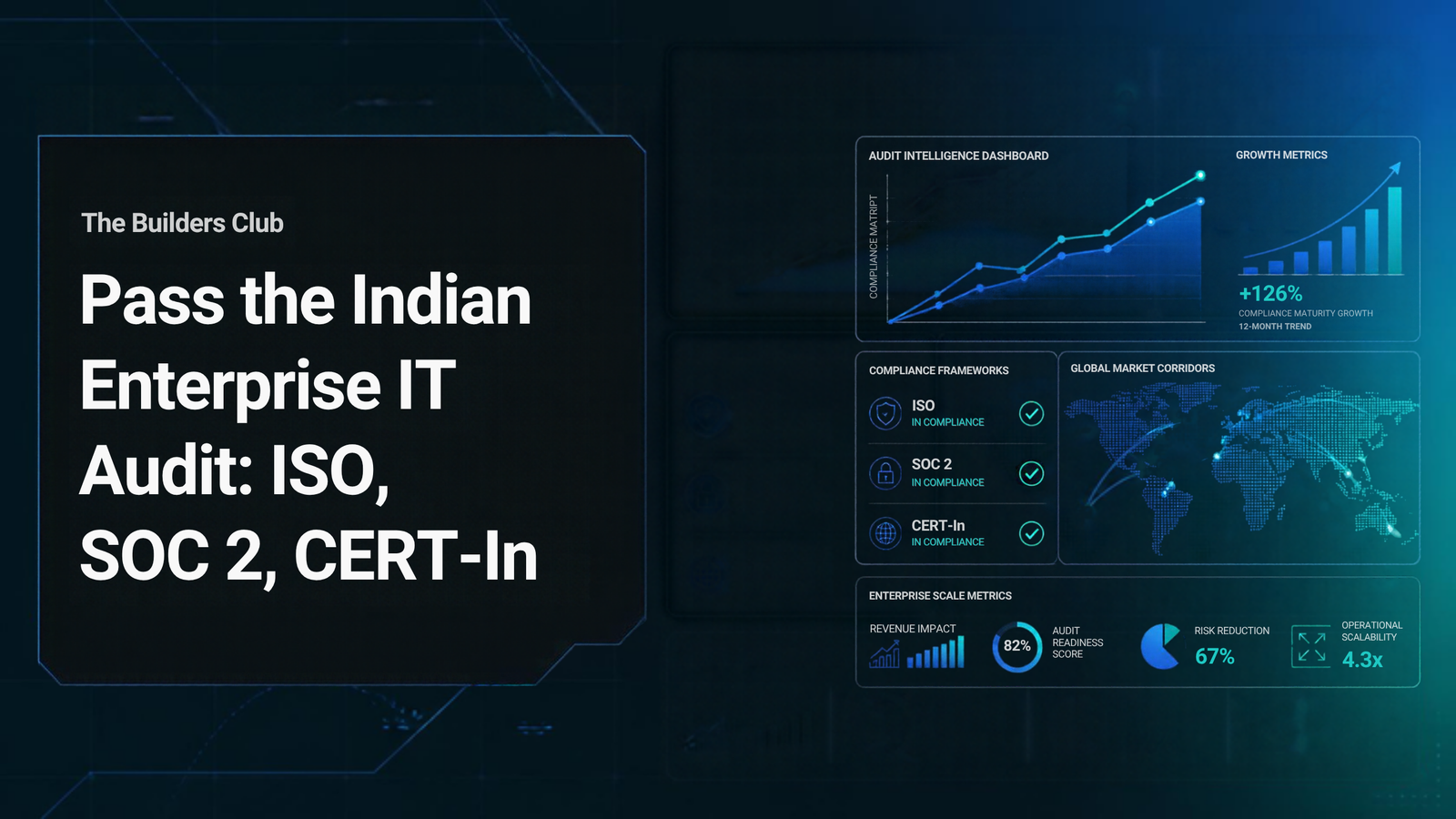
Why Most Startups Fail Indian Enterprise IT Audits: The ISO, SOC 2 and CERT-In Checklist to Pass

Which security certifications Indian enterprises expect from software vendors: ISO 27001, SOC 2, VAPT, CERT-In directions and DPDP readiness, in a practical order.
Passing an Indian enterprise IT audit: ISO, SOC 2 and CERT-In checklist
Advertisement

You win the business champion, the pilot goes well, and then the deal lands on the desk of the information security team. The questionnaire has 200 questions, and the first one asks for your ISO certificate.

For many Indian startups, the IT audit is where promising enterprise deals go to wait.

What is the short answer on security certifications for Indian enterprise buyers?

There is no single mandatory certificate. In practice, most large buyers expect ISO/IEC 27001 or a SOC 2 report, a recent independent penetration test, compliance with CERT-In directions on incident reporting and logging, and a clear position on personal data under India’s DPDP Act. Regulated sectors add their own requirements on top. Start with ISO 27001 and a VAPT, then add SOC 2 if you also sell to US buyers.

Which certifications do Indian corporate IT teams actually ask for?

Item What it shows How commonly asked
ISO/IEC 27001 An audited information security management system Very common for Indian enterprises
SOC 2 Type II Independent report on controls over a period, from the AICPA framework Common where buyers or investors are global
VAPT report Penetration test and vulnerability assessment of your application and infrastructure Almost universal; many buyers prefer a CERT-In empanelled auditor
CERT-In compliance Incident reporting, log retention and time-sync practices Increasingly asked in questionnaires
DPDP readiness Handling of personal data under India’s data protection law Rising quickly as the rules phase in
Sector rules RBI, SEBI or IRDAI requirements for banks, brokers and insurers Mandatory for regulated buyers

Which items are mandatory depends on the buyer and their regulator. Confirm the exact list with each customer’s security team instead of assuming.

What does CERT-In expect from you?

The CERT-In directions of April 2022 apply broadly to service providers, intermediaries, data centres and bodies corporate. The points that most often appear in vendor questionnaires are:

  • Incident reporting: specified cyber incidents must be reported to CERT-In within six hours of noticing them.
  • Log retention: logs of ICT systems must be maintained for a rolling 180 days and be available to CERT-In on request, with a copy held within India.
  • Clock synchronisation: system clocks should sync to the NTP services of NIC or NPL.
  • Point of contact: you must designate and share a contact for incident coordination.

Read the summary of the directions from ManageEngine for a practical overview, and the primary text on the CERT-In site for the authoritative wording.

How does the DPDP Act affect your audit readiness?

The Digital Personal Data Protection Rules were notified on 13 November 2025 and are being phased in. Key obligations around notice, consent, security safeguards and breach intimation are scheduled to apply from 13 May 2027, according to a legal summary of the rules. The Act places obligations mainly on the data fiduciary, so your enterprise customer will push duties down to you through the data processing agreement.

Prepare now: know what personal data you process, where it sits, who can access it and how you would notify a customer of a breach.

What is a sensible order to get certified?

  1. Baseline hygiene (weeks 1 to 4): single sign-on and MFA, role-based access, encryption in transit and at rest, backups, logging, vendor list.
  2. Policies and evidence (months 1 to 3): information security policy, access reviews, incident response plan, change management, employee training records.
  3. Penetration test: commission a VAPT, fix critical findings and retain the report with the remediation evidence.
  4. ISO 27001 audit: typically a multi-month effort including internal audit and certification audit stages.
  5. SOC 2: add when customers or investors ask for it. A Type II report needs an observation period, so plan for it early.

Timelines depend on company size and existing maturity. Use compliance automation tools if they help, but remember that an auditor will still ask for real evidence of real practice.

How do you handle the security questionnaire itself?

  • Keep a master answer library so every questionnaire starts from approved responses.
  • Prepare a security pack: certificates, pen test summary, architecture diagram, data flow diagram, sub-processor list and DR plan.
  • Offer a call with your security lead early. A clear conversation often shortens a written review.
  • Be accurate. Overclaiming a control that an auditor later cannot verify can end the deal and the relationship.

Frequently Asked Questions

Is ISO 27001 mandatory to sell software to Indian enterprises?

It is not a legal requirement in general, but many large buyers ask for it as part of vendor onboarding. Where you lack it, some buyers accept a detailed questionnaire, a penetration test and a remediation roadmap, though this usually lengthens the review.

Do I need both ISO 27001 and SOC 2?

Not necessarily. For a company selling mainly to Indian enterprises, ISO 27001 typically carries more weight. If you also sell to US customers or work with global investors, a SOC 2 report is commonly requested, and the overlap between the two frameworks reduces the extra effort.

What does CERT-In require from a SaaS vendor?

The 2022 directions require reporting specified incidents within six hours, keeping ICT logs for 180 days with a copy available in India, synchronising clocks to NIC or NPL time sources and nominating a point of contact. Check the current text and your specific obligations with legal counsel.

Conclusion

Passing an Indian corporate IT audit is a matter of preparation, not luck. Build the basics early, get an independent VAPT and ISO 27001, track CERT-In and DPDP obligations, and keep a ready security pack. Doing this before you need it turns the audit from a six-month delay into a routine step.

This article is general information, not legal or compliance advice. Confirm requirements with your counsel and each customer’s security team.

If you are building a B2B company for Indian enterprise buyers, join The Builders Club community to compare notes with other founders and CXOs who are working through the same problems.

About the author: Sohail Khan is the Founder and Director of The Builders Club, a professional community of 35,000+ founders and CXOs across India, the UAE, Singapore and the US. He writes about enterprise go-to-market, sales and scaling for B2B founders.

Advertisement
Advertisement
Facebook
X
LinkedIn
Land and Expand: Western Tech vs. Tier-1 Indian Enterprises

Dissecting the ‘Land and Expand’ Thesis: Upsell Velocities Inside Western Tech Companies vs. Tier-1 Indian Enterprises

Land and expand works in both markets, but the engine is different. In Western tech companies, expansion follows usage and seat growth. In Tier-1 Indian enterprises, expansion follows trust and new approvals. Forecasting both with the same upsell curve will overstate one and understate the other. This post explains the mechanics so you can plan a realistic expansion path. What is the land and expand model? Land and expand means winning a small initial deal, proving value, then growing contract value through more users, modules or business units. Its success is measured by net revenue retention, discussed in McKinsey’s research on NRR in B2B tech. Note: public benchmarks on upsell velocity by geography are scarce. Treat the comparisons below as structural patterns and use your own cohort data. How does expansion happen inside Western tech companies? Usage-triggered growth. Teams add seats or tiers as adoption spreads. Budgets are often held by team leads. Self-serve upgrades. Smaller expansions may not need a new procurement cycle. Faster internal referrals. Peer teams within the same company often adopt tools they see colleagues using. How does expansion happen inside Tier-1 Indian enterprises? Approval-triggered growth. Each new business unit may need its own sponsor, budget and sometimes a fresh security review. Relationship-led referrals. A senior leader introducing you to another division is worth more than usage data alone. Group-level frameworks. Once you are an approved group vendor, onboarding additional entities can become faster, which is where the expansion curve steepens. Lumpy rather than linear. Expansion often arrives as a step change after a successful quarter or leadership review. Expansion velocity compared: Western tech vs Tier-1 Indian enterprises Factor Western tech company Tier-1 Indian enterprise Expansion trigger Usage and seat growth New sponsor, new division, new approval Early pace Faster, often incremental Slower, often step-wise Long-run potential Capped by company size and seat count Can be large across group entities Main accelerator Product adoption Executive sponsorship and group vendor approval Main risk Downgrades and consolidation Stalled approvals between divisions How do you build an expansion plan that fits the market? Define the expansion map at landing. List every division, entity and use case that could adopt the product. Turn the first win into a reference. A short, approved case study is portable across divisions. Get group-level approval where possible. A master agreement or empanelment can shorten later onboarding. Assign an expansion owner. Do not leave growth to support staff. Forecast in stages. Model Indian expansion as step changes tied to approvals, not as a smooth monthly curve. When should you stop investing in an account? If, after two quarters, you still have only one sponsor, no group-level visibility and no referral, expansion is unlikely. Shift effort to accounts with multiple advocates. FAQ What is land and expand in enterprise SaaS? It is a model where a vendor wins a small first contract, proves value and then grows revenue through more users, modules or business units. Success is measured by net revenue retention. Is land and expand slower in India? Early expansion is often slower because each division may need separate approvals, but it can accelerate sharply once you are an approved group vendor with senior sponsors. How do I plan an upsell forecast for Indian enterprises? Model expansion as step changes linked to specific approvals, new divisions and executive reviews. Use your own historical cohorts rather than a generic monthly growth rate. Conclusion Land and expand is a durable strategy in both markets, but the triggers differ. Western accounts grow with adoption. Indian enterprise accounts grow with trust and approvals. Plan the expansion map before you land, and forecast in steps. Want to learn how other founders expanded across Indian business groups? Join The Builders Club. References and further reading McKinsey: The net revenue retention advantage in B2B tech Harvard Business Review: The risks of prioritising short-term revenue over customer fit Harvard Business Review: Winning the right customers isn’t just a sales issue Gartner: The B2B buying journey and how to optimise it NASSCOM-Frost: Enterprise digital transformation About the author: Sohail Khan is Founder and Director of The Builders Club, a professional community of 35,000+ founders and CXOs across India, UAE, Singapore and the US.

Read More »

The Paid Pilot Showdown: Do Proof-of-Concepts Convert Better in Western Markets or Indian Enterprises?

A paid pilot is not a free trial with an invoice. It is a commercial test with a pre-agreed definition of success. In many Western markets, buyers are used to paying for pilots and expect a go or no-go decision at the end. In many Indian enterprises, pilots are still run as free evaluations that drift for months with no clear path to a contract. Here is how the two approaches differ, why conversion rates are hard to compare, and how to run a pilot that actually ends in a signature. What is a paid pilot, and how is it different from a PoC? A proof of concept (PoC) tests whether something is technically possible. A paid pilot tests whether it creates business value in a real environment, with real users, under a commercial agreement. The word “paid” matters because payment forces a budget owner, a scope and a decision date. Without those, a pilot becomes a long free service. Note: there is no reliable public dataset comparing PoC-to-contract rates between Western and Indian enterprises. The patterns below come from how buying processes typically work, so measure your own conversion rate and treat it as your benchmark. How do pilots typically run in Western markets? Budget exists for experimentation. Innovation or departmental budgets often fund pilots, so charging a fee is accepted. Success criteria are written down. Metrics, timelines and the decision-maker are agreed before kickoff. Procurement has a pilot template. Many large buyers have standard pilot or evaluation agreements, which shortens legal time. Outcome is a decision. Convert, extend with conditions, or stop. How do pilots typically run in Indian enterprises? Free evaluation is the default expectation. Teams often ask vendors to prove value before any money moves. Sponsor is clear, budget is not. The business head may love the pilot, while the commercial approval sits elsewhere. Scope expands quietly. Extra integrations, extra users and extra reports get added without changing the commercial terms. Timeline is relationship-led. Decisions follow internal bandwidth, leadership changes and budget cycles, not just pilot results. Western vs Indian pilots: where do conversion rates diverge? Dimension Typical Western enterprise Typical Indian enterprise Pilot fee Commonly accepted Often resisted; may be credited against the contract Success criteria Documented up front Often verbal or evolving Decision owner Named budget holder Sponsor plus a wider approval chain Main failure mode Pilot succeeds but loses to priorities Pilot drags on without a decision Best protection Clear exit criteria Commercial conversion terms signed first The key insight is that conversion depends less on market and more on pilot design. A well-structured pilot in either country converts better than a loose one. How do you design a pilot that converts in India? Agree on the business problem, not the feature list. Write the one metric the sponsor will defend internally. Set a fixed duration. Typically 4 to 12 weeks, depending on integration depth. Put an end date in writing. Charge something. If a full fee is not possible, charge a partial fee that is credited against the first-year contract. Even a nominal commitment signals seriousness. Pre-agree the conversion path. State the commercial terms that apply if success criteria are met, so the next step is a signature rather than a new negotiation. Name every approver early. Identify IT, security, finance and procurement stakeholders while the pilot is running, not after. Hold a formal readout. Present results to the sponsor and the decision-maker together, with a clear recommendation. What are red flags that a pilot will not convert? No budget owner has attended a single meeting. The success metric keeps changing. Requests for new features appear mid-pilot with no change in scope or fees. The sponsor cannot name the next approval step. FAQ Should Indian startups charge for pilots? Wherever possible, yes, even partially. A paid or credited pilot filters out casual evaluations and pushes the buyer to identify a budget and a decision-maker. If a fee is impossible, require a signed pilot agreement with success criteria and a conversion clause. How long should an enterprise pilot last? Most pilots work best between 4 and 12 weeks, based on integration complexity. Longer pilots often lose momentum. Set a fixed end date and a decision meeting in the calendar before you start. What is a good PoC-to-contract conversion rate? There is no universal benchmark. Track your own rate across your first 10 pilots, split by whether they were paid, credited or free. That internal comparison is more useful than any generic industry figure. Conclusion Pilots convert when they are designed as commercial decisions. Define success in writing, attach a fee or credit, fix the timeline, and agree on the conversion path before the first login. Do that, and the Western-versus-Indian gap narrows considerably. Want pilot templates and peer advice? Join The Builders Club to learn how founders structure pilots with large enterprises. Join the community. About the author: Sohail Khan is Founder and Director of The Builders Club, a professional community of 35,000+ founders and CXOs across India, UAE, Singapore and the US.

Read More »