
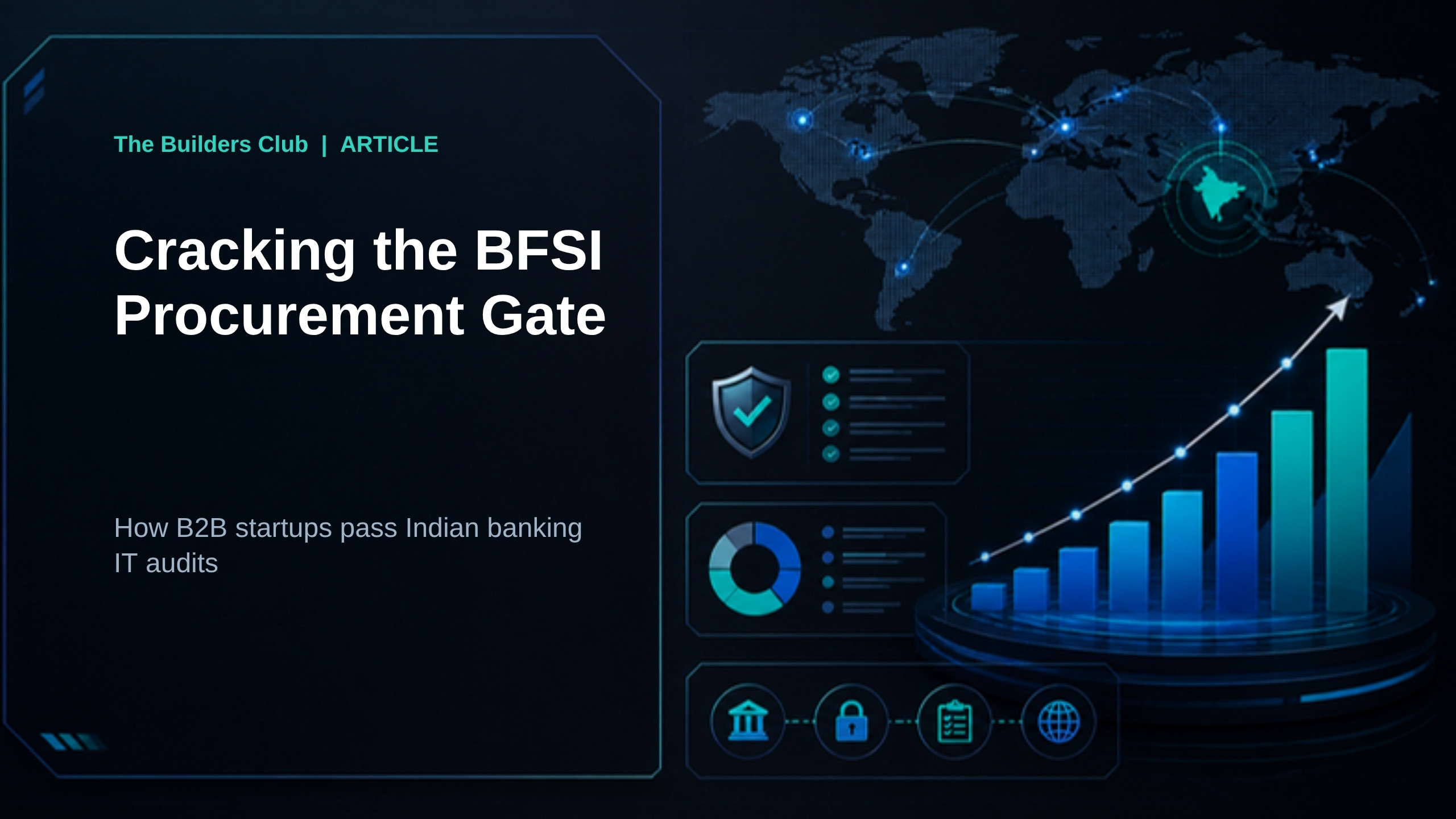
Banks, financial services firms and insurers are the most attractive and most demanding buyers in Indian B2B. They pay well and they stay for years. But a startup that walks in without audit-ready answers can lose six months in a vendor risk queue.
The short answer: BFSI procurement in India is a regulator-shaped process. Buyers must prove they control third-party risk, so they audit vendors on security, outsourcing controls, data location, business continuity and exit. Startups that prepare evidence mapped to those themes pass faster.
This is a general guide, not legal or compliance advice. Each institution sets its own requirements, so confirm them with the buyer.
Why is BFSI procurement harder than other sectors?
Regulated institutions answer to supervisors such as the Reserve Bank of India, SEBI and IRDAI. Those rules on outsourcing, technology risk and cyber resilience flow down to vendors through contracts and audits. The buyer cannot waive them, so the vendor must meet them.
What does a BFSI IT audit actually examine?
Expect a vendor due-diligence process that covers governance, security, resilience and exit. The audit team will ask for evidence, not assurances.
| Audit area | What reviewers ask | Evidence to prepare |
|---|---|---|
| Information security | Policies, access control, encryption, vulnerability management | ISO/IEC 27001 or SOC 2 report, security policies |
| Application security | Secure development and testing | Recent VAPT report with closure evidence |
| Data location and privacy | Where data sits and who can access it | Data-flow diagram, residency statement, DPA |
| Business continuity | Recovery objectives and tests | BCP and DR plan, test results |
| Incident response | Detection, reporting and cooperation | Incident plan, contact matrix |
| Third-party risk | Your sub-processors and subcontractors | Sub-processor list and controls |
| Exit and audit rights | Ability to audit you and leave cleanly | Audit clause, data return and transition plan |
How do you prepare an audit-ready pack step by step?
Build one pack once and refresh it every quarter. Assign an owner for each area and keep evidence dated. Reviewers trust current, specific documents.
- Complete a gap assessment against ISO/IEC 27001 or SOC 2 controls.
- Commission a VAPT by a qualified provider and fix high-severity findings before sharing the report.
- Document data flows, hosting regions and sub-processors.
- Write and test a business continuity and disaster recovery plan.
- Prepare an incident response plan with named contacts and notification timelines.
- Draft audit-rights and exit clauses you can accept in a contract.
What do regulated buyers expect on cyber resilience?
Buyers increasingly expect vendors to support their own regulatory frameworks, such as SEBI’s Cybersecurity and Cyber Resilience Framework for market entities. Even where a framework does not apply to you directly, you may be asked to show comparable controls. Map your controls to the buyer’s framework in a simple table.
How do you handle audit rights and on-site visits?
Accept reasonable audit rights, with notice, scope and confidentiality rules. Offer a standard audit process, such as remote evidence review followed by a limited on-site or virtual walkthrough. Flat refusal usually ends the conversation.
What mistakes make startups fail BFSI audits?
Most failures come from missing evidence, outdated reports and inconsistent answers. They rarely come from lack of effort.
- Claiming certifications that are in progress as if complete
- Submitting a VAPT report with unresolved critical issues
- Leaving sub-processors off the list
- Not testing disaster recovery
- Sending different answers to security, legal and procurement
Frequently Asked Questions
Do Indian banks require ISO 27001 or SOC 2 from vendors?
Many do, or they ask for equivalent evidence. If you are not certified yet, offer a detailed control mapping, a recent penetration test and a clear certification timeline.
How long does a BFSI vendor audit take?
It varies by institution and risk rating, often several weeks to a few months. Having an audit-ready evidence pack and a named internal owner shortens the cycle.
Can a startup sell to banks without a long track record?
Yes, but the risk review will focus on your controls, financial stability and continuity plans. Strong evidence, reference customers and a phased pilot with limited data help offset a short track record.
Conclusion
The BFSI gate rewards preparation. Understand that regulators shape the buyer’s questions, build one evidence pack covering security, data, continuity, third parties and exit, and keep it current. A startup that treats the audit as a product feature wins trust that lasts for years.
Next step: Selling to banks and insurers? Meet founders and CXOs who have been through it at thebuildersclub.me.
References and Further Reading
- Draft Master Direction on Outsourcing of IT Services, Reserve Bank of India
- Master Directions, Reserve Bank of India
- Cybersecurity and Cyber Resilience Framework by SEBI: A Step Towards Digital Safety, Bar & Bench
- Navigating India’s Cybersecurity Guidance for Finance Organizations, Sonatype
- CERT-In, Indian Computer Emergency Response Team