
Ask any Indian CIO where the next rupee of technology budget will go and the answer is rarely “more of the same”. Data, AI, cloud and security are all fighting for capital at once, while compliance obligations keep growing.
We compiled the published budget research from Gartner, Bain, PwC, GlobalData and Capterra to show where Indian enterprise IT money is going. One limit up front: no public source breaks budgets down by individual corporate group, so this is an enterprise-wide view.
Where are Indian enterprises allocating IT capital in 2026?
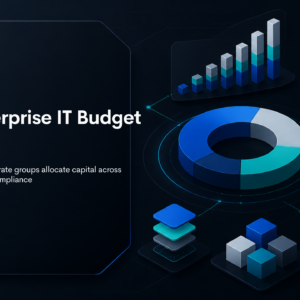
Into modernisation, all at once. Bain’s survey of more than 250 Indian CIOs and CXOs found capex runs at 50 to 60 percent of IT budgets, against 20 to 30 percent for global peers. Of that capex, about 30 percent goes to data modernisation and AI, 25 percent to core application modernisation, 25 percent to cloud and infrastructure, and 20 percent to cybersecurity. Gartner expects total Indian IT spending of $176.3 billion in 2026, up 10.6 percent.
Key findings at a glance
| Metric | Figure | Source and scope |
|---|---|---|
| India IT spending, 2026 | $176.3 billion, up 10.6% | Gartner forecast |
| Software spending, 2026 | $24.7 billion, up 17.6% | Gartner |
| Data center systems, 2026 | $9.4 billion, up 20.5% (29.2% in 2025) | Gartner |
| Information security spending, 2026 | $3.4 billion, up 11.7% | Gartner |
| IT budget growth, 2026 | 6% to 8%, 200–250 bps above global peers | Bain India Enterprise Technology Report 2026, 250+ CIOs, CDOs and CXOs |
| Capex share of IT budgets | 50% to 60% (global peers 20% to 30%) | Bain |
| Capex split | Data and AI 30%, core apps 25%, cloud and infra 25%, cybersecurity 20% | Bain |
| Executives expecting higher cyber budgets | 93%; 17% plan rises of 15% or more | PwC India (via Telecom Lead) |
How was this report compiled, and how should you read it?
This is a secondary research compilation, completed in October 2026, with no primary survey. Gartner figures are forecasts built on vendor sales data. Bain and PwC figures come from executive surveys and may reflect stated intent more than actual spend. Capterra surveyed businesses of all sizes, not only large corporates.
Two limits matter. First, none of the sources reports spend by named conglomerate. Second, compliance spend is not reported as a separate line, so we use security spending and survey data as the closest proxies.
Which IT segments are growing fastest?
Data centre systems and software. Gartner’s table shows data centre systems growing 20.5 percent in 2026 on AI infrastructure and sovereign cloud demand, and software growing 17.6 percent as enterprises buy AI-enabled applications. Devices remain the largest block of spend but grow more slowly.
| Segment | 2026 spend | Growth | Share of total (our calculation) |
|---|---|---|---|
| Devices | $66.4 billion | 9.9% | 37.7% |
| Communications services | $40.4 billion | 5.4% | 22.9% |
| Software | $24.7 billion | 17.6% | 14.0% |
| Data center systems | $9.4 billion | 20.5% | 5.3% |
| IT services | Not itemised in the release | 11.1% | n/a |
Shares are our arithmetic on Gartner’s figures against the $176.3 billion total. Gartner also expects IT services growth of 12 to 14 percent a year over the next few years.
How much capital is going to infrastructure?
A large share of the change in spending. Bain reports that data modernisation and AI account for more than 40 percent of the change in spending, and about a quarter of capex each goes to cloud and infrastructure and to core application modernisation. Gartner links data centre growth to AI infrastructure and to data privacy and sovereign cloud requirements.
GlobalData adds the macro view: it expects Indian enterprise ICT to grow at a 15.5 percent CAGR through 2030, and found 92.3 percent of enterprise ICT decision-makers raised their ICT budgets in 2026.
What does a typical budget split look like in rupee terms?
As an illustration only, using Bain’s percentages and our assumptions, take a ₹100 crore annual IT budget with capex at 55 percent. That is ₹55 crore of capex, which splits into about ₹16.5 crore for data and AI, ₹13.75 crore for core application modernisation, ₹13.75 crore for cloud and infrastructure, and ₹11 crore for cybersecurity.
How much is going to compliance and security?
Gartner puts Indian information security spending at $3.4 billion in 2026, about 1.9 percent of total IT spending by our calculation. Security software is the largest and fastest-growing segment at 12.4 percent growth, and managed security services are the fastest-growing sub-segment at 15.1 percent. Gartner links the growth to AI-driven threats and to the Digital Personal Data Protection (DPDP) Act.
- PwC India research found 93 percent of Indian executives expect higher cyber budgets, and every executive surveyed said regulatory mandates had pushed them to strengthen security.
- 86 percent of organisations in the same research had increased spending on AI governance.
- The DPDP Rules were notified on 14 November 2025, turning the Act into day-to-day operational requirements.
- Capterra’s India survey found IT security the top software investment priority at 44 percent, ahead of AI at 42 percent.
Is the spending delivering value?
Not yet, according to the people holding the budgets. Bain found only 15 percent of business leaders see IT as truly strategic, 70 percent see it as good but not great, three in four cite misalignment between business and IT goals, and about 90 percent say data foundations are too weak to scale. Leaders also described fatigue with proofs of concept that delivered little measurable return.
Bain’s warning is the sharpest line in the research: without a change in operating model, today’s surge risks creating the legacy technology of tomorrow.
What should vendors take from this budget data?
- Pitch to funded lines. If your product maps to data and AI, application modernisation, cloud or security, you are asking for money already earmarked.
- Lead with compliance in regulated accounts. Security and DPDP obligations are budget catalysts, not afterthoughts.
- Expect scrutiny on value. With PoC fatigue widespread, propose paid pilots with measurable outcomes.
- Plan for capex timing. With capex at more than half of IT budgets, approvals follow annual planning cycles.
What are the gaps in the data?
We found no group-level budget disclosure, no separate compliance budget line and no vertical split of capex. Bain’s survey is its first edition, so there is no trend line yet.
Sources
- Gartner: India IT spending forecast 2026
- Gartner: information security spending in India 2026
- Bain: India Enterprise Technology Report 2026
- PwC India cybersecurity survey (Telecom Lead)
- Odgers: regulation is driving cyber spend in India
- GlobalData: India enterprise ICT forecast
- Capterra India: 2025 Tech Trends Report
Frequently Asked Questions
Where are Indian enterprises putting their IT capex?
Bain’s survey of more than 250 Indian CIOs and CXOs found about 30 percent of capex goes to data modernisation and AI, 25 percent to core application modernisation, 25 percent to cloud and infrastructure and 20 percent to cybersecurity. Capex itself is 50 to 60 percent of IT budgets, against 20 to 30 percent globally.
How much do Indian enterprises spend on cybersecurity and compliance?
Gartner forecasts $3.4 billion of information security spending in India in 2026, up 11.7 percent, which is about 1.9 percent of total IT spending. No public source reports compliance as a separate budget line, but PwC India found 93 percent of executives expect higher cyber budgets.
Which IT segment is growing fastest in India?
Data centre systems, which Gartner expects to grow 20.5 percent in 2026, followed by software at 17.6 percent. AI infrastructure and sovereign cloud and data privacy requirements are driving the data centre growth.
Conclusion
Indian enterprises are modernising the entire stack at once, with capex above half of IT budgets and security, data, AI and cloud competing for it. Budgets are growing, but leaders say returns are unproven and data foundations are weak. Vendors that map to a funded line, lead with compliance where it applies and prove value early will find the money; the rest will compete for what is left.
Want more benchmarks and playbooks like this? Join The Builders Club, a community of 35,000+ founders and CXOs across India, the UAE, Singapore and the US.