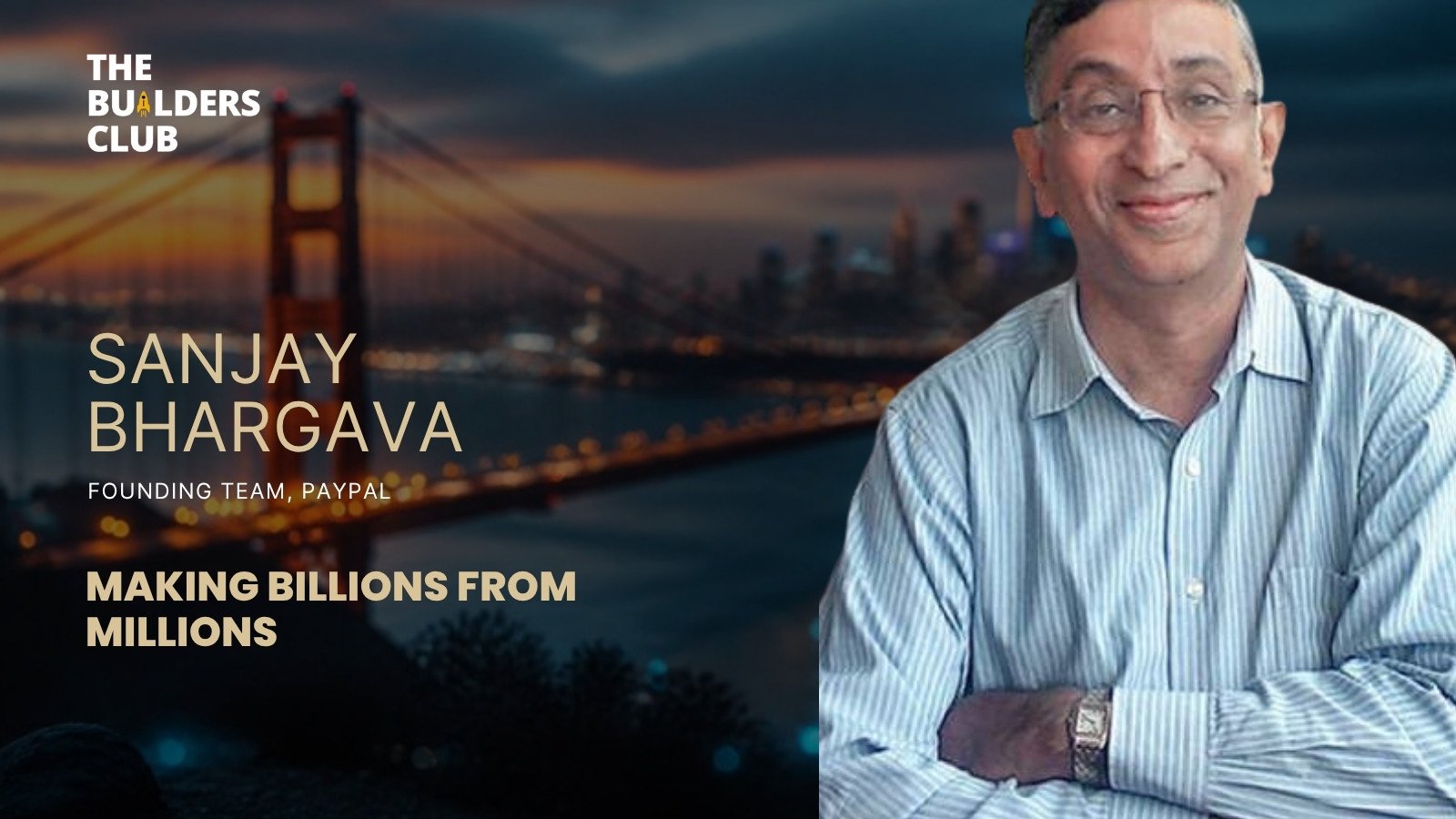
He walked out of a senior job at Citibank in 1999 to chase an idea about sending money by email, and ended up as a VP on the founding team of PayPal. Sanjay Bhargava calls himself a retired builder, and he has plenty of stories.
In Part 2 of this conversation on The Builders Club Startup Founders Podcast, he explains how PayPal was built, what working with Elon Musk was like and the personal rules that shaped his career.
How was PayPal built? Sanjay Bhargava’s core thesis
Sanjay credits PayPal’s success to a global architecture from day one, relentless attention to cost and fraud, constant innovation and a team of very different people who shared a mission. The company started with a small beachhead of eBay power sellers but was designed to serve everyone.
He also argues that founders should build optionality: live below your means, keep a fallback plan and treat a big leap as a coin toss where heads wins big and tails does not cost much.
- Think big, execute small. Start with a beachhead but architect for the world.
- The infinity equation. Push customers toward infinity and cost to serve toward zero.
- Team diversity. Product, tech, back end, design, communications and risk all mattered.
- Build optionality. A modest lifestyle gave him the freedom to leave a secure job.
Who is Sanjay Bhargava and how did he reach PayPal?
Sanjay studied at the Scindia School, IIT Bombay and IIM Ahmedabad, spent about 18 months in the Tata Administrative Service, and then joined Citibank. He stayed roughly 18 years across India, Thailand and the US, ending in a global role covering payments strategy and quality.
In 1998 he saw that email gave every person a globally unique address, which could let payments ignore where someone banks. He left Citibank in 1999 to pursue it.
What happened to his first startup attempt?
He raised angel backing but his founding partner would not relocate to the West Coast or release him from a one-page agreement, so the startup never got going. Sanjay calls it a blessing in disguise, because he then joined X.com, which became PayPal, as a founding employee.
His advice: do not sign anything casually with a co-founder, and remember that being an early employee in a winner can pay off enormously.
What was it like to work with Elon Musk at X.com?
Sanjay says Elon is bright, a disruptive thinker and a very hard worker, even after selling his first company. The early team worked around 100-hour weeks for the first three months.
Recruiting was memorable. A late-night meeting at a 24-hour burger place in Palo Alto ran from about 8 pm to 4 am, followed by a 15-day trial period before Sanjay formally joined.
- Elon built a team of very diverse people and convinced them to join.
- He pivoted when needed, from a mutual fund idea to payments.
- Sanjay negotiated for equity rather than salary, because he was joining to build a rocket ship.
What is the infinity equation behind PayPal’s growth?
The team used the idea of the infinity equation: get your customers to tend toward infinity and your cost to serve to tend toward zero. Starting with eBay power sellers, they aimed to serve every segment, which is why person-to-person payments were free.
On the cost side, any manual step multiplies by a huge volume, so processes had to be digital with fixed, scalable costs. That included fraud costs, which Sanjay said deserve their own long discussion.
- Start with a small beachhead segment.
- Expand to all segments so customers tend toward infinity.
- Remove paper and manual steps from the process.
- Keep costs fixed and scalable, including fraud and processing.
Why did PayPal succeed when others failed?
Sanjay tracked around 70 startups attempting similar things and says nearly all failed. In his view PayPal won because it architected modules for the world, such as adding money, withdrawing and moving money, which could vary by country.
It also innovated continually. He noted PayPal once shipped one release a month while its CEO now describes dozens of releases a day, and that the company invested heavily in design, reconciliation and error tracking.
- Global architecture from the start.
- A team spanning front end, back end, risk, communications and design.
- Heavy loss-making early on; he said the company lost a large sum before cash break-even.
- Close tracking of competitors and alternative currencies.
What mindset advice does he give young founders?
Sanjay shared three messages: know yourself and invest in yourself, make better choices, and be a positive change maker. He argues that investing in your skills may be the best return you ever make, and that making choices is like trading with your future self.
He also stressed optionality. He lived well but not flashily at Citibank, which let him leave at 42. His rule is that heads should mean a big win and tails should not cost much.
- Find what you are good at, even if it is not being a CEO.
- Take courses; he recommended a Harvard edX course on entrepreneurship in emerging economies.
- Fear of failure is cultural; failing well can be a badge of honour.
- Never compare yourself with peers, since you cannot tell who ends up where.
What does he think about bitcoin and blockchain?
Sanjay said he was sceptical of bitcoin until mainstream institutions, including PayPal, moved in, and then read The Bitcoin Standard. He sees bitcoin as sound money, but says blockchain adoption in other fields depends on incentives, not just technology.
His example was pharma: consumers would love a verified supply chain, but other players bear the cost with little benefit unless regulation requires it. He prefers regulation over bans.
- Incentives decide adoption.
- Regulate crypto instead of banning it.
- Expect many entrants and a few winners, as in the dot-com era.
Further reading and sources
Frequently asked questions
What is the infinity equation?
It is a mental model Sanjay Bhargava describes from PayPal’s early days. You try to make your customers tend toward infinity by serving every segment, while pushing your cost to serve toward zero by digitising everything. Fixed, scalable costs divided by huge volume become tiny.
Should a founder take a salary or equity at an early-stage startup?
Sanjay negotiated for stock rather than pay when he joined PayPal, because he believed the company could be a rocket ship. His view is that a startup is worth joining for the upside, so equity is where to focus. Not every startup succeeds, which is why he also recommends building a fallback.
How do you build optionality as a founder?
Sanjay lived below the level his Citibank salary allowed, so he had savings and freedom to leave. He treats a bold move like a coin toss where heads wins big and tails does not cost much, and he keeps a plan B. That approach lets you take risks without being a slave to lifestyle.
Conclusion
Sanjay Bhargava’s story shows that a big outcome can begin with a modest idea, a global design and a team that enjoys the work. His habits, from living below your means to investing in yourself, make bold moves possible.
If you are weighing a leap, ask what your downside really is and what fallback you can build today.
Want more conversations like this? Join The Builders Club, our community of 35,000+ founders and CXOs, and explore more episodes of the Startup Founders Podcast.