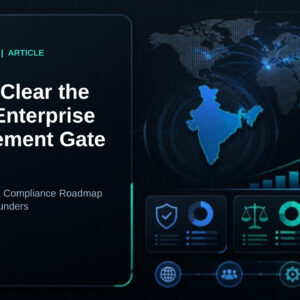

You have won the business sponsor. The demo went well. Then an email arrives with a 120-question security questionnaire, a vendor registration form and a request for your “standard legal terms.” Welcome to the Indian enterprise procurement gate.
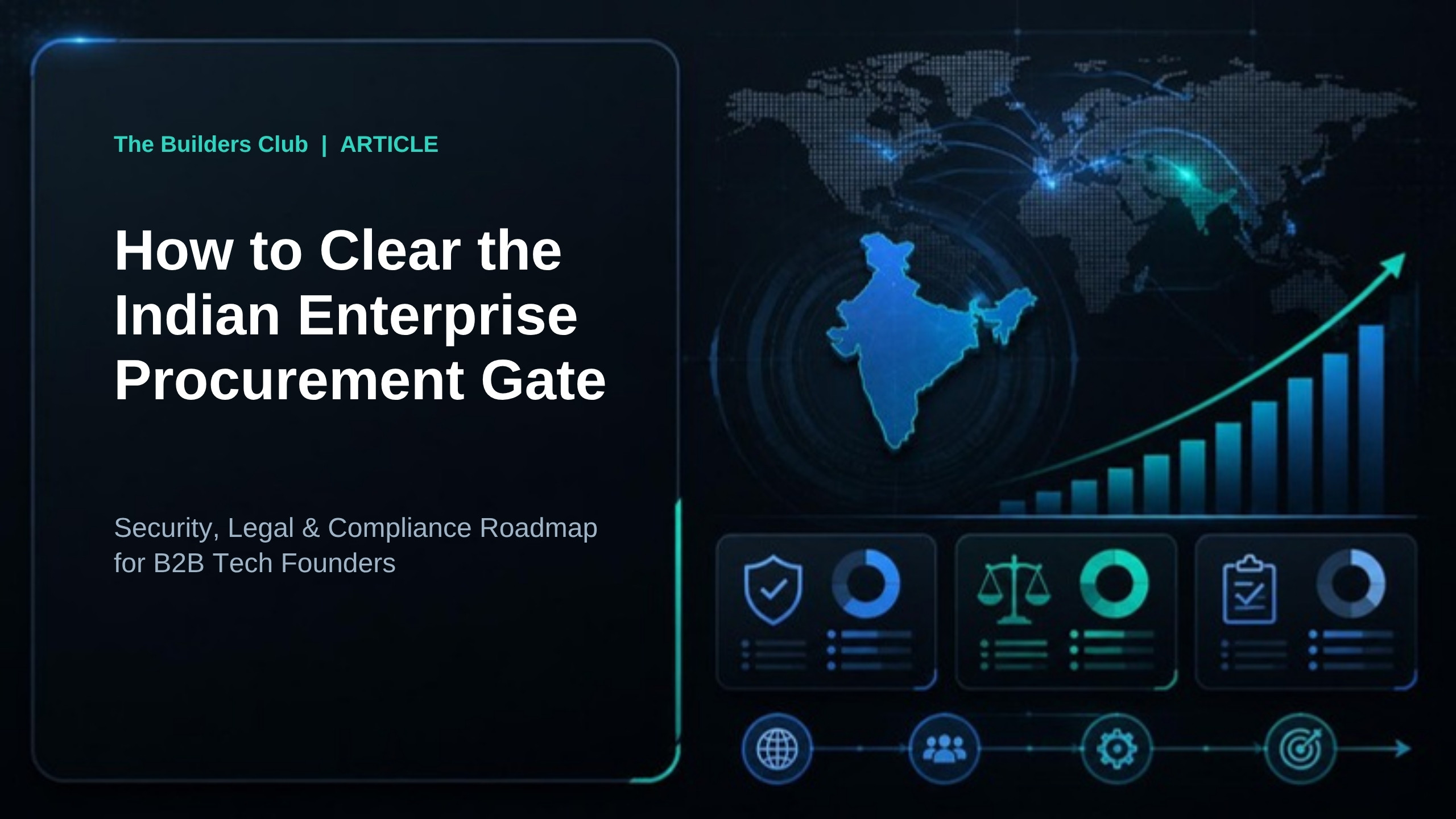
The short answer: procurement in large Indian companies is a sequence of three parallel reviews: information security, legal and commercial, and compliance and vendor onboarding. Founders who prepare a single evidence pack for all three before the first formal request typically clear the gate in weeks instead of quarters.
This roadmap breaks the gate into steps you can run in order, with the documents each team usually asks for.
What does the Indian enterprise procurement gate actually consist of?
Think of it as three desks that rarely sit in the same room. Each has a veto, and each runs on its own clock.
| Gate | Who owns it | What they check | Typical evidence |
|---|---|---|---|
| Security | CISO or IT security team | Data handling, hosting, access control, incident response | Security questionnaire, architecture diagram, pen-test summary, ISO 27001 or SOC 2 report |
| Legal and commercial | Legal counsel, finance, procurement | Contract terms, liability, IP, payment, data protection | MSA draft, DPA, insurance, company documents |
| Compliance and onboarding | Vendor management, compliance, risk | Vendor credibility and regulatory fit | KYC documents, GST and PAN, references, sector-specific attestations |
Step 1: How do you map the stakeholders before the paperwork starts?
Ask your champion, in writing, three questions: who signs off on security, who reviews the contract, and who onboards vendors. Then request a named contact at each desk.
- Security: ask whether a standard questionnaire exists and whether an existing certification can replace it.
- Legal: ask whether you will contract on their paper or yours.
- Vendor onboarding: ask for the vendor registration checklist on day one, not at PO stage.
Step 2: How do you pass the security review?
Build a standing security pack
Prepare one pack and reuse it: a data-flow and hosting diagram, an access-control and encryption summary, a vulnerability and penetration-testing summary, and your incident response and business continuity outline. An ISO/IEC 27001 certificate or a SOC 2 report will answer a large share of questionnaire items on its own.
Answer the India-specific questions
Indian security teams often ask where data is stored, who can access it, and how quickly you report incidents. Know your position on CERT-In incident reporting and log retention directions, and be ready to state your hosting region clearly.
Prepare for regulated-sector add-ons
If the buyer is a bank, insurer or listed company, expect extra scrutiny. The Reserve Bank of India expects regulated entities to manage outsourcing and IT vendor risk, and the buyer will push those obligations down to you through audit rights and exit clauses.
Step 3: How do you get through legal and commercial vetting?
Legal teams rarely reject a vendor. They slow down because the first draft puts every clause in dispute. Reduce the surface area.
- Offer a short, plain-language MSA or order form with clearly marked negotiable clauses.
- Pre-decide your positions on liability cap, indemnity, IP ownership, termination and data return.
- Attach a data processing addendum aligned with the Digital Personal Data Protection Act, 2023 and its rules.
- Confirm payment terms and invoicing format with finance early, including GST details.
- Keep your company documents, authorised signatory and insurance certificates ready.
Step 4: How do you finish vendor onboarding and compliance?
This stage fails on small things. Missing PAN or GST certificates, an unsigned code of conduct, a bank detail mismatch or an unavailable reference can each add weeks.
- Company registration, PAN, GST registration and cancelled cheque
- Signed vendor code of conduct, anti-bribery and conflict-of-interest declarations
- Two or three customer references the buyer can actually call
- Sector attestations where relevant, such as regulator-specific cloud or data-localisation confirmations
What mistakes slow founders down at the procurement gate?
- Starting the questionnaire only after the commercial discussion ends.
- Letting the sales lead answer technical security questions without engineering input.
- Sending different answers to different departments.
- Treating the business sponsor’s approval as a purchase approval.
Frequently Asked Questions
How long does Indian enterprise procurement usually take?
It varies by sector and deal size, but founders should plan for weeks to a few months after business approval. Regulated buyers and large groups take longer. Having a ready security pack and standard legal terms is the biggest lever for shortening it.
Do I need ISO 27001 or SOC 2 to sell to Indian enterprises?
Not always, but a recognised certification removes many questionnaire items and reassures security teams. If you do not have one yet, offer a detailed security overview, a penetration-test summary and a remediation timeline.
Should I use my contract or the enterprise’s contract?
Large Indian enterprises usually prefer their own paper. Offer your terms as a starting point, but be ready to work from theirs, with your pre-decided positions on liability, IP and data protection.
Conclusion
Clearing the Indian enterprise procurement gate is a process problem, not a persuasion problem. Map the three desks early, keep one reusable evidence pack for security, legal and compliance, and agree the paperwork timeline before the commercial discussion closes. Founders who treat procurement as part of the sales motion close faster and keep their champions credible inside the company.
Next step: Selling to Indian enterprises? Join the founders and CXOs in The Builders Club community at thebuildersclub.me to share playbooks and get introductions.