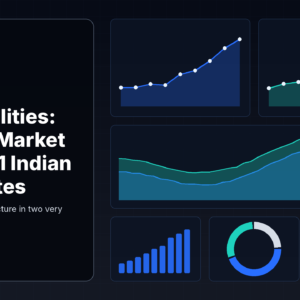
A UK mid-market firm and a Tier-1 Indian corporate house will both buy core infrastructure from you, but they will not pay, decide or expand the same way. UK mid-market deals tend to be smaller, faster and process-led. Indian group deals tend to start with a modest first contract and grow through relationships across divisions.
Founders who price both markets with one ACV assumption end up mispricing one of them. Here is how to think about the difference.
What is ACV, and why does it vary so much by market?
Annual Contract Value (ACV) is the average yearly revenue from a customer contract, excluding one-time fees. It is shaped by company size, buying authority, budget structure and how the buyer prefers to commit spend.
Two companies of similar revenue can have very different ACVs for the same product, because the buying behaviour, not the product, decides how much they sign at once.
Note: the comparisons below describe structural patterns, not published statistics. Validate every number against your own deal history before using it in a plan.
How do UK mid-market firms buy core infrastructure?
The buyer group in a UK mid-market company is usually smaller, with a CTO, head of IT or operations lead holding most of the authority. Procurement follows a defined process, and contracts are generally standardised.
- Compliance first. Data protection under UK GDPR, supplier due diligence and security questionnaires are routine gates.
- Clear scope. Buyers expect a defined package, a fixed term and a predictable renewal.
- Faster decisions, smaller contracts. Fewer approvers usually shorten the cycle, but the initial ACV is often constrained by mid-market budgets.
How do Tier-1 Indian corporate houses buy the same infrastructure?
Large Indian groups often operate as a portfolio of businesses under a shared brand. Technology decisions can sit with a central IT team, a group CIO, or the individual business heads, and sometimes all three.
- Wider committee. IT infrastructure, security, finance, legal and the business owner may each have a say.
- Land small, expand across entities. A first deal in one division can become a group-wide relationship once trust is established.
- Heavier customisation and negotiation. Expect requests on terms, integration, support models and pricing structure.
- Regulatory overlays. Sector regulators and India’s phased data protection rollout may shape requirements.
UK mid-market vs Tier-1 Indian groups: what changes for ACV?
| Factor | UK mid-market | Tier-1 Indian corporate house |
|---|---|---|
| Buying committee | Smaller, role-defined | Larger, spans IT, business, finance, legal |
| Sales cycle | Usually shorter once process starts | Often longer and less linear |
| Initial ACV | Capped by mid-market budgets | Often a small first step, such as one unit or pilot |
| Expansion path | Seats, modules, upgrades | Additional divisions, group entities, geographies |
| Negotiation focus | Compliance, SLAs, term length | Commercial structure, customisation, support |
| Biggest risk | Price pressure and churn | Stalled approvals and scope creep |
How should you price and structure deals in each market?
For UK mid-market
- Lead with a clear package, a compliance pack and a defined onboarding plan.
- Aim for annual contracts with a visible upgrade path, since expansion is usually module-based.
- Use references from similar-sized companies; they matter more than brand names.
For Tier-1 Indian corporate houses
- Design a first contract small enough to approve quickly, but linked to a roadmap for broader rollout.
- Define what is standard and what is paid customisation from day one, to protect margins.
- Map the group structure and identify which entity signs, which pays and which uses the product.
FAQ
Is ACV higher in India or in the UK?
It depends on the segment, product and contract structure, and there is no reliable universal figure. In general, UK mid-market deals may close faster at moderate sizes, while large Indian groups can grow into bigger relationships over time through multi-division expansion. Compare using your own deal data.
Should I use the same pricing model in both markets?
Keep the core pricing logic consistent, but adapt packaging. UK buyers often prefer clear tiers and fixed terms. Indian enterprises may need flexible rollout phases, with the commercial structure explained in terms of business outcomes.
Which market is better for a first enterprise customer?
Choose based on your strengths. If you have a compliance-ready product and a repeatable process, UK mid-market can offer quick validation. If you have strong relationships and room to customise, a Tier-1 Indian group can become a long-term anchor account.
Conclusion
ACV is shaped by how a buyer commits, not just by what they buy. Plan UK mid-market deals around process and compliance, and Indian group deals around relationships and staged expansion. Use one pricing logic, but two go-to-market playbooks.
Selling across borders? Compare notes with founders and CXOs who sell in both markets. Join The Builders Club and get invited to our next roundtable.
About the author: Sohail Khan is Founder and Director of The Builders Club, a professional community of 35,000+ founders and CXOs across India, UAE, Singapore and the US.