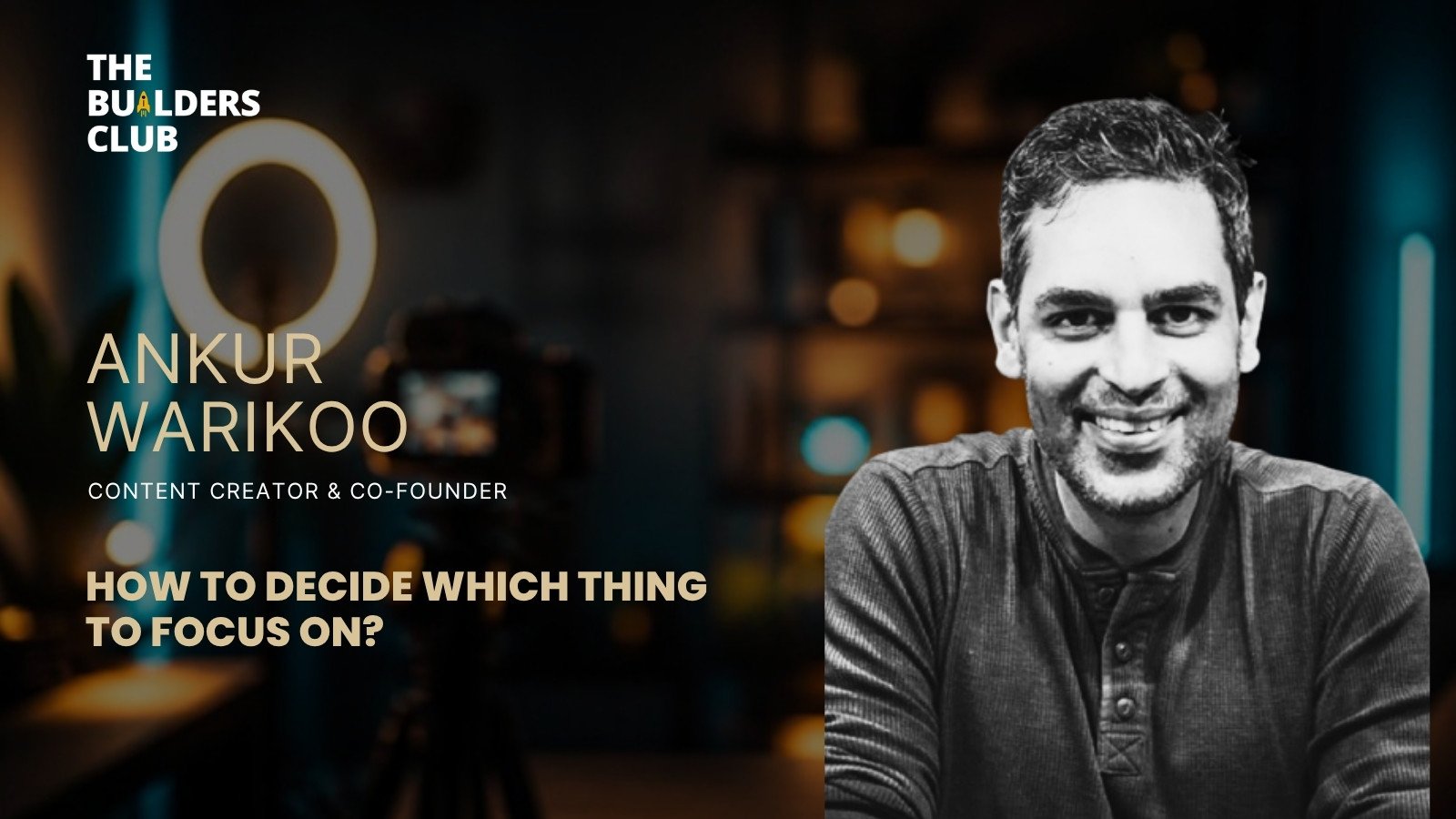
Most of us pick our path out of ignorance, not choice. That is the starting point of Ankur Warikoo’s talk at The Builders Club’s first town hall.
The entrepreneur, angel investor and creator behind the slogan awareness is everything explains what founder awareness really means, why the glamour of startups misleads, and how to size your first funding round.
What does awareness mean for a founder? Ankur Warikoo’s core thesis
Ankur defines awareness as making a choice because you know the alternatives, not because it is the only one you can see. The way to build it is to deliberately spend time with people who are nothing like you and who challenge your beliefs, without needing to agree with them.
He applies the same idea to startups. Founders should observe the world dispassionately and ask whether millions of people feel a problem deeply enough to pay for a fix, rather than building around their own frustration.
- Leave the echo chamber. Seek out people and platforms that broaden your view.
- Do not scratch only your own itch. A real problem is felt by millions and is worth paying to solve.
- Start small. Prove demand with a simple business before building a platform.
- Seed funding is a bet on people. Keep dilution low and optimise for your Series A.
Why is awareness everything for a founder?
Ankur points to how most students choose science, commerce or humanities after Class 10 based on what family and friends suggest. In his view, most life choices are made from ignorance of the alternatives.
People also gravitate to others like them, and social feeds show us what we already believe. That makes the bubble bigger without challenging our beliefs.
- Spend time with people from different backgrounds and generations.
- Listen to opposing views to understand them, not to be convinced.
- Treat it as a way to cover your blind spots.
Why is entrepreneurship harder than it looks?
He compares startups to a sprinter’s race: the ten-second win is celebrated, but the daily training behind it goes unseen. Founders rarely get a finish line, and funding or an exit is rare.
Ankur adds that being an employee has real merit when treated as a way to grow, and that founders are not superior to people in jobs.
Is it good advice to solve your own problem?
Ankur calls the common advice to scratch your own itch misleading. His first startup, a used car marketplace, assumed buying and selling cars was painful, but in 2010 it was not a big enough problem for most people.
What matters is whether millions of people feel the problem deeply and would pay for it, directly or indirectly. Founders should ask how they have survived without a solution so far.
- Describe the problem without reference to your own life.
- Check that millions of people experience it.
- Confirm they care enough to pay or change behaviour.
- Only then design the solution.
How should you start a business when you have passion but few resources?
Responding to a chef with a home-cooked food platform idea, Ankur recommended starting as a one-person dhanda. Cook ten meals, sell them over WhatsApp and see how quickly demand appears.
As orders grow, add another cook, then a commercial kitchen and delivery. Only after months of proven demand should the platform and app follow. He wants founders to aim for a sustainable business first, not a giant company on day one.
How do you choose a co-founder, and recover when a team falls apart?
Ankur gave three tests for a co-founder. They should have a core skill the startup needs, they should see the same data and reach different conclusions, and they must share your values. Shared values matter most in hard times.
For someone whose team had not worked out, he advised reflecting honestly: list what you missed, ask why you ignored it, and use that to decide whether to build a team again or run solo.
- Core skill: engineering for tech, selling for sales, supply chain for logistics.
- Different thinking: disagreement adds value.
- Same values: this holds you together in rough weather.
How much should an early-stage startup raise in a seed round?
At seed, Ankur says neither founder nor investor has much data, so the bet is on the team, the early thesis and the size of the opportunity. In 2021 he described seed valuations of roughly one to three million dollars as a ballpark.
He suggested giving up no more than 10 to 15 percent, which means raising about 100,000 to 300,000 dollars, perhaps up to 500,000. Treat the seed as preparation for a Series A and expect the plan to change.
Further reading and sources
Frequently asked questions
How much equity should a founder give up in a seed round?
Ankur Warikoo advises keeping early dilution to about 10 to 15 percent. At a one to three million dollar valuation, that implies raising roughly 100,000 to 300,000 dollars, and perhaps up to 500,000 with strong traction.
What should I look for in a co-founder?
Look for a core skill your startup depends on, a habit of reaching different conclusions from the same data, and shared values. Ankur says values matter most because they hold the team together when things get hard.
Should I validate a startup idea before building a platform?
Yes. Ankur suggests proving demand with a small, manual business first, for example selling a few meals on WhatsApp. Build the platform once customers and supply are already working.
Conclusion
Ankur Warikoo’s message is to widen your view before narrowing your choices. Seek out different people, test problems that millions share, and treat funding as a tool to grow, not to survive.
Your next step is to talk to three people outside your usual circle this week and ask what problems they face.
Want more conversations like this? Join The Builders Club, our community of 35,000+ founders and CXOs, and explore more episodes of the Startup Founders Podcast.