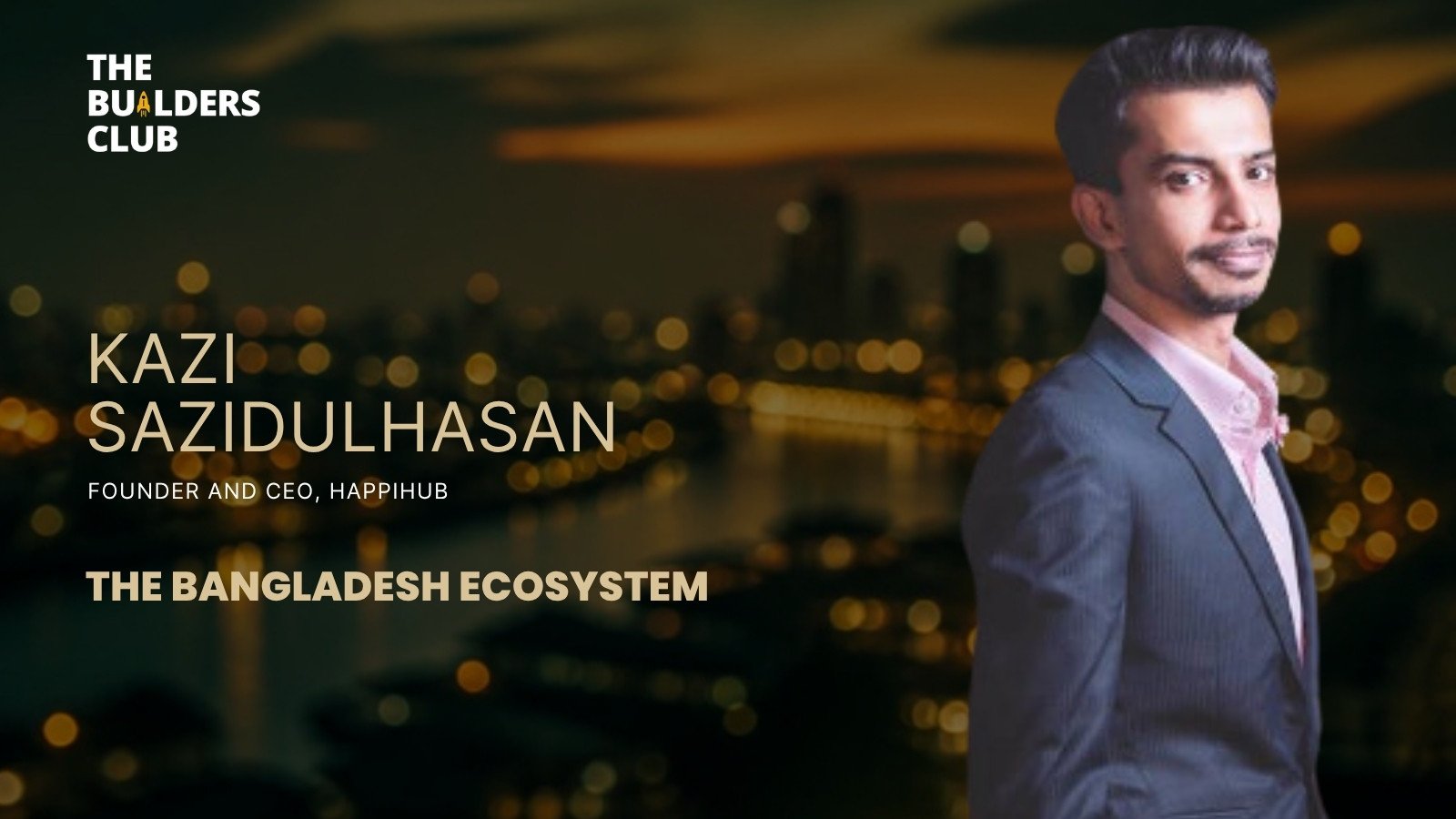
What do you build when 20 million people hold a bank account but only about one million hold a credit card? Kazi Hasan built a cashback app that turns a paper bill into a reward.
In this episode of The Builders Club Startup Founders Podcast, the founder and CEO of Happihub walks through a cashback startup in Bangladesh: the model, the economics, the growth tricks and the market behind it.
How does a cashback startup in Bangladesh work? Kazi Hasan’s core thesis
Happihub is a bill-receipt scan based digital cashback platform. A shopper snaps a photo of a receipt, the system verifies it, and cashback lands in an in-app wallet. Kazi’s thesis is that this serves two neglected groups at once: middle and lower-middle class consumers who cannot get credit-card rewards, and small retailers who have no tool to understand their customers.
The second half matters most. Because the app reads the receipt, merchants learn which items a customer actually bought, not just the amount spent. That item-level data is what makes the model more valuable to merchants than a plain payment cashback.
- A real gap in the market. Bangladesh has roughly 20 million bank account holders but only about 1 million credit card holders, leaving a huge group without purchase rewards.
- Receipt data is the product. Item-level purchase data lets merchants retarget customers in a way generic payment apps cannot.
- Stay lean to survive. The founders self-funded the pilot and kept the team small until the model showed traction.
- Meet customers where they are. Influencers, referrals and Facebook-style visibility beat formal channels for this audience.
Why did Kazi Hasan start Happihub?
Before founding Happihub, Kazi noticed that purchase savings were mostly reserved for people who qualified for bank credit cards. Friends and family members like him often could not access those discounts and rewards, even when they shopped regularly.
He pitched the idea to two university juniors over phone and chat, and after about two months of discussion the team came together. A CTO joined later, and the first version launched toward the end of 2018 as a discount platform.
- Problem on the consumer side: no easy purchase-savings option for the middle class.
- Problem on the merchant side: most local restaurants, shops and pharmacies have no tool to identify loyal customers.
- Early insight: customers in this market are not very loyal and follow the offer, so visible daily savings can win them.
Why did Happihub move from discounts to cashback?
The discount model was simple but hard to scale. A customer claimed a discount in the shop and left, so the platform learned nothing about what was in the basket and had little reason to keep the user inside the app.
The team studied reward platforms such as Magicpin in India and Fetch Rewards in the US, then restructured their own model around their users’ needs.
How does the receipt-scan cashback flow work?
The user uploads a photo of the bill, and the system checks a few data points to filter out fake or reused receipts. If the bill is valid, cashback is credited within about three hours.
- Wallet balance can be used for internet and mobile top-ups.
- It can also be spent on shopping from partner e-commerce options.
- This broader redemption is what Kazi says sets it apart from voucher-only or cash-out-only rivals.
How does a receipt-scan cashback business make money?
Merchants fund the cashback and pay Happihub a commission on top. In Kazi’s example, a restaurant offering 10 percent cashback on a bill also pays a small extra percentage, so the total charge lands around 12 percent. The company also earns from selling partner vouchers through the wallet.
Why do merchants agree? Kazi says a payment app knows only that you spent a certain amount, while Happihub knows that you ordered a specific item. That lets a merchant retarget, say, buyers of one menu item, and it also brings exposure to the user base.
- Customer pays a bill the usual way and uploads the receipt.
- The system verifies the receipt and credits cashback from the merchant’s funds.
- The merchant pays the cashback plus a commission to the platform.
- The merchant gets item-level data and remarketing access in return.
How did Happihub grow on a tiny budget?
The founders put in about 8,000 USD of their own savings and drew no salary until their first pre-seed round from an Indian angel investor. They kept the team small, reasoning that a big team would kill the company if the model failed.
At the time of the conversation Happihub reported 100-plus partner stores, more than 45,000 registered users and over 10,000 monthly active users. It was also preparing a seed round.
- Referral program: two short campaigns brought in about 20,000 users at roughly 25 cents per registration, with the referrer paid in full only after the friend used the app.
- Influencers and food bloggers: video explainers helped users who struggled with a text description of cashback.
- Low spend: Kazi said marketing cost about 3,000 USD over the previous year.
How do you win merchants and build for the bottom of the pyramid?
For small merchants such as single-branch restaurants, a direct sales pitch works. Bigger brands ask for proof first, so Happihub funds small cashback offers from its own pocket to build a customer base, then shows the brand its own customer data.
For consumers, the lesson was to understand where they spend attention. Kazi’s team saw that this audience watches food videos and likes effortless extra income, so they used influencers and referral rewards.
What challenges did he flag?
Commission collection is risky because some merchants delay payments. Kazi noted that subscription models, like Magicpin’s merchant subscription, give more security, and Happihub planned to introduce a monthly plan of around 35 USD alongside added services.
- Explaining cashback to less educated users takes simple video.
- Feature-phone users are not targeted; the product is smartphone-first.
- Receipt reading uses a customised Google Vision API with some manual spam checks, and the team planned to build its own scanner.
Why is Bangladesh an attractive market for startups?
Kazi described a young population with a median age of about 27, rising smartphone and internet use, and a fintech space led by mobile financial services. He expected Bangladesh to become one of South Asia’s biggest startup markets after India. For background, see this overview of the economy of Bangladesh.
He also explained why Facebook matters: for many users it is effectively the internet, and many small sellers run their shops through pages and live sessions instead of websites. The conversation then moved to micro-lending and buy now pay later, where Kazi saw large demand but regulatory limits.
- Facebook pages and live selling dominate small-business commerce.
- Micro-lending players are active in both consumer and farmer segments.
- Buy now pay later has strong need but faces policy constraints.
Further reading and sources
- Cashback reward program (Wikipedia)
- Fetch Rewards (Wikipedia)
- Economy of Bangladesh (Wikipedia)
- Buy now, pay later (Wikipedia)
Frequently asked questions
What is Happihub?
Happihub is a Bangladeshi digital cashback platform founded by Kazi Hasan. Users scan a bill receipt and receive cashback in an app wallet, which they can spend on mobile top-ups and online shopping. Merchants pay for the cashback and get customer purchase data in return.
How can a startup acquire users cheaply in an emerging market?
Kazi’s team used short referral campaigns and influencer or food-blogger reviews. Referral rewards were paid in full only after a referred friend actually used the app, which kept acquisition cost near 25 cents per registration. Video explainers also helped less tech-savvy users understand the product.
Should a marketplace charge merchants commission or a subscription?
Kazi says commissions are flexible but risky, because merchants may delay payment. Subscriptions give predictable, upfront revenue and more security. Happihub was moving toward a monthly subscription for merchants, bundled with more services.
Conclusion
Kazi Hasan’s story shows how a clear market gap, a lean team and data that merchants cannot get elsewhere can build a fintech business in a young market. The key moves were switching from discounts to cashback, funding the pilot with savings, and acquiring users through referrals and influencers.
If you are building for underserved consumers, start by learning where they spend attention and what they need, then keep costs low until the model is proven.
Want more conversations like this? Join The Builders Club, our community of 35,000+ founders and CXOs, and explore more episodes of the Startup Founders Podcast.