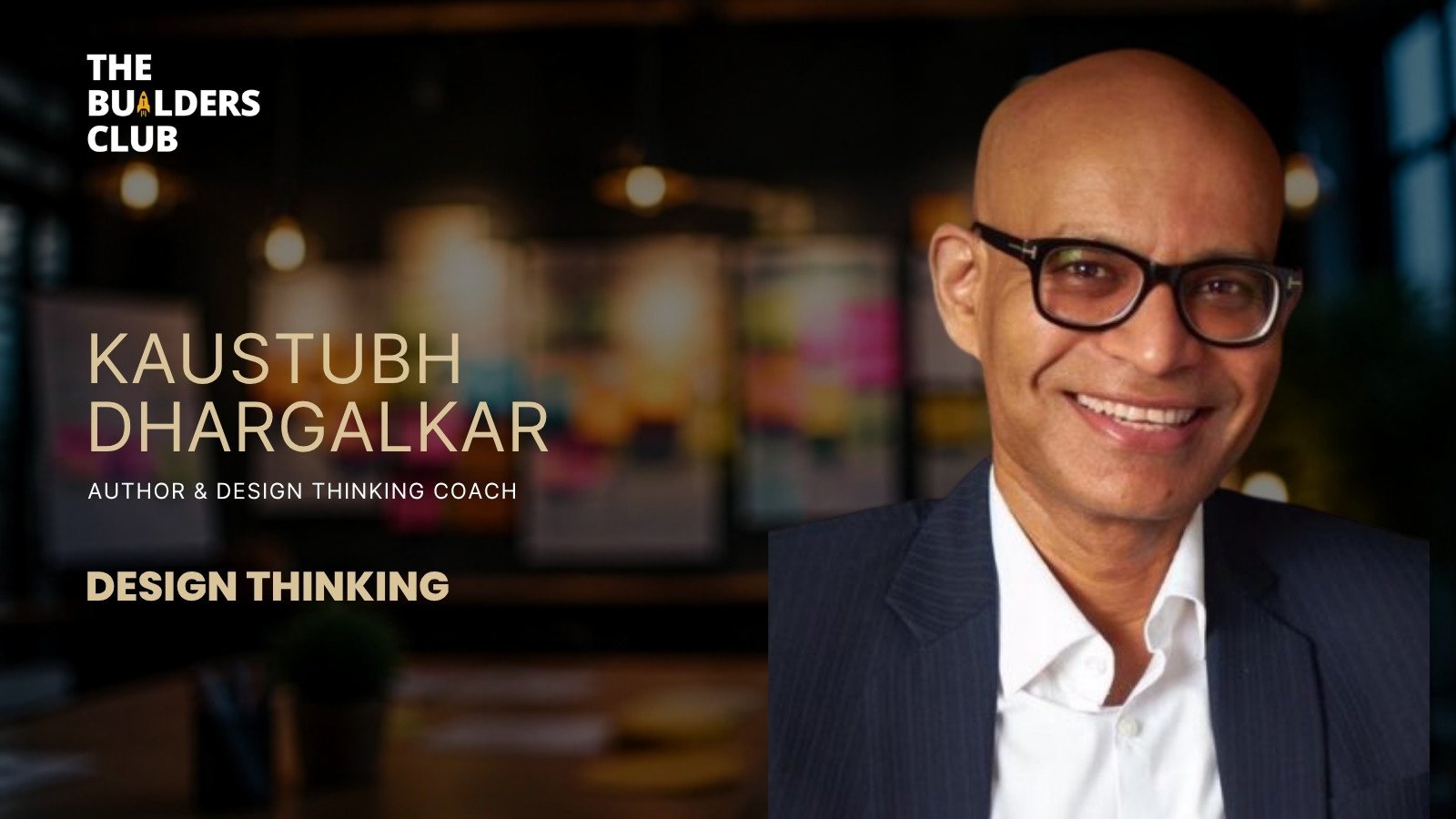
Design thinking for startups is not about slick interfaces. It is a habit of understanding users so well that the product almost designs itself. Kaustubh Dhargalkar, a four-time founder, visiting faculty member and author of the book It’s Logical, makes that case in this Water Cooler Conversation.
He started his first company around 1990 in manufacturing, sold his stake in his first three companies in the mid-2000s, and now consults, trains and mentors startups. The conversation moves from a press-machine factory to Google, UX versus UI, and a call-centre story that shows innovation coming from the lowest rung of the hierarchy.
What is design thinking, and why does it matter for startups?
Kaustubh defines design thinking as a highly user-centric, exploratory and iterative approach to problem solving. You keep the user at the centre, keep exploring what they need, and keep adjusting your offering to their feedback.
For founders, he says it is the most reliable route to product-market fit. His rule is simple: user first, technology later, because many startups fall in love with a technology and forget that someone has to use it.
- User first, technology later. Understand the person and their context before choosing the tool.
- Make what might sell. Do not build first and then hunt for a market.
- Experience before interface. Map the user journey, then design the UI.
- Listen to the last mile. Frontline staff often hold the insight senior leaders miss.
What did Kaustubh’s own startup journey teach him?
After his MBA he went into manufacturing, starting with job work for large companies and then switching to his own table-mounted press machines. He realised customers were not really buying presses; they wanted more productive assembly lines.
That insight pushed the company from selling machines to offering one-window assembly-line automation. By the early 2000s he found himself more administrator than creator, and after a search he brought in an investor and cashed out of the businesses in 2005.
What went wrong with the testing-machine bet?
A verbal order for a large number of testing machines led him to set up a separate factory, but the deal behind it collapsed. He then tried to sell the already-built, sophisticated machine to local manufacturers who did not want to pay for it, and cheaper local products beat him.
His lesson: rather than trying to sell what you make, try to make what might sell. He also warns against relying on a verbal commitment.
How does design thinking apply beyond apps and websites?
Kaustubh stresses that design thinking is not limited to interface design. It can be applied to manufacturing, finance, marketing and even personal problems because it gets to the root of the issue.
The usual stages he lists are empathy, problem definition, ideation, prototyping and testing. What appeals to him most is the emphasis on empathy, which creates what he calls a last-mile connection with the user.
- Spend time in the user’s context; in his automation days he would spend five to six days watching an assembly line.
- Fit products into existing habits instead of expecting people to change.
- Treat habit-changing giants as rare exceptions, not a plan.
What can founders learn from how Google defined its business?
He argues that in its first decade, Google was really in the business of satisfying human curiosity, not just search. Once you define your business at that level, the next questions become obvious, such as what else people are curious about.
Because search data shows what people look for in real time, expansion into maps, video and more followed naturally. He also contrasts the clean Google page with cluttered portals of the era as an example of reducing pain and distraction.
What is the difference between UX and UI?
Kaustubh is clear that experience comes first and interface second. Understand the journey, then design what appears where.
His example is a bank home-loan site. A house hunter first thinks about locality, builders and brokers, schools and amenities, and only then a loan, so a site that supports that whole journey simplifies the experience and may open new revenue streams.
- Map the real user journey.
- Identify the pain points and unmet needs.
- Design the interface to serve that journey.
How should startups do user research?
His advice is to start with qualitative research to learn what parameters people use to decide, then use quantitative methods to learn how many people prefer each. Jumping straight to a questionnaire risks missing parameters users would have told you in conversation.
He cannot give a fixed number of interviews. You know you have done enough when you keep hearing the same themes. For students aiming at product management, he recommends getting good at qualitative user research, requirement gathering, people management and goal-setting frameworks such as OKRs.
- Run a small cohort of early customers, with full transparency that the product is new.
- Keep communication tight so you can adapt as behaviour shifts.
- Early adopters who see your effort often become your best advocates.
What does the call-centre case study show?
A large outsourcing firm asked Kaustubh how to make its calling process more efficient. He insisted that frontline callers join a workshop, not just senior managers.
A telecaller observed that she could sense within a few sentences whether a prospect would convert. That led the team to analyse voice patterns against millions of recorded calls and build a speech-based tool that categorises prospects, so callers are prompted accordingly and unlikely prospects go to other channels. His takeaway: innovation is understanding the user, spotting the unseen and unsaid, and acting on it creatively.
Further reading and sources
- Design thinking (Wikipedia)
- Product-market fit (Wikipedia)
- User experience (Wikipedia)
- Objectives and key results (Wikipedia)
Frequently asked questions
What are the steps of design thinking?
Kaustubh Dhargalkar lists empathy, problem definition, ideation, prototyping and testing. He says the most important part is empathy, because understanding the user in context is where innovation starts.
Should startups do qualitative or quantitative research first?
Start with qualitative research to discover what parameters matter to users, then use quantitative methods to measure how many people want each. Surveys alone can miss factors that real conversations reveal.
What is the difference between UX and UI?
UX is the whole experience and journey of the user, while UI is the interface that carries it. Kaustubh says to understand the experience first and then design the interface to fit it.
Conclusion
Kaustubh Dhargalkar’s message is that great products come from empathy, not from technology looking for a use. Define what your customer truly wants, test with a small group of early users, and listen to people closest to the customer.
Before your next build, spend time in your user’s world and write down the unseen problem you are solving.
Want more conversations like this? Join The Builders Club, our community of 35,000+ founders and CXOs, and explore more episodes of the Startup Founders Podcast.