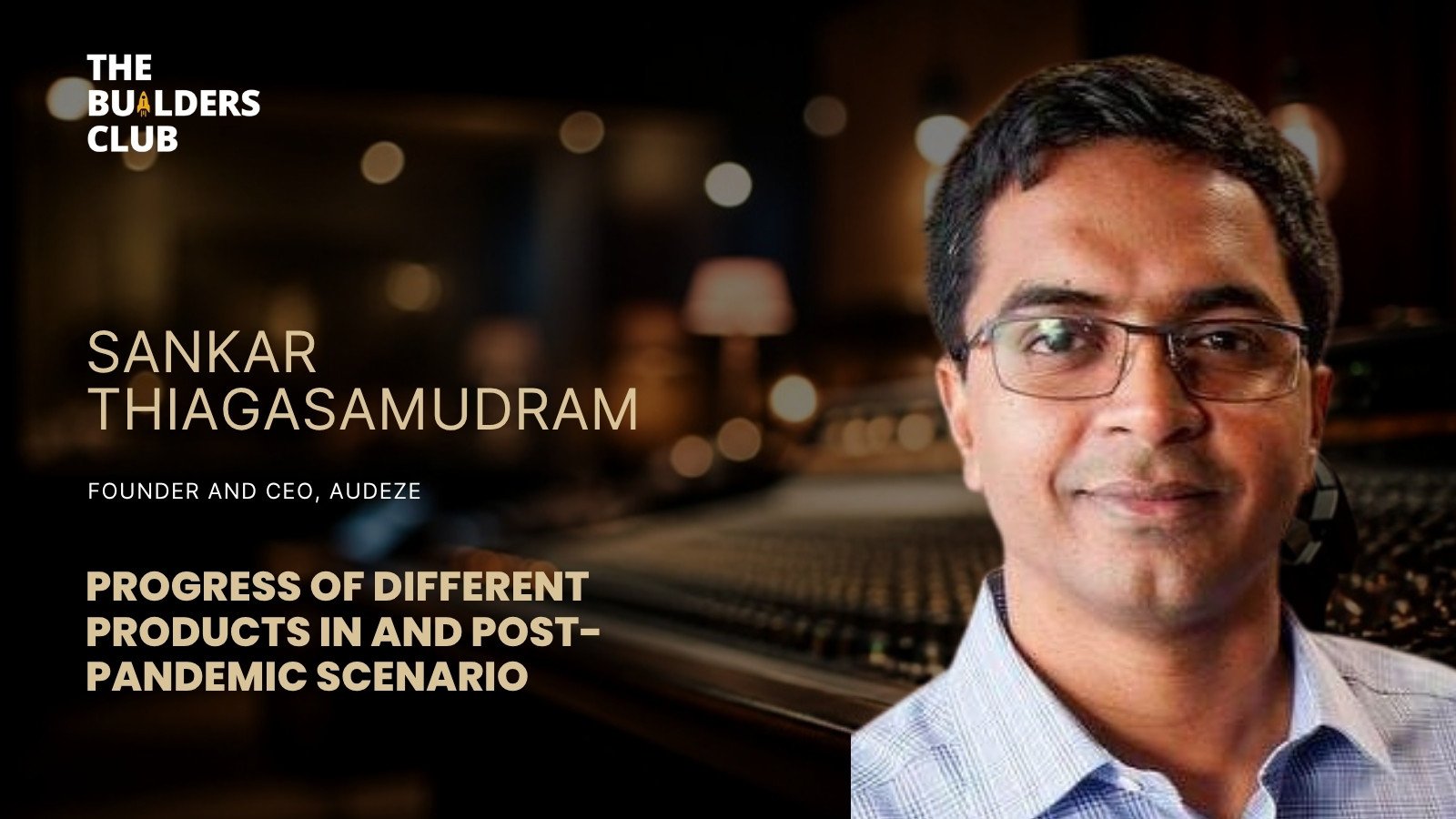
How does a small hardware startup take on a headphones industry full of brands with decades of history? Sankar Thiagasamudram, founder and CEO of California-based Audeze, built his answer around sound quality, a passionate community and a factory of his own.
In this Water Cooler Conversation on The Builders Club Discord, he shares his journey from designing video cards to making high-end headphones, and what he thinks about wireless audio, manufacturing and the founder decision to quit a well-paid job.
How can a startup compete in the headphones industry?
Sankar’s answer is to avoid the middle of the market. Mainstream consumer audio demands heavy capital and distribution, so Audeze targets the long tail of the bell curve: niches such as audiophiles, pro audio for mixing and mastering, and more recently high-end gaming.
He says the company plays a long-term game, aiming to be known for sound quality in the way older specialist brands are. Sound quality is the north star for every product.
- Go niche first. Win passionate communities, then expand to adjacent markets.
- Be nimble. Large incumbents struggle to build small products for a niche selling around a million dollars a year.
- Let users shape the product. Feedback on forums and Reddit feeds into firmware and features.
- Own your core technology. In-house thin-film and transducer manufacturing created a defensible edge.
How did Audeze start?
Sankar grew up in Coimbatore and studied at PSG College, which he says had a strong entrepreneurial culture. Years later he worked on designing video cards, and saw how RED reshaped the movie-camera business with far cheaper cameras.
Audeze began almost as a hobby around 2008 and 2009, using thin-film technology he knew from earlier work. It took him two to three years to convince himself to leave a well-paying job, and he has run the company full time since 2013.
How do you build a community around a hardware product?
Growth came largely from word of mouth. Early on, limited manufacturing capacity meant customers waited weeks or months, which added to the buzz.
Sankar credits several factors for the community.
- Organic recommendations from audiophiles and later from musicians and sound engineers.
- Thousands of forum threads, notably on Head-Fi, where users suggest improvements.
- Fans posting pictures, even tattoos, of the product.
- Direct feedback on gaming headsets that the team turns into later firmware releases.
Why did early validation matter?
He recalls showing an early prototype to an Oscar-winning music composer, who spent hours listening and encouraged him to go full time. That, he says, gave the team confidence that it was more than a flash in the pan.
Will wireless replace wired headphones?
Sankar expects wireless to become mainstream, helped by better codecs and the coming Bluetooth LE Audio standard, which supports features like broadcast to multiple headphones and syncing to more than one source.
But he does not see wires disappearing. Audeze offers both options, and for studio work, latency still matters: the lowest wireless latency the team had achieved was about 18 milliseconds, which is too high for some musicians.
- Wireless for convenience and new use cases such as broadcast audio.
- Wired for the lowest latency, such as playing instruments.
- Dual connections in gaming headsets: a low-latency 2.4 GHz dongle plus a separate Bluetooth link for chat.
Why manufacture in the US, and is it worth it?
Audeze makes its own thin film, magnets and etched circuits in Orange County, California, so Sankar describes it as a transducer manufacturer, not just a brand. Environmental rules and liability around chemical etching led the team to patent a laser-etching method.
For gaming headsets, where average prices are far lower than its audiophile range, the transducers are made in the US but final assembly is done in China to keep costs competitive. During the pandemic the factory moved from one shift to two to allow social distancing, while demand rose.
How do you differentiate a hardware product?
Sankar suggests finding one or two areas where you can stay ahead, because successful features get copied. Audeze put head-tracking sensors into a gaming headset in 2018 to create virtual surround sound, a feature that now appears in mainstream products.
The idea came from a real problem: a film studio needed to quality-check surround mixes on headphones at scale. He advises making sure a feature is useful, not gimmicky, and warns against building a product and then hunting for a market.
- Think 18 months ahead: chipset features like transparency mode and noise cancellation will become checkboxes.
- Use design partners; Audeze worked with a car maker’s design studio and adopted a five-year-back-casting approach.
Should you quit your job to start a company?
Sankar says it depends on your circumstances. For him, three things lowered the risk: his skills would still be valued if the company failed, Audeze was already getting traction, and his spouse also had a strong income.
He also learned to separate business success from personal worth, and says he filled gaps such as finance by asking a friend to teach him and by hiring experienced people.
Further reading and sources
- Audeze official website
- Headphones (Wikipedia)
- Bluetooth Low Energy (Wikipedia)
- Planar magnetic headphones (Wikipedia)
Frequently asked questions
How can a new brand compete with established headphone makers?
Sankar Thiagasamudram recommends avoiding the mainstream middle and focusing on niche communities such as audiophiles, pro audio and gaming. Being small and nimble lets you serve groups that large companies find too small to bother with.
Should a hardware startup manufacture in-house?
It depends on your technology. Audeze makes its own thin film, magnets and circuits because its approach is different from standard drivers, while it assembles lower-priced gaming headsets overseas to hit price points.
Will wired headphones disappear?
Not entirely, according to Sankar. Wireless will be mainstream, but wired remains important where very low latency matters, such as studio recording, so Audeze offers both.
Conclusion
Sankar Thiagasamudram’s story shows that a hardware startup can win by choosing a niche, listening to its community, and controlling its core technology. Differentiate where it truly helps customers, not for novelty.
If you are building a product, pick a long-tail market first and plan for what the technology will look like in 18 months.
Want more conversations like this? Join The Builders Club, our community of 35,000+ founders and CXOs, and explore more episodes of the Startup Founders Podcast.