The report runs in three segments (client expectations, GTM and channels, and the AI stack), and closes with an execution plan and an eight-point checklist for the 2027 plan.
Who Was in the Room
Six operators who sell to enterprises every day, from a global IT services major to AI-native start-ups. The session was moderated by Sohail Khan, The Builders Club.
- Ashish Bhatia, Global Presales Leader, Cloud & Infrastructure, DXC Technology
- Rahul Chaturvedi, Head of Middle East & Africa, Perfios
- Deepak Arjan Bhatia, Co-Founder & Chief Business Officer, Quickwork
- Raghav Kumar, Head of Marketing, Beacon.li
- Subramaniam Krishnan, VP, Marketing & Customer Growth, Anunta
- Ramakrishna K, Vice President, E42.ai
Eight Strategic Imperatives for 2027
Shifts one to four describe what clients now expect. Shifts five to eight describe how the best teams respond.
1. From AI features to provable outcomes
Buyers have stopped asking what the AI is and started asking what it owns end to end. Leading with the business problem shrinks the funnel, but fills it with high-intent buyers.
2. Governance and sovereignty gate the deal
Data privacy, AI governance and sovereign cloud now sit inside proposals as a core pillar. The EU AI Act and India’s DPDP regime have pushed the question into every region.
3. Contracts price in AI efficiency
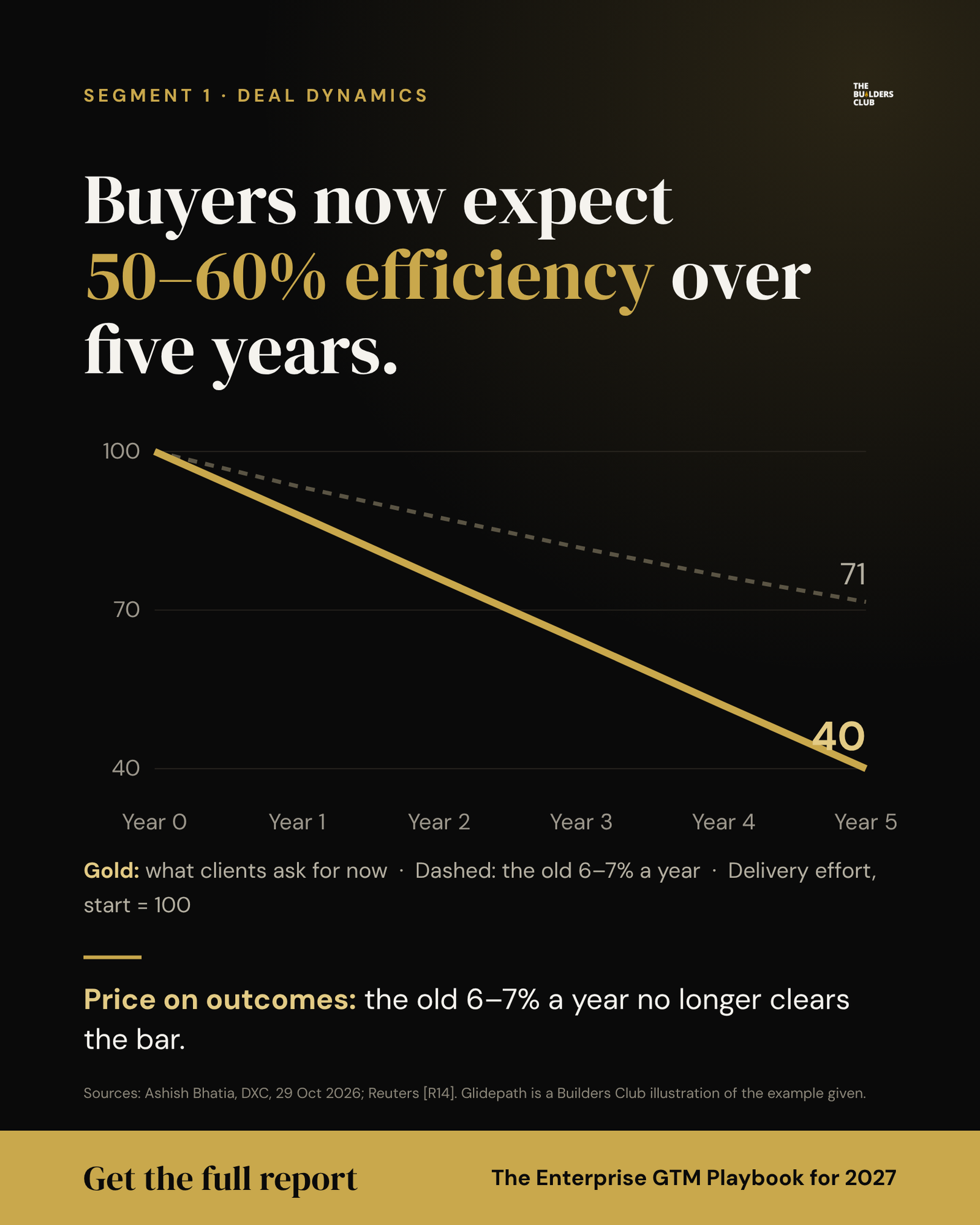
Clients now expect 50 to 60 per cent efficiency built into five-year contracts, against the 6 to 7 per cent a year that used to be pre-baked. Deals are smaller, faster and more focused.
4. A different story in every market
India asks how much cheaper it is than building in-house, the US asks for outcomes, the Gulf asks about regulation, and Africa asks for lower economics at scale. The product travels; the value proposition does not.
5. Partners first, direct next
Panellists used a well-chosen local partner as the primary channel for the first 12 to 18 months. The move to direct should follow reference customers, partner performance and commercial readiness.
6. Focus beats activity
Paid ads are being cut hard (one panellist by about 85 per cent). Money is moving to curated roundtables, customer workshops, organic content and customer proof.
7. Signals, not spray
ABM runs on a stack of intent signals (topic, first-party site, G2, sales-call transcripts), with exclusion criteria and a bi-weekly marketing and sales loop.
8. Verify, then trust
Buyers want to touch and verify. Expect CFOs to ask for the money, technical evaluation to be done by agents, and documentation and APIs to become a marketing channel.
The Numbers That Framed the Discussion
- ~85%: paid-ads budget cut at Anunta
- 50-60%: efficiency clients expect over a five-year contract
- 12-18 months: partner-led phase at Perfios before direct
- 2-4 weeks: fastest recent close, reported by E42.ai
The one-line takeaway: in 2027 the winning enterprise GTM motion is narrow, local, partner-led and evidence-heavy. Pick one problem, prove it in production, tell the story market by market, and let customers and partners carry it.
Segment 1: What Enterprise Clients Expect Now
Across six very different businesses the same pattern surfaced. Buyers are no longer impressed by the presence of AI. They want to know what it will own, what it will cost, where the data will sit and who can vouch for it. Outcomes over AI features was the one theme raised by all six panellists.
There’s no infra proposal that goes across without AI being incorporated. It depends at which stage the AI is incorporated.
Ashish Bhatia, DXC Technology
Proposals now carry governance, speed and efficiency
Ashish Bhatia named three structural changes in enterprise proposals. A simple GRC slide has given way to data privacy, governance and AI-governance pillars. Half-billion and billion-dollar deals are less frequent outside government and semi-government buyers in the US, Germany and the UK, and lead cycles are more focused and faster. And the cost case has been rewritten: annual efficiencies of 6 to 7 per cent used to be pre-baked into Excel models, while in the last 6 to 12 months clients have asked for 50 to 60 per cent across a five-year term.
Reuters reporting on Indian IT services shows the same pressure from several directions: Persistent Systems pointing to 25 to 30 per cent less for the same work, and Tech Mahindra noting that some rivals assume 70 to 80 per cent productivity gains over five to seven years. These are executive statements, not a client survey, but the 50 to 60 per cent ask sits inside that range.
Cycles are shorter, but the average journey is longer
Ramakrishna K described enterprise cycles that once ran 12 to 16 months now closing in about six, and some recent AI-native deals in two to four weeks. Dreamdata’s analysis of 3.5 million customer journeys points the other way, with first touch to closed revenue stretching to 272 days from 211. The likely reconciliation is that narrowly scoped, AI-native deals close fast, while the average B2B journey lengthens as buying groups grow. Build proposal and demo assets that can be turned around in days, and scope deals around one measurable problem.
Lead with the problem, not the AI
Raghav Kumar joined Beacon.li as the category filled with near-identical claims. Messaging built around “AI orchestration” tested badly at events, a “sea of sameness”. The fix was to lead with the problem statement and treat AI as the how. Top-of-funnel volume narrowed, but the funnel became cylindrical rather than conical, because the buyers who arrived already knew what they were looking for.
Proof, peers and pre-selection decide deals
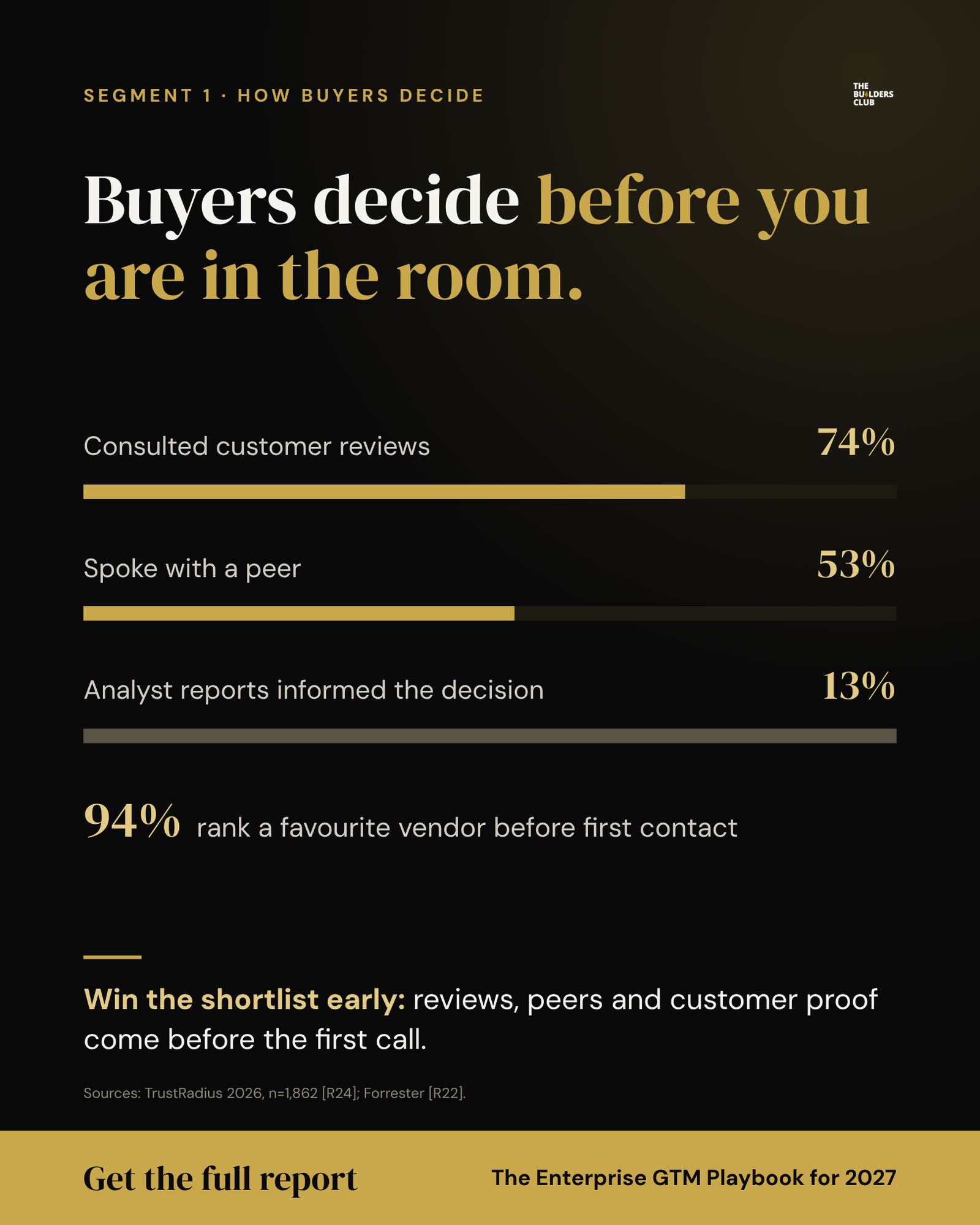
Subramaniam Krishnan expects customers to demand proof they can verify. Buyer research agrees. In TrustRadius’s 2026 study, 74% of technology buyers consulted customer reviews and 53% spoke with a peer, while analyst reports informed only 13%. 6sense data shows 94% of buying groups ranked a favourite vendor before first contact, and about 77% bought from that favourite. Gartner finds 67% of B2B buyers prefer a rep-free experience.
The POC-to-production gap is real
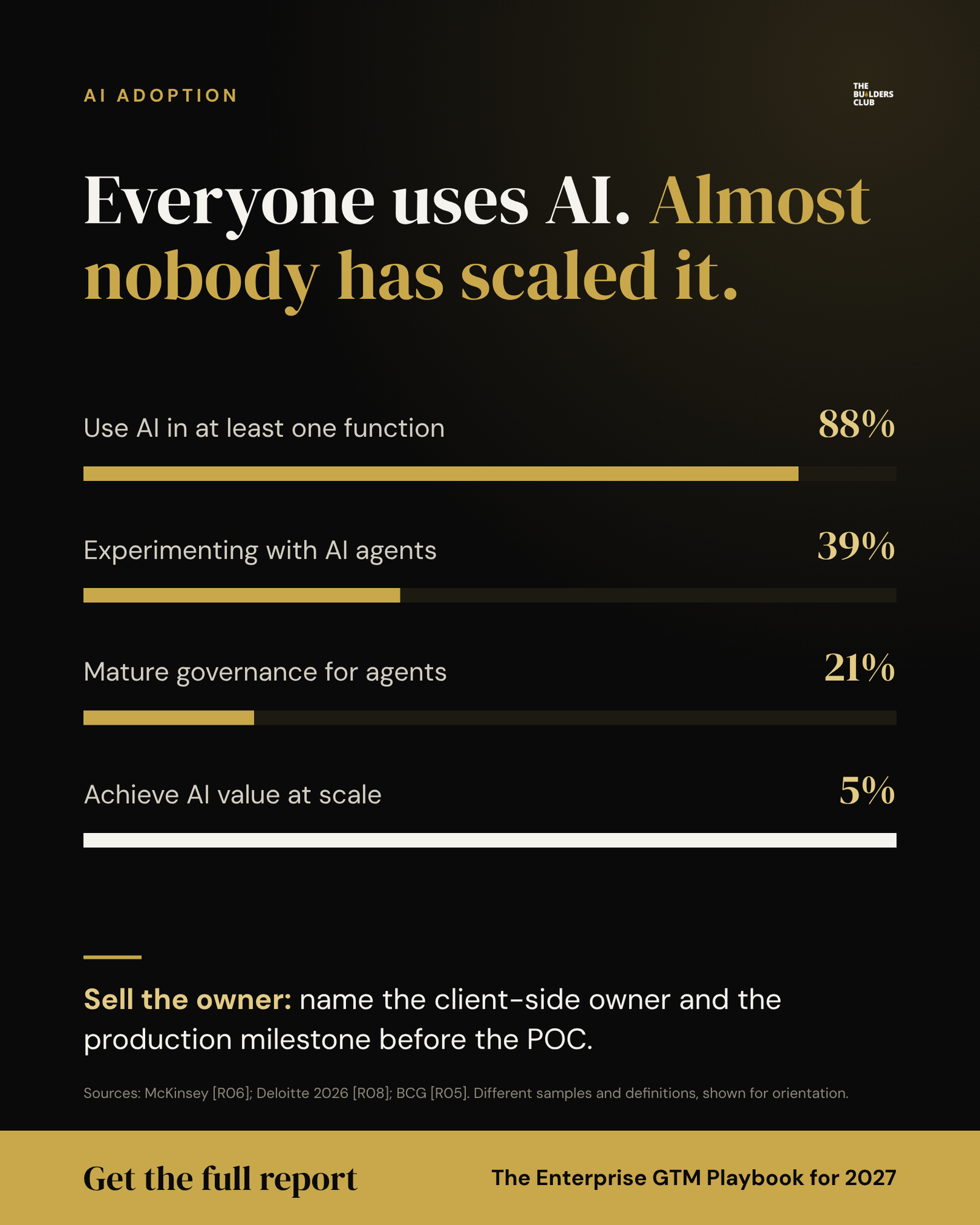
Ramakrishna K warned that many AI projects fail on ownership: after the proof of concept, no single person on the client side takes the decision. Market data shows broad adoption and thin returns. Gartner predicts over 40% of agentic AI projects will be cancelled by the end of 2027, and the MIT NANDA study, as reported by Fortune, found about 5% of pilots reach rapid revenue acceleration, with purchased specialist tools succeeding about 67% of the time against roughly a third for internal builds. Look for a named owner before investing in the proof of concept.
Sovereignty is now a sales variable
Rahul Chaturvedi was blunt about the gap between AI excitement and banking reality: in banking the question is not only the business outcome but regulation, governance and compliance. Anunta deployed sovereign clouds at four locations in 12 months. Gartner forecasts sovereign cloud IaaS spending of $80 billion in 2026, up 35.6%, and Deloitte finds 83% of organisations rate sovereign AI at least moderately important to strategy. Only 21% report a mature governance model for autonomous agents.

- Make your data-residency and support-location story explicit in the first deck, not the appendix.
- Prepare a deployment menu: cloud, sovereign cloud, on-prem, air-gapped.
- Know which hyperscaler sovereign offerings you can partner with if you cannot own the stack.
No Universal Playbook: What Buyers in Each Region Ask First
Rahul Chaturvedi’s experience across 15 markets in three regions was the clearest case study of the day. Perfios started in India in 2008, went international around 2018 and now operates in about 20 countries. Its early assumption, that a product that works in India would be adopted abroad, did not hold.
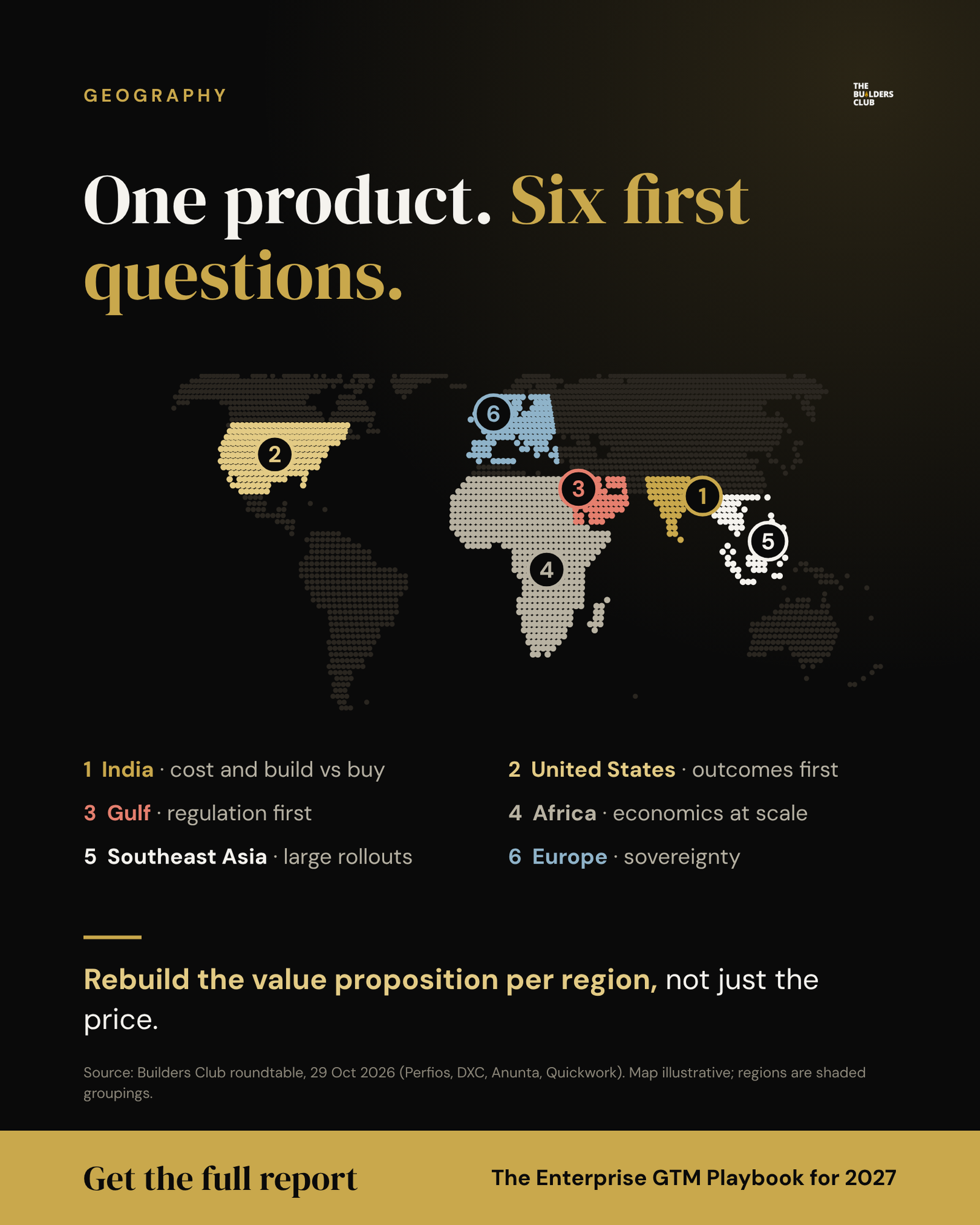
| Region | What leads the conversation | How to position |
|---|---|---|
| India | Cost, scale, build vs buy | Lead with cost and speed against an internal build; show the efficiency maths |
| United States | Outcomes, time to value | Lead with the outcome and quantified throughput |
| Gulf (Saudi, UAE) | Regulation, compliance, delivery cadence | Lead with compliance posture; use a local partner; price on effort saved |
| Africa (Kenya, South Africa, Egypt) | A business problem solved at lower economics | Lead with economics and scale; localise price by country |
| Singapore / SEA | Large-scale rollouts | Show scale references; work through regional partners |
| Europe (Germany, France) | Sovereignty | Prove you can operate inside the sovereign stack, or partner with those who do |
Having a good product is good, but to scale it up in different markets you need a unique value proposition and a story for each market, which should be localised.
Rahul Chaturvedi, Perfios
Partner-led entry, then own the relationship
When nobody in a new market knows you, partnerships are the key channel, but never a substitute for direct sales and a foot on the ground. Perfios ran partner-led for the first 12 to 18 months, cracked its first reference customers, and then built direct sales so that partner and direct became complementary. The panel’s four partner-selection attributes:
- Domain credibility: does the partner understand the domain and the business?
- Access to decision makers: not just a wide network, but the right stakeholders.
- Understands your solution: the willingness and ability to learn and position your product.
- Commitment to build together: invested in your growth journey, not a one-off introduction.
On pricing in a market without scale, do not convert INR price lists to dollars. Price on the process you replace. In Rahul’s example, an analyst takes five working days to process a loan application in the UAE and the product reduces it to one day. That is four of five days saved, an 80 per cent reduction. Cost out the analyst’s time, estimate the saving per application, and place the price against it.
Segment 2: GTM and Channels
The channel scorecard
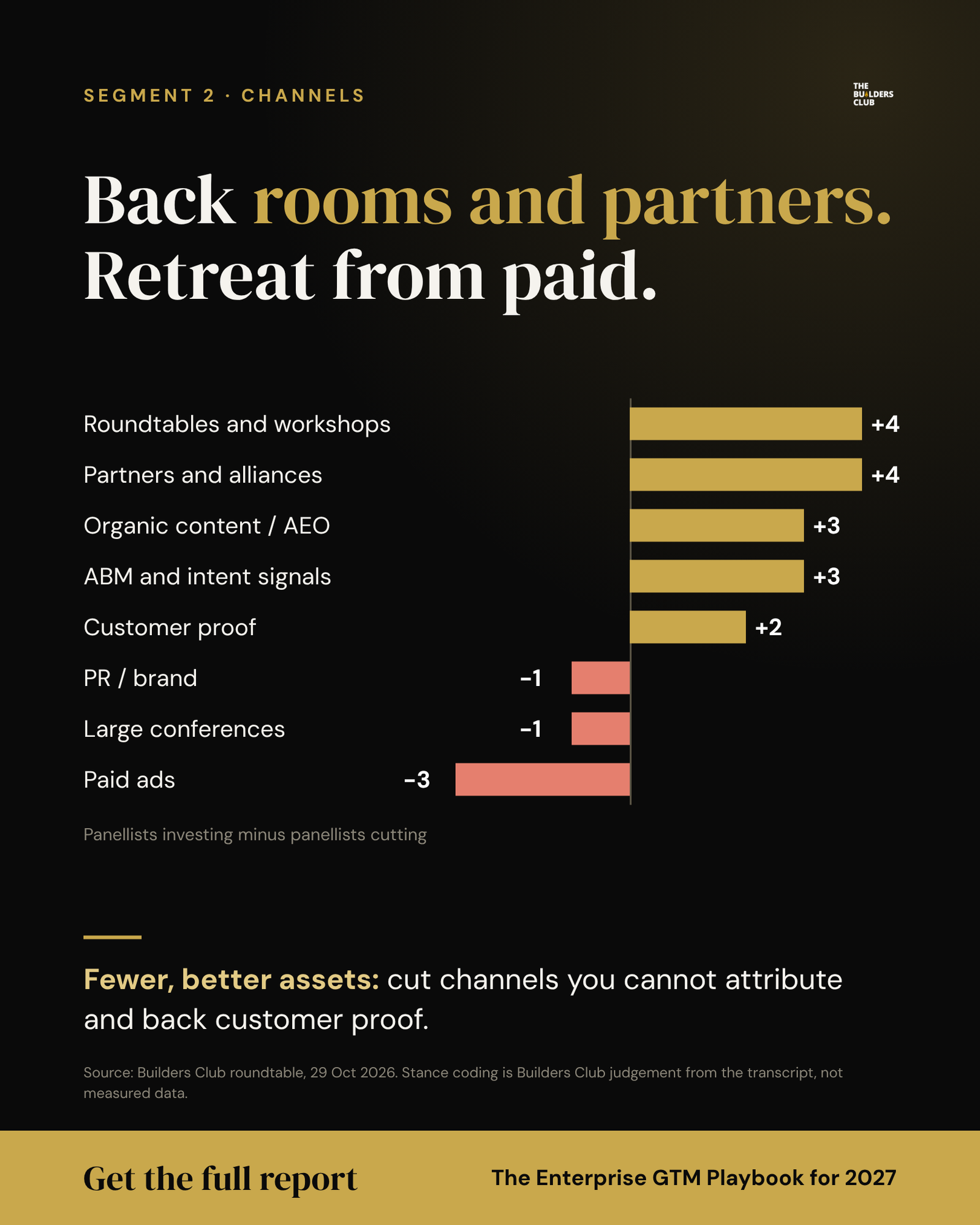
Each panellist was asked what worked in 2026 and what they would do differently in 2027. Counting panellists who are investing in each channel minus those cutting it, the net conviction reads as follows (a Builders Club reading of the transcript):
- Roundtables and workshops: +4
- Partners and alliances: +4
- Quality organic content / AEO: +3
- ABM and intent signals: +3
- Customer proof and references: +2
- PR / brand campaigns: -1
- Large conferences: -1
- Paid ads / online campaigns: -3
The paid-ads retreat and the rise of quality organic
Three of the six panellists are actively reducing paid acquisition. Anunta cut paid by about 85 per cent, E42.ai finds organic traction better than paid LinkedIn and Google ads, and Quickwork found online and direct-mail campaigns gave first meetings but low conversion on a complex, long-cycle sale. The data adds a dissent: Gartner finds paid media is still 30.6% of marketing budgets and HubSpot shows paid social among the largest planned increases. The cut is a choice about complex enterprise sales, not a market-wide trend.
We are really low on paid ads now. People have switched off from paid ads, thanks to all these answer engines coming and answering things for you. A customer talking about what he has done, a video case study, is working better.
Subramaniam Krishnan, Anunta
Fund channels by the job they do
Buyers often form a shortlist before contacting vendors, and some of that preference is built by channels attribution cannot see. A channel that cannot be attributed is not always one that does not work. The report’s framework tags every line of the budget with one role and judges it on that job:
| Role of the channel | Question it answers | Evidence to use |
|---|---|---|
| Demand creation (podcasts, organic content, community, customer stories, curated events) | Are target buyers forming a preference for us before they contact anyone? | Buyer interviews, share of target accounts reached, branded search trend, controlled holdouts |
| Demand capture (paid search, review sites, intent-triggered outreach, SEO) | Are we present when an in-market account looks for a solution? | Account-level attribution, pipeline from target accounts, intent-to-meeting conversion |
| Deal acceleration (case studies, references, roundtables for open deals, demos) | Does it move live opportunities forward faster, or lift win rate? | Stage velocity, win rate and cycle length for exposed vs unexposed deals |
Never cut a creation channel on attribution data alone. Review quarterly, and move money from the stop column to the increase column. This is a Builders Club framework, not a statement made by any panellist; thresholds and budgets should be set with finance.
ABM on signals, with sales in the loop
Raghav Kumar described Beacon.li as ABM-first rather than carpet-bombing companies. The system has five parts: a shared account list and ICP agreed with sales at the start of the year, a stack of intent signals (Bombora topic intent, first-party website intent, G2 category intent, sales-call transcripts and closed-door roundtable conversations), an explicit exclusion list, bi-weekly sprints with sales, and a feedback loop from won and lost conversations.
What doesn’t get said enough is knowing who you’re not supposed to sell to, and what the exclusion criteria are within your ICP. It’s a mistake we learned the hard way.
Raghav Kumar, Beacon.li
Alliances were the clear winner
Sohail Khan’s synthesis at the end of the segment: alliances and partnerships are the clear winner, organic and quality content is the way to go, and nothing mass is going to work; everything has to be hyper-personalised. Ashish Bhatia noted that hyperscalers sell through service providers and that depth matters, with real expertise across the breadth of a cloud’s services rather than three to five. Ramakrishna K’s rule of thumb: if one in four customers pursued through a partner closes, the spend on that partner is recovered.
Growing inside a mature category
Anunta sells managed desktop-as-a-service, a mature category with long cycles. Subramaniam Krishnan described two signals that drive expansion: day-to-day conversations between delivery staff and CIOs, CTOs and function heads, and conversations with the business leaders of the same account about their plans for the next one to two years. Customer workshops, cross-pollination between customers (a manufacturing client taken to a bank, for example) and roundtables with OEMs turn those signals into pipeline.
Segment 3: The AI Stack Behind Enterprise GTM
Each panellist gave a short view of the tools they use and what they see clients using. The pattern is a multi-model stack, with Claude named by all six panellists and individual teams stitching other models and automation tools around it.
- Anunta built an in-house ABM agent that works across engines: research on Perplexity, content on ChatGPT, and Claude inside HubSpot running campaigns and ABM.
- Beacon.li treats marketing owners as product managers of their discipline, tracks mentions and prompt gaps with tools built on Claude, Supabase and n8n, and packages key processes as Claude skills for consistency.
- E42.ai builds its own tools to cut recurring tool cost, and built an AI co-worker that reads signals and identifies intent across siloed market tools.
- Quickwork uses Claude skills for agentic orchestration and has enabled them for customers, keeping models open with small language models for on-prem and cloud.
- DXC uses RFP tools such as Loopio and Responsive plus internal RAG tools, and sees many product-based tools being substituted by well-trained LLMs.
Market data is consistent with the panel. Menlo Ventures puts Anthropic at 40% of enterprise LLM spend against 27% for OpenAI and 21% for Google, though the sample is US-only. On the buyer side, Forrester predicts agentic buying will play a role in 75% of B2B purchases in 2027, and Gartner forecasts $15 trillion of B2B spend intermediated by agents by 2028.
Technical evaluation will increasingly happen via agents. Your APIs and your user documentation will end up becoming your marketing channel.
Raghav Kumar, Beacon.li
On token costs, Sohail Khan expects prices to rise as frontier model providers become the railroads of the digital economy. a16z’s analysis shows the cost of a given level of performance falling about 10x a year, while total enterprise spend keeps climbing. Both can be true, so budget for volume, not price.
Six Predictions for 2027
Each panellist closed with one prediction. They rhyme: more scrutiny, more proof and more completeness.
- Subramaniam Krishnan, Anunta: customers will demand proof they can verify after 18 to 24 months of tall claims.
- Rahul Chaturvedi, Perfios: banks will favour technology players that solve the entire leg of the journey over point solutions.
- Ramakrishna K, E42.ai: buyers will ask how much of the process the AI co-worker can own; in finance that points toward self-operating finance.
- Raghav Kumar, Beacon.li: technical evaluation will run through agents, and documentation and APIs become marketing channels.
- Deepak Arjan Bhatia, Quickwork: a unified platform with end-to-end customer insight and lower total cost of ownership will decide which use cases AI powers.
- Ashish Bhatia, DXC: as in the 2018 to 2022 cloud era, CFOs will challenge CIOs on AI investment, efficiency promised and headcount unchanged.
Tested against the evidence we could verify, the strongest support is for the buyer-side predictions: verification, peer trust, agent-mediated evaluation and CFO scrutiny. The weakest is for vendor-specific outcomes such as self-operating finance, where no 2027 evidence was found. Build plans on the first group and treat the second as option value.
Choose Your Path: A 90-Day Plan
A single checklist hides the fact that the advice came from six different businesses. The full report sets out four paths, each with a target segment, buying committee, proposition, accountable owner, budget and day 30, 60 and 90 decision gates:
- Path A: emerging vendor entering a new market
- Path B: established vendor in a mature category with deep accounts
- Path C: established platform adding AI to an existing category
- Path D: direct entry after partner success
On when to go direct, treat 12 to 18 months as a typical window, not a rule. Move only when at least two in-market references will speak publicly, partners source or influence a meaningful share of pipeline at or above plan win rate, and the direct unit economics have been signed off by finance.
Your 2027 Action Checklist
- Narrow the ICP and name the problem. Pick one function or problem and lead with the outcome, with an explicit exclusion list reviewed bi-weekly with sales.
- Ship a governance and sovereignty pack. Data residency, support location, AI-governance model and a deployment menu in the first deck.
- Localise the value story per market. India: cost vs build. US: outcome and time to value. Gulf: compliance. Africa: economics at scale. Do not convert price lists.
- Price on outcomes and show the efficiency maths. Quantify process time saved, and prepare for 25 to 60 per cent efficiency asks in multi-year deals.
- Run a path-specific 90-day plan. Choose a path by maturity, category and market, with owners and decision gates.
- Fund channels by their job. Split demand creation, capture and deal acceleration, and put saved budget behind customer proof and curated events over mass reach.
- Build a joint customer growth programme. Baseline and success criteria before the pilot, a named customer owner, documented results and value reviews that surface expansion and references.
- Make yourself legible to agents. Treat documentation, APIs and structured content as marketing assets, and monitor how AI answer engines mention you.
Closing Directives From the Panel
Focus wins. More activities does not mean more growth.
Ramakrishna K, E42.ai
What really wouldn’t work in 2027 is something that is mass. What really would work is custom.
Ashish Bhatia, DXC Technology
Lead from the outcomes. AI is the how, not the end goal.
Raghav Kumar, Beacon.li
Customers will want proof that they can actually verify.
Subramaniam Krishnan, Anunta
Collaboration is going to be a very important way forward.
Deepak Arjan Bhatia, Quickwork
The 2027 playbook in one paragraph: pick a problem and prove it in production. Tell that story separately in each market. Let local partners open doors and customers vouch for you. Spend less on volume and more on curated rooms, quality content and signals you can measure. Be explicit about where data sits and who can touch it. And price on the outcome, because the CFO is going to ask for the money.
Get the Complete Enterprise GTM Playbook for 2027
The full report goes further than this summary. It includes:
✓ Theme consensus and channel scorecard showing which of the six panellists is investing, maintaining or cutting each channel
✓ Panel vs market scorecard testing each claim against analyst, survey and regulator data
✓ Regional demand data for India, the Gulf, Africa, Southeast Asia, Europe and the US
✓ Four 90-day execution paths with owners, budgets and decision gates
✓ A full source index for every market figure cited
About This Report
Transcript-derived content reflects the 29 October 2026 CMO Roundtable hosted by The Builders Club. Quotes are lightly edited for length and readability, and figures attributed to panellists are verbal estimates, not audited data. Charts labelled as Builders Club analysis are our tallies and codings of the transcript. Secondary data was verified on source pages on 30 October 2026; items reported via another publisher’s study should be checked at origin before external citation.
The Builders Club is a community of 35,000+ founders and CXOs across India, the UAE, Singapore and the US.
Frequently Asked Questions
The Enterprise GTM Playbook for 2027 is a Builders Club report built from the CMO Roundtable held on 29 October 2026. It brings together insights from marketing and business leaders at DXC Technology, Perfios, Quickwork, Beacon.li, Anunta and E42.ai, and sets their claims against 2025 and 2026 market data. It ends with four 90-day execution paths and an eight-point action checklist.
Six operators spoke: Ashish Bhatia (DXC Technology), Rahul Chaturvedi (Perfios), Deepak Arjan Bhatia (Quickwork), Raghav Kumar (Beacon.li), Subramaniam Krishnan (Anunta) and Ramakrishna K (E42.ai). The session was moderated by Sohail Khan of The Builders Club.
Ashish Bhatia said that annual efficiencies of 6 to 7 per cent used to be pre-baked into cost models, while in the last 6 to 12 months clients have asked for 50 to 60 per cent across a five-year term. Reuters reporting on Indian IT services shows similar pressure, though these are executive statements rather than a client survey. The practical response is to quantify process time saved and anchor price on that saving.
Perfios used a local partner as the primary channel for the first 12 to 18 months, then built direct sales. The panel’s four partner-selection attributes are domain credibility, access to decision makers, understanding of your solution, and commitment to build together. The report advises moving to direct only when references, partner performance and commercial readiness all pass, not on a calendar.
Three of the six panellists are reducing paid acquisition. Anunta cut its paid budget by about 85 per cent, E42.ai finds organic outperforming paid LinkedIn and Google ads, and Quickwork found online campaigns gave first meetings but low conversion. The report cautions that this is a choice for complex, long-cycle enterprise sales, since market data shows paid media is still a large share of marketing budgets overall.
The report recommends tagging every budget line with one role: demand creation, demand capture or deal acceleration. Each role is judged on its own evidence, such as buyer interviews and holdout tests for creation, account-level attribution for capture, and stage velocity for acceleration. A creation channel should not be cut on attribution data alone.
The full 40-page report is available to download from the link in the Get the Complete Enterprise GTM Playbook for 2027 section above.