
// PODCAST

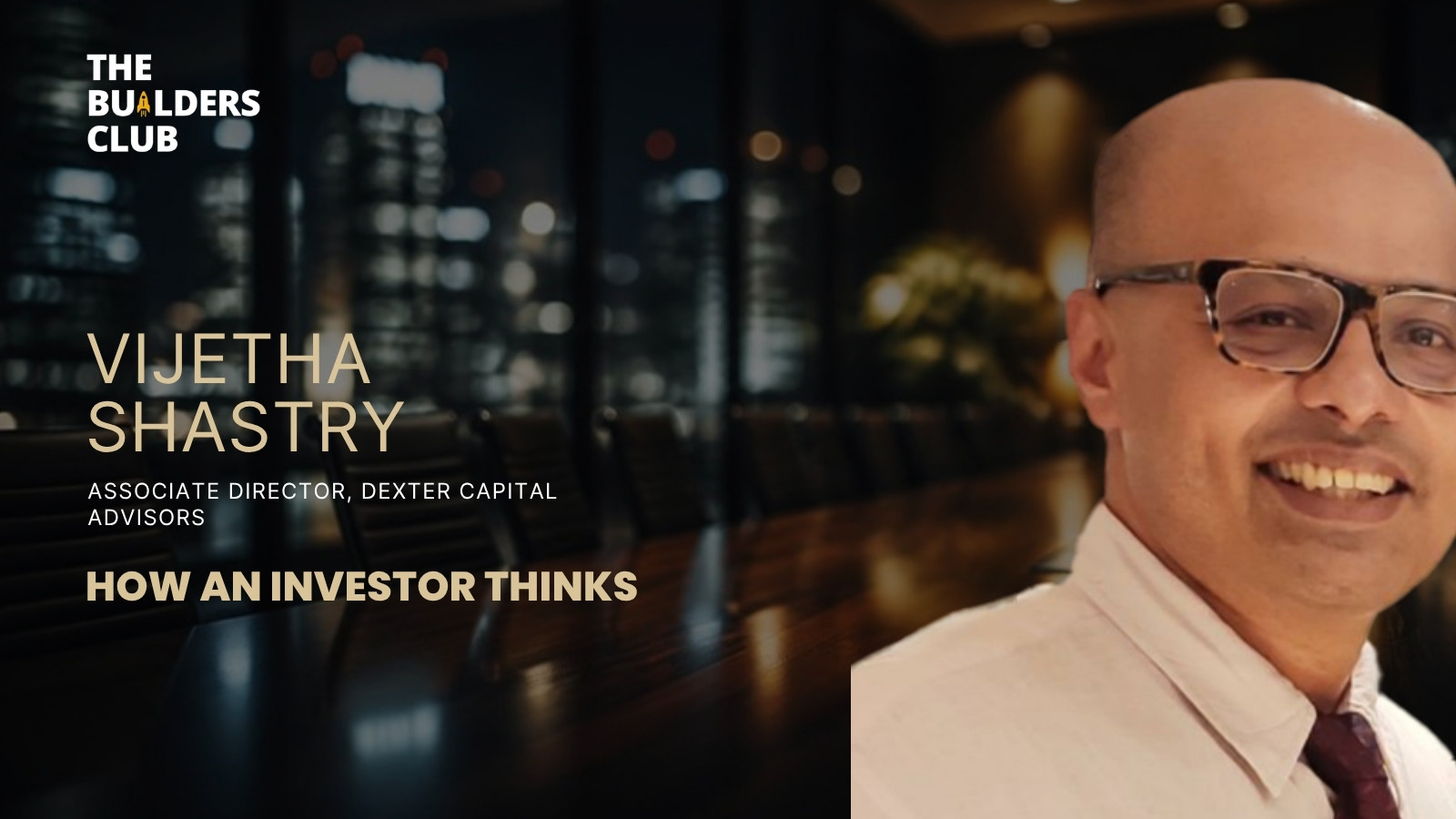
How an Investor Thinks: What VCs and Angels Look For | Vijetha Shastry, Dexter Capital

Vijetha Shastry of Dexter Capital and Dexter Angels, with nearly three decades in the startup ecosystem, explains what drives investors, how funds work and how founders should approach them.
Vijetha Shastry, Dexter Capital on The Builders Club Startup Founders Podcast
Advertisement

Every founder has been told no by an investor and wondered why. Vijetha Shastry has spent close to three decades around startups, from NASSCOM and TiE to Headstart, and now works on the investor side at Dexter Capital and Dexter Angels.

In this episode he explains how an investor thinks, what they check before writing a cheque, and what founders keep getting wrong.

How does an investor think? Vijetha Shastry’s core thesis

Investors make money only when there is an exit, so almost every decision traces back to that. Vijetha’s advice is to look at your startup through the investor’s eyes: the team, the size of the sector, regulation, and whether the business can plausibly scale beyond one city.

A no is rarely personal. Usually the company simply does not fit that fund’s thesis, stage or existing portfolio, and good venture capital investors are also answerable to the people whose money they manage.

  • Exits drive everything. Funds return money to their own backers, so they back companies with a credible path to a follow-on round or exit.
  • Research the investor first. Theses, portfolios and stages are public; spraying every fund wastes a founder’s scarce time.
  • Due diligence is deep. Expect checks on the founders, customers, partners and sector risks.
  • Do the basics properly. Register the company, keep clean legal paperwork and show real customer proof.

What do investors look for in a founder and a startup?

Vijetha says investors start with the founding team and the size of the market, then ask whether this team can actually address it. They will talk to alumni networks and people the founder may not even know are being called.

He also stresses global ambition. A business built only for a small city rarely produces the large exits that investors need.

  • The founding team, its reputation and whether it can handle stress
  • Market size, and a real USP or moat, not just a big addressable market
  • Regulation and policy risk, especially in fintech, crypto and Web3
  • Governance and compliance, including diversity and environmental goals at many funds

How does a VC fund make money and why does that matter to founders?

A VC fund is a bit like a startup: it raises money from limited partners such as family offices, pension funds and institutions, then invests it over several years. A small share goes to management fees, and profits above that become the fund’s carry.

Because funds must return capital in a few years, even patient investors have a clock. Vijetha notes that funds also specialise, so each one behaves differently.

  1. The fund raises capital from family offices, HNIs, pension funds and others.
  2. It invests across a portfolio in tranches over several years.
  3. Exits and follow-on rounds return money to backers.
  4. A track record lets the fund raise its next fund.

How should founders approach the right investors?

His strongest message is against a spray-and-pray approach. If a fund only backs D2C, a SaaS founder is wasting everyone’s time, and an early-stage fund will not answer a request for a very large cheque.

He suggests a one-pager plus a longer deck, and talking to founders already in the investor’s portfolio.

Where does the research come from?

Most of it is public: fund theses, portfolios, published industry reports and events. Reports from consulting firms and bodies like NASSCOM are useful for understanding where funds are looking.

  • Read the fund thesis and the existing portfolio
  • Check if the fund already backs a competitor
  • Network at demo days and community events

How do you reach a fund?

You do not always need the general partner. A partner or principal can take your pitch to the analysts, who dig into the sector and ask for MIS and information.

How do early-stage founders handle advisors, legal basics and pre-orders?

In the live Q&A, Vijetha repeatedly warned founders to get the basics right. He told one founder to build a checklist before seeking an advisor, involve a lawyer, link compensation to milestones and avoid handing out too many advisory shares that can hurt the next round.

To another founder, he said to register the company first, open a current account and treat unpaid pre-orders as weak proof. Real advances or payments carry more weight.

  • Draft a checklist of what you need from an advisor
  • Use contracts and NDAs, and tie rewards to outcomes
  • Register the company before taking money
  • Raise from family and friends before thinking about Series A

Should founders chase speed and scale or profitability?

There is no single answer, in his view. He pointed to recent examples of blitzscaling backfiring and said scaling with poor-quality customers fails under due diligence, because retention, unit economics and runway get checked.

The skill is reading the market: expand rapidly when cash, customers and unit economics are strong, and conserve cash when conditions in your sector are weak.

Do investors compete with each other?

Companies compete, but investors usually collaborate. A lead investor typically takes a large share and brings in others for the rest, and everyone wants the best founders and the best terms.

Vijetha adds that term sheets and shareholder agreements are critical documents, and funding usually arrives in tranches linked to milestones.

Further reading and sources

Frequently asked questions

What is the main thing investors want from a startup?

A credible path to an exit. Investors make money when there is a follow-on round or sale, and they must return capital to their own backers. That is why they look closely at team, market size and scalability.

How do I find the right investor for my startup?

Research funds’ public theses, stages and portfolios, and only approach those that match your sector and stage. Talking to founders in their portfolio and attending community events also helps. Avoid mass-emailing every fund.

Why do investors say no even when the idea is good?

Often it is fit, not quality. The startup may be outside the fund’s sector or stage, overlap with an existing portfolio company, or lack proof such as paying customers. A no is not necessarily a verdict on you.

Conclusion

Vijetha’s message is to think from the investor’s side: understand their incentives, research before you reach out, and show proof, not promises.

Before your next conversation, write your one-pager, shortlist five matching funds and tidy your legal basics.

Want more conversations like this? Join The Builders Club, our community of 35,000+ founders and CXOs, and explore more episodes of the Startup Founders Podcast.

Never miss an episode

Join 35,000+ founders and CXOs in The Builders Club community.

Join the Community
Advertisement
Advertisement
Facebook
X
LinkedIn
Silicon Valley VPs vs. Indian Family Business Promoters

The Executive Sponsor Trap: Selling to Silicon Valley VPs vs. Securing Commitments from Indian Family Business Promoters

A Silicon Valley VP can usually sign inside a budget they own. An Indian family business promoter often holds the final say but delegates the evaluation, and that gap is where deals stall. Treating a friendly mid-level sponsor as the decision-maker is the most common mistake in cross-border enterprise sales. Here is how the two models differ and how to secure a commitment that survives promoter review. What is the executive sponsor trap? It is the assumption that the person championing your product has the authority to buy it. In US enterprise sales, a VP or director often does hold budget. In many Indian family-run groups, authority sits with the promoter or family council, while managers and professional CEOs run evaluations. How do US VPs make buying decisions? Delegated authority. A VP typically owns a departmental budget with a defined spending limit. Process-led approval. Procurement and legal run a standard path once a business case is approved. Rep-free research. Buyers do much of their research independently, as shown in Gartner’s 2026 sales survey, so your first call is rarely the start of their evaluation. How do Indian family business promoters make buying decisions? Final say at the top. The promoter or a small family circle may approve significant spend, even when a professional CEO handles daily operations. For context, see Business Today on professional CEOs in Indian business families. Trust over process. A recommendation from a known peer, advisor or existing vendor carries heavy weight. Group thinking. Decisions consider the whole group, not only one business unit, which can slow or accelerate a deal sharply. Tech caution. Research on Indian family businesses by Inc42 describes growth-driven but technology-cautious attitudes, which means proof and references matter. Academic work such as the Indian School of Business research on family business groups offers background on how these groups are structured. Sponsor authority compared: Silicon Valley vs family-run Indian groups Factor Silicon Valley VP Indian family business promoter Budget ownership Often in the VP’s own budget Often approved at group or promoter level Who evaluates The VP’s team Managers, CIO or professional CEO What builds trust Data, ROI case, peer reviews Personal credibility, references, introductions Typical blocker Competing priorities and budget timing No access to the final decision-maker Commitment signal Signed order form Promoter or senior leadership endorsement, then paperwork How do you secure a real commitment from a promoter-led company? Ask the authority question early. “Who gives the final nod on a decision of this size?” is polite and effective. Arrange a senior-to-senior meeting. Your founder or most senior leader meets the decision-maker with the sponsor’s backing. Use a trusted introducer. A mutual contact, existing client or advisor opens doors more reliably than outreach. Give the sponsor a promoter-ready summary. One page covering outcome, risk, cost, and references in plain language. Confirm the paperwork route. Once approval is verbal, ask who triggers legal, security and procurement. What if you cannot reach the promoter? Work through the professional CEO or CIO, and ask them to describe what the promoter will want to see. Prepare that material in advance. FAQ Who makes the final software buying decision in an Indian family-owned business? It varies, but for significant spend the final approval often rests with the promoter or a small family group, while managers and a professional CEO run the evaluation. Ask early who gives the final nod. How is selling to a US VP different from selling to an Indian business promoter? US VPs typically own a budget and follow a defined buying process. Promoters weigh trust, references and group-level considerations, so you need senior access and credible introductions. How do I get a meeting with a promoter or business owner? Use warm introductions from mutual contacts, existing customers, advisors or community events. Ask your internal sponsor to request the meeting and prepare a short, outcome-focused briefing. Conclusion Do not mistake enthusiasm for authority. In the US, test whether your VP owns the budget. In Indian family groups, find the person who gives the final nod, and get there through trusted introductions and a promoter-ready summary. Need warm introductions to promoter-led enterprises? Join The Builders Club. References and further reading Gartner Sales Survey: 67% of B2B buyers prefer a rep-free experience (2026) Gartner: The B2B buying journey and how to optimise it Business Today: Why Indian business families are hiring professional CEOs Inc42: Indian family businesses are growth-driven but tech-cautious Indian School of Business: Family business groups in India About the author: Sohail Khan is Founder and Director of The Builders Club, a professional community of 35,000+ founders and CXOs across India, UAE, Singapore and the US.

Read More »

Why the Self-Serve PLG Playbook Fails with Indian Enterprise CXOs (And the High-Touch Assisted Model That Actually Wins)

Self-serve PLG works when the user is also the buyer. In Indian enterprises, they almost never are. A product-led funnel can get your tool into a team’s hands, but it rarely gets a CXO to sign. The model that wins is a high-touch, assisted motion that uses product usage as proof, not as the whole sales strategy. Here is why the standard playbook stalls in India’s large organisations, and what to run instead. Why does the self-serve PLG playbook fail with Indian enterprise CXOs? Product-led growth, as described by pioneers such as OpenView, assumes that users discover, try and adopt the product themselves, and that revenue follows usage. That assumption holds for tools with low risk, low price and individual buyers. Enterprise buying in India breaks all three conditions at once. The user is not the buyer. An analyst may love your tool. The budget sits with a CIO, CFO or business head who has never opened it. Risk is organisational. A CXO signs against security, vendor-continuity and reputational risk, none of which a free trial answers. Trust is personal. Decisions often move on credibility, references and conversations with someone they respect, not on a sign-up flow. Does a free trial or freemium plan ever work in Indian enterprises? It can work for teams, departments and SMB-sized units, where one manager has a card or small discretionary budget. It rarely scales to the top accounts without a human who turns usage into a business case. What does the high-touch assisted model actually look like? Assisted does not mean old-fashioned. It means every stage of the product experience is paired with a person who removes a specific obstacle. Stage Pure self-serve PLG Assisted model for Indian enterprises Discovery Organic search, product trial Warm introduction, peer room, referral Evaluation Self-guided trial Guided pilot with named success criteria Decision User upgrades with a card Business case built for the CXO and the committee Contracting Click-through terms Negotiated MSA, security review, procurement Expansion In-app prompts Account lead plans rollout across divisions How do you turn product usage into a signed enterprise contract? Use the product as the evidence, and a person as the translator. A practical sequence: Find your champion. Identify the user who gets the most value and ask them to explain the problem in their own words. Quantify the result. Convert usage into time saved, errors avoided or revenue influenced, in a one-page summary the CXO can read in two minutes. Map the buying committee. Ask your champion who else must say yes: IT, security, finance, legal, and the business owner. Run an executive conversation. A founder or senior lead speaks to the CXO about outcomes and risk, not features. Offer a scoped commitment. A defined pilot or first-division rollout with clear exit and expansion terms reduces perceived risk. When should you still invest in self-serve? Do not abandon it. Use self-serve as the top of the funnel and as a signal engine. Track which accounts have several active users, which teams invite colleagues, and which admins explore security settings. Those are the accounts your sales team should call first. Think of it as product-qualified leads feeding a human-led close. Many global companies now run exactly this hybrid, and it fits Indian enterprise buying better than a pure self-serve approach. FAQ Is PLG dead for B2B SaaS in India? No. PLG is useful for building awareness, usage data and champions inside accounts. It fails as the only motion for large enterprises, where committees, security reviews and relationships decide the contract. A hybrid model works better. What is a product-qualified lead (PQL)? A PQL is an account or user whose in-product behaviour suggests buying intent, such as multiple active teammates or admin-level exploration. Sales teams use PQLs to prioritise who to approach with a human conversation. How many people does an assisted enterprise sale need? It depends on deal size, but you typically need one senior owner for the relationship, one technical resource for security and integration questions, and a customer success lead after signing. Founders often cover the first two roles in early deals. Conclusion PLG gets you into the room, but it does not get a CXO to sign. In Indian enterprises, winning sales pair product evidence with human trust: a champion, a business case, a guided pilot and a senior conversation. Building an assisted enterprise motion? Meet founders and CXOs who have done it at The Builders Club, and bring your toughest sales question to our next roundtable. Join The Builders Club. About the author: Sohail Khan is Founder and Director of The Builders Club, a professional community of 35,000+ founders and CXOs across India, UAE, Singapore and the US.

Read More »