// ARTICLE

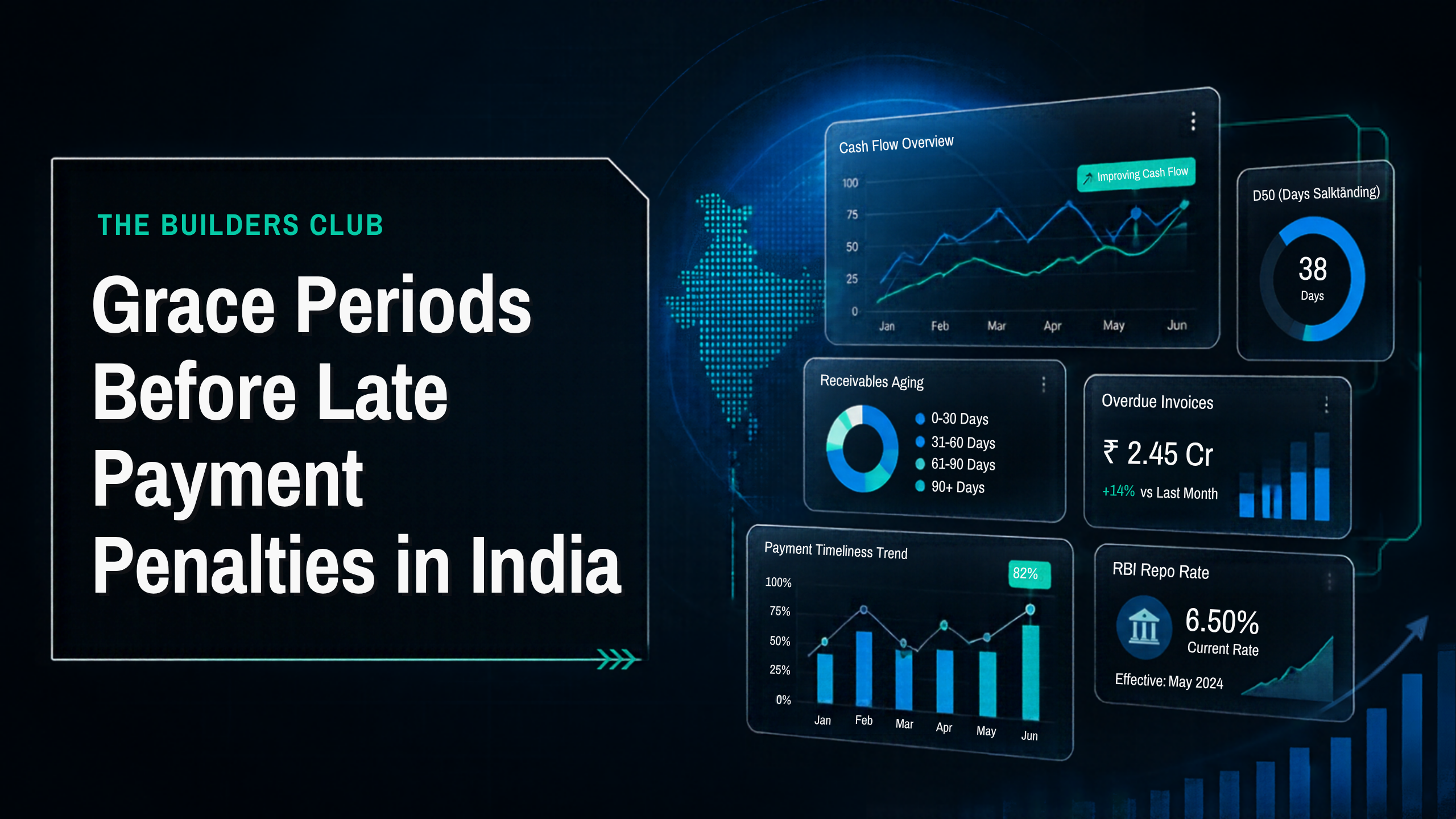
What Is the Standard Grace Period Before Late Payment Penalties Apply for Indian Enterprise Clients?

Grace periods, payment terms and late fees in Indian enterprise contracts: MSME rules, Section 43B(h), Section 74 and clause wording that holds up.
Grace periods before late payment penalties in India - The Builders Club
Advertisement

Your contract says payment is due in 30 days and late fees apply after that. The customer’s finance team reads “30 days” as “30 days from our internal approval”. The late fee clause then gets struck out in legal review, “as it is not our policy”.

Few clauses in an enterprise contract cause as much quiet friction as the one on late payment.

What is the short answer on grace periods for late payment in India?

There is no single standard grace period for Indian corporate clients. In practice, buyers negotiate a payment term (commonly counted from receipt of a correct invoice) and then a short grace window of about a week to a fortnight before interest applies. The one firm benchmark is the law for micro and small suppliers: payment within the agreed period, capped at 45 days, or 15 days if nothing is agreed in writing.

The grace window figures here are common negotiating practice, not a rule. Treat them as a starting point.

What does Indian law say about payment deadlines?

If you are a registered micro or small enterprise, the MSMED Act and Section 43B(h) of the Income Tax Act apply to buyers paying you. Payment must be made by the agreed date, which cannot exceed 45 days from acceptance of the goods or services, and by 15 days where there is no written agreement. Delayed payment attracts compound interest at three times the RBI bank rate. See this ClearTax explainer on Section 43B(h) and the Business Standard explainer on the 45-day MSME payment rule.

  • It protects suppliers classed as micro or small enterprises, not medium or large vendors.
  • Check your Udyam registration and classification with your chartered accountant.
  • Policy changes have been discussed, so confirm the current position before relying on it. See this YourStory report on proposals to relax the rule.

How do grace periods work in practice?

Payment term versus grace period

The payment term is the number of days in which the invoice is due. The grace period is the extra time after the due date before late interest starts. Many contracts have the first and not the second, and buyers then ask for one. Agree both, and agree what starts the clock.

What starts the clock

Specify one of: invoice date, date of receipt of a correct invoice, or date of acceptance. The first is best for you. The last gives the customer the most control. Add a deemed-acceptance rule so that silence is not a way to delay payment.

Contract point Vendor-friendly position Common compromise
Payment term 30 days from invoice date 30 to 45 days from receipt of a correct invoice
Grace period None, interest from the due date 7 to 15 days before interest applies
Late interest Monthly rate on overdue amount Lower rate, capped, on undisputed amounts only
Suspension right Suspend service after notice Suspend after 30 days overdue and written notice
Disputed invoices Pay undisputed part on time Dispute raised in writing within a set period

Can you enforce late payment penalties in India?

You can, if they are a reasonable pre-estimate of loss. Section 74 of the Indian Contract Act lets a court award reasonable compensation up to the amount named, not a punitive sum. Interest on overdue invoices is therefore safer than a flat penalty. For the legal background, see this SCC Online analysis of Section 74 and liquidated damages.

What should the late payment clause say?

  1. State the payment term and what starts the clock.
  2. State a grace period in calendar days.
  3. State interest on overdue undisputed amounts, from the end of the grace period.
  4. Give the right to suspend service after written notice for persistent non-payment.
  5. Set a short, written window for the customer to dispute an invoice.

How do you keep the relationship intact while chasing payment?

Send a polite reminder before the due date, copy the business sponsor, and escalate only after the grace period passes. Most delays are process failures such as a missing purchase order number, not a refusal to pay. Fix the process first.

References and Further Reading

Frequently Asked Questions

Is there a standard grace period before late payment penalties in Indian B2B contracts?

No. Terms are negotiated, and a short grace window of roughly a week to a fortnight after the due date is a common compromise. Micro and small enterprise suppliers have a statutory limit of 45 days on payment terms, with 15 days if there is no written agreement.

Can I charge interest on late payments from Indian enterprise customers?

Yes, if the contract provides for it. Interest on overdue undisputed amounts is easier to defend than a fixed penalty, because Indian courts look for reasonable compensation for the loss. Ask your lawyer to check the wording, and note that micro and small suppliers have statutory interest rights.

What if the customer says their policy does not allow late payment fees?

Offer alternatives: a reasonable grace period, a lower interest rate on undisputed amounts only, or a right to suspend service after notice. These protect you without a headline penalty. Also check whether the MSME payment rules apply to you, since they operate regardless of contract wording.

Conclusion

Late payment terms are negotiable, but they are not optional. Define the payment term, the starting event, a modest grace period and interest on undisputed overdue amounts, and check whether the MSME rules already protect you. Good drafting turns an awkward chase into a routine process.

This article is general information, not legal, tax or financial advice. Please consult your CA or lawyer.

If you are building a B2B company for Indian enterprise buyers, join The Builders Club community to compare notes with other founders and CXOs who are working through the same problems.

About the author: Sohail Khan is the Founder and Director of The Builders Club, a professional community of 35,000+ founders and CXOs across India, the UAE, Singapore and the US. He writes about enterprise go-to-market, sales and scaling for B2B founders.

Advertisement
Advertisement
Facebook
X
LinkedIn

Why the Self-Serve PLG Playbook Fails with Indian Enterprise CXOs (And the High-Touch Assisted Model That Actually Wins)

Self-serve PLG works when the user is also the buyer. In Indian enterprises, they almost never are. A product-led funnel can get your tool into a team’s hands, but it rarely gets a CXO to sign. The model that wins is a high-touch, assisted motion that uses product usage as proof, not as the whole sales strategy. Here is why the standard playbook stalls in India’s large organisations, and what to run instead. Why does the self-serve PLG playbook fail with Indian enterprise CXOs? Product-led growth, as described by pioneers such as OpenView, assumes that users discover, try and adopt the product themselves, and that revenue follows usage. That assumption holds for tools with low risk, low price and individual buyers. Enterprise buying in India breaks all three conditions at once. The user is not the buyer. An analyst may love your tool. The budget sits with a CIO, CFO or business head who has never opened it. Risk is organisational. A CXO signs against security, vendor-continuity and reputational risk, none of which a free trial answers. Trust is personal. Decisions often move on credibility, references and conversations with someone they respect, not on a sign-up flow. Does a free trial or freemium plan ever work in Indian enterprises? It can work for teams, departments and SMB-sized units, where one manager has a card or small discretionary budget. It rarely scales to the top accounts without a human who turns usage into a business case. What does the high-touch assisted model actually look like? Assisted does not mean old-fashioned. It means every stage of the product experience is paired with a person who removes a specific obstacle. Stage Pure self-serve PLG Assisted model for Indian enterprises Discovery Organic search, product trial Warm introduction, peer room, referral Evaluation Self-guided trial Guided pilot with named success criteria Decision User upgrades with a card Business case built for the CXO and the committee Contracting Click-through terms Negotiated MSA, security review, procurement Expansion In-app prompts Account lead plans rollout across divisions How do you turn product usage into a signed enterprise contract? Use the product as the evidence, and a person as the translator. A practical sequence: Find your champion. Identify the user who gets the most value and ask them to explain the problem in their own words. Quantify the result. Convert usage into time saved, errors avoided or revenue influenced, in a one-page summary the CXO can read in two minutes. Map the buying committee. Ask your champion who else must say yes: IT, security, finance, legal, and the business owner. Run an executive conversation. A founder or senior lead speaks to the CXO about outcomes and risk, not features. Offer a scoped commitment. A defined pilot or first-division rollout with clear exit and expansion terms reduces perceived risk. When should you still invest in self-serve? Do not abandon it. Use self-serve as the top of the funnel and as a signal engine. Track which accounts have several active users, which teams invite colleagues, and which admins explore security settings. Those are the accounts your sales team should call first. Think of it as product-qualified leads feeding a human-led close. Many global companies now run exactly this hybrid, and it fits Indian enterprise buying better than a pure self-serve approach. FAQ Is PLG dead for B2B SaaS in India? No. PLG is useful for building awareness, usage data and champions inside accounts. It fails as the only motion for large enterprises, where committees, security reviews and relationships decide the contract. A hybrid model works better. What is a product-qualified lead (PQL)? A PQL is an account or user whose in-product behaviour suggests buying intent, such as multiple active teammates or admin-level exploration. Sales teams use PQLs to prioritise who to approach with a human conversation. How many people does an assisted enterprise sale need? It depends on deal size, but you typically need one senior owner for the relationship, one technical resource for security and integration questions, and a customer success lead after signing. Founders often cover the first two roles in early deals. Conclusion PLG gets you into the room, but it does not get a CXO to sign. In Indian enterprises, winning sales pair product evidence with human trust: a champion, a business case, a guided pilot and a senior conversation. Building an assisted enterprise motion? Meet founders and CXOs who have done it at The Builders Club, and bring your toughest sales question to our next roundtable. Join The Builders Club. About the author: Sohail Khan is Founder and Director of The Builders Club, a professional community of 35,000+ founders and CXOs across India, UAE, Singapore and the US.

Read More »
Why US Retention Playbooks Fail with Indian Conglomerates

Enterprise SaaS Churn Showdown: Why Customer Retention Strategies in the US Market Fail with Indian Conglomerates

US retention playbooks are built on product usage. Indian conglomerates renew on relationships, sponsor continuity and internal politics, so a healthy usage dashboard can still hide a churn risk. Founders who copy the US customer success model often see accounts go quiet, then disappear at renewal with no warning. This guide compares how churn actually happens in the two markets and what to change in your retention system. How does churn differ between US enterprise accounts and Indian conglomerates? In the US, churn is usually signalled by falling usage, low adoption and unanswered success calls. Health scores, automated playbooks and quarterly business reviews are designed to catch these signals early. In large Indian groups, churn is more often triggered by a change in people, budget ownership or group-level vendor policy. Usage can look fine while the real decision is being made in a room you are not in. Note: there is no reliable public dataset comparing enterprise SaaS churn between the US and Indian conglomerates. The patterns below describe how buying and renewal typically work. Validate them against your own renewal history. Why do US retention strategies stall in Indian groups? The user is not the renewer. A product-led health score tracks users, but renewal is approved by a business head, CIO or finance owner who may never log in. Sponsor change breaks the account. A transfer or reorganisation can remove your champion overnight, and the new owner inherits a vendor they did not choose. Group-level consolidation. Corporate procurement may rationalise vendors across entities, replacing point solutions with a single group-approved supplier. Silence is not satisfaction. Indian teams may avoid raising problems directly, so a relationship manager hears concerns that a ticket queue never shows. For a framework on why net revenue retention drives enterprise value, see McKinsey’s analysis of net revenue retention in B2B tech. The metric matters everywhere; what changes is the leading indicator you track. US vs Indian conglomerate retention: a side-by-side comparison Dimension US enterprise pattern Indian conglomerate pattern Main churn signal Declining product usage Sponsor change, budget reshuffle, vendor consolidation Who renews Department head with a defined budget Business head plus IT, finance and procurement Best early-warning tool Health score and automated alerts Named relationship owner and regular executive contact Typical save play Adoption campaign, training Senior-to-senior conversation and a group-level value review Renewal timing Calendar-driven Budget-cycle and approval-chain driven What should a retention system look like for Indian enterprise accounts? Map at least three contacts per account. One champion, one budget owner and one technical or compliance contact. Start renewal conversations 120 to 180 days out. Approval chains are long, so a 30-day reminder is too late. Review business outcomes, not features. Bring a one-page value summary the sponsor can forward to their own boss. Track people changes. Set a trigger when a champion changes role, and request an introduction to the successor within two weeks. Assign a named relationship owner. A shared support inbox is not a relationship. What metrics should replace pure usage health scores? Add relationship and commercial signals: executive meetings held in the last quarter, number of active sponsors, approval status of the next renewal, and any open procurement or security reviews. FAQ Why do Indian enterprise customers churn even when product usage is high? Renewal is often decided by people who do not use the product, such as business heads, IT and procurement. A sponsor change, budget cut or group-level vendor consolidation can end a contract regardless of usage. How early should I start an enterprise renewal in India? Start 120 to 180 days before term end. Approval chains involve several functions, and late starts leave no time to resolve security, legal or commercial questions. Can US customer success tools be used for Indian accounts? Yes for tracking adoption and tickets, but they need an added relationship layer. Pair them with named account owners, executive contact tracking and a record of every stakeholder in the approval chain. Conclusion Retention is a relationship problem as much as a product problem in Indian conglomerates. Keep your US-style usage analytics, then add stakeholder mapping, early renewal conversations and a named relationship owner for every large account. Want to compare retention playbooks with founders who sell to Indian groups? Join The Builders Club. References and further reading McKinsey: The net revenue retention advantage in B2B tech Gartner: The B2B buying journey and how to optimise it Harvard Business Review: The risks of prioritising short-term revenue over customer fit Inc42: Indian family businesses are growth-driven but tech-cautious NASSCOM-Frost: Enterprise digital transformation About the author: Sohail Khan is Founder and Director of The Builders Club, a professional community of 35,000+ founders and CXOs across India, UAE, Singapore and the US.

Read More »