// ARTICLE

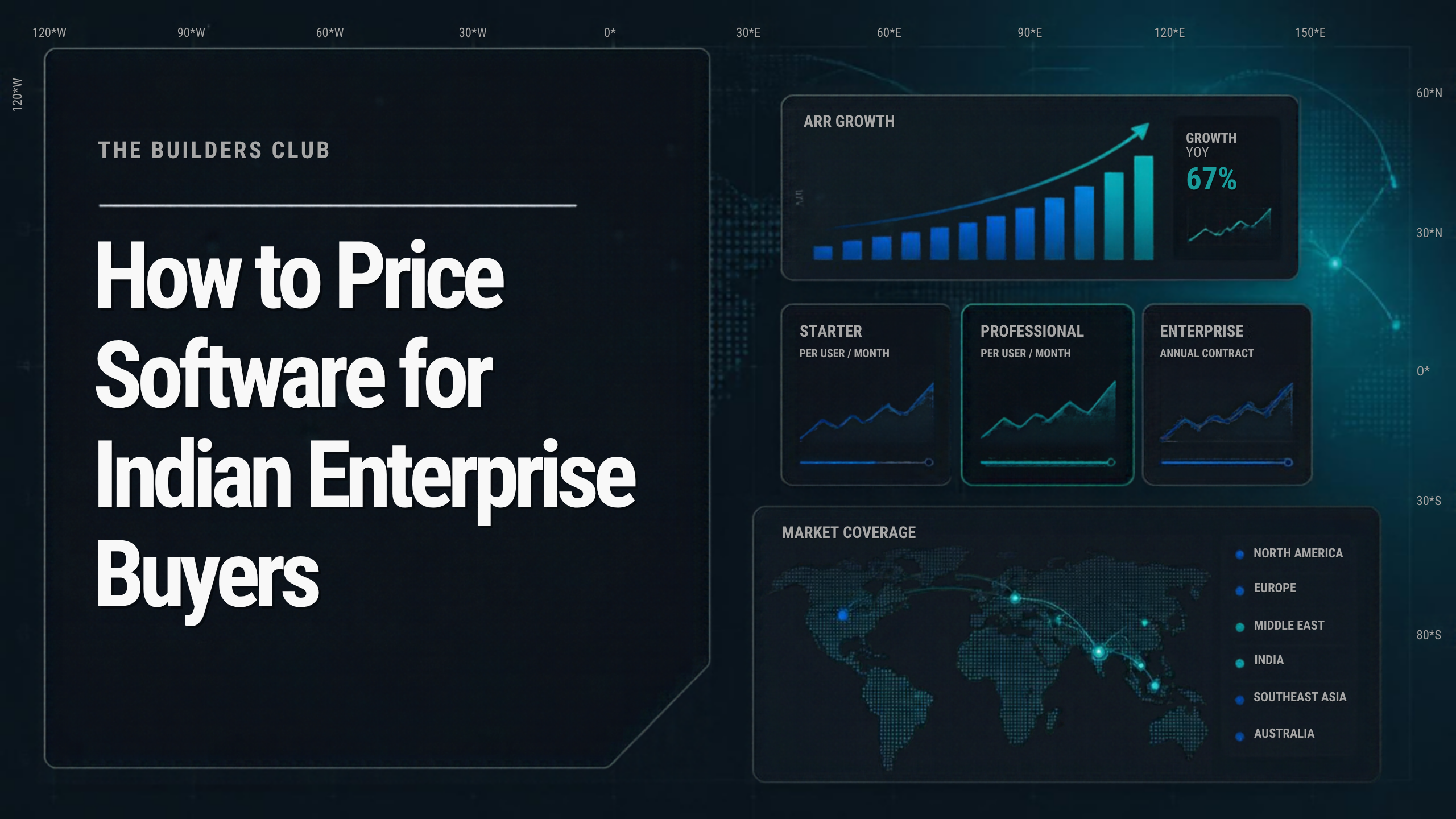
How to Price Software for Indian Enterprise Buyers Without Custom Requests Eating Your Margin

A practical pricing and scope framework for B2B founders selling software to Indian enterprises, with a change-request process that protects margins.
How to price software for Indian enterprise buyers without custom requests eating your margin
Advertisement

Every founder selling to Indian enterprises eventually gets the same email: “We love the product. Just a few small changes for our environment.” Six months later, half your roadmap belongs to one customer and the contract value has not moved.

The problem is rarely the customer. It is a pricing model that treats customisation as free.

What is the short answer on pricing software for Indian enterprises?

Price the product as a standard platform fee, price anything custom as separately scoped and separately paid work, and give every change request a clear route: configuration, paid services, or the product roadmap. If a request has no price and no route, it becomes free engineering.

The rest of this post breaks down how to set that up so it survives a procurement negotiation.

Why do custom requests destroy margins in Indian enterprise deals?

Three forces combine. Large buyers often run procurement as a competitive process, so every vendor is asked to fit the buyer’s existing workflow. Business teams negotiate scope informally while procurement negotiates price formally. And founders, eager to land a marquee logo, say yes in meetings that nobody records.

The result is scope that grows without a matching invoice. Your effective margin falls quietly, and it shows up months later as engineers stuck on one account.

How should you structure pricing for an enterprise buyer?

Separate the platform fee from services

Use two lines on every commercial proposal: a recurring platform fee and a one-time or time-boxed implementation fee. The platform fee covers what every customer gets. The implementation fee covers integration, data migration, configuration and training.

Anchor on value metrics, not only seats

Seat pricing invites arguments about how many users “really” need access. A metric tied to usage, such as transactions, entities, locations or modules, grows with the value the customer gets and is harder to discount arbitrarily.

Build in a standard discount ladder

Decide in advance what you give for multi-year terms, higher volume or prepayment. Indian buyers will ask for a discount; a ladder lets you trade discount for something concrete instead of conceding it for free.

How do you stop scope creep before it starts?

Treat every request as one of four types and respond accordingly:

Request type Example Your response
Configuration Different approval levels, custom fields, role setup Included in implementation, within a stated limit
Integration Connect to the customer’s ERP or internal systems Priced as a scoped services line, with acceptance criteria
Custom development A workflow that only this customer needs Paid change request, with the IP position agreed in writing
Roadmap-worthy A capability several customers have asked for Product backlog, with no promised date unless funded

Put this table, or something like it, into your statement of work. When a request arrives, you are not saying no. You are saying which row it sits in.

What should a change request process look like?

  1. All requests come in writing to a named owner on both sides.
  2. Your team responds within a fixed window with the request type, effort estimate and price.
  3. Nothing starts until the customer approves the change in writing.
  4. Approved changes are tracked against the original scope and reviewed in the monthly governance call.

The monthly review matters. It gives the customer’s sponsor visibility into how much extra they are asking for, which often reduces the volume of requests by itself.

How do you protect margins while still looking flexible?

Founders worry that a rigid structure will cost them deals. In practice, enterprise buyers respect a vendor who can say precisely what is included. Vague flexibility looks like risk to a procurement team that has been burned before.

  • Offer packages, not blank cheques: a Standard and an Enterprise tier, with a defined list of what changes between them.
  • Cap included services: for example, a fixed number of configuration hours before billing starts.
  • Decide the IP position early: if the customer pays for custom development, state who owns it and whether you can reuse it. Ambiguity here becomes a dispute later.
  • Track margin per account: measure engineering hours against revenue for each enterprise customer every quarter.

When is it right to say yes to a custom request?

Say yes when the request is paid, scoped, and either strategically useful or likely to be needed by other customers. A paid custom feature for a flagship account can fund a roadmap item you would have built anyway. Say yes without payment only as a deliberate investment, with a named owner who has agreed the cost.

Frequently Asked Questions

Should Indian enterprise software be priced per user or per usage?

Both can work, but usage or value-based metrics tend to hold up better in negotiation because they scale with the benefit the customer receives. Per-user pricing is simpler but invites debate over who counts as a user and pushes buyers to cap seats.

How do I charge for customisation without losing the deal?

Present it as a separate, scoped line item with a clear outcome and acceptance criteria. Buyers are generally more comfortable paying for defined work than for an open-ended promise, and a priced option shows you take their requirement seriously.

What discount is reasonable for a large Indian enterprise?

There is no universal figure. Decide your floor price in advance and give discounts only in exchange for something concrete, such as a longer term, larger volume, faster payment or a reference. Avoid unconditional discounts, because they reset the baseline for renewals.

Conclusion

Healthy enterprise margins come from structure, not from saying no more often. Separate the platform from services, give every request a type and a price, and run changes through a written process. Your customers get clarity, and your engineers stay on the roadmap.

If you are building a B2B company for Indian enterprise buyers, join The Builders Club community to compare notes with other founders and CXOs who are working through the same problems.

About the author: Sohail Khan is the Founder and Director of The Builders Club, a professional community of 35,000+ founders and CXOs across India, the UAE, Singapore and the US. He writes about enterprise go-to-market, sales and scaling for B2B founders.

Advertisement
Advertisement
Facebook
X
LinkedIn
Silicon Valley VPs vs. Indian Family Business Promoters

The Executive Sponsor Trap: Selling to Silicon Valley VPs vs. Securing Commitments from Indian Family Business Promoters

A Silicon Valley VP can usually sign inside a budget they own. An Indian family business promoter often holds the final say but delegates the evaluation, and that gap is where deals stall. Treating a friendly mid-level sponsor as the decision-maker is the most common mistake in cross-border enterprise sales. Here is how the two models differ and how to secure a commitment that survives promoter review. What is the executive sponsor trap? It is the assumption that the person championing your product has the authority to buy it. In US enterprise sales, a VP or director often does hold budget. In many Indian family-run groups, authority sits with the promoter or family council, while managers and professional CEOs run evaluations. How do US VPs make buying decisions? Delegated authority. A VP typically owns a departmental budget with a defined spending limit. Process-led approval. Procurement and legal run a standard path once a business case is approved. Rep-free research. Buyers do much of their research independently, as shown in Gartner’s 2026 sales survey, so your first call is rarely the start of their evaluation. How do Indian family business promoters make buying decisions? Final say at the top. The promoter or a small family circle may approve significant spend, even when a professional CEO handles daily operations. For context, see Business Today on professional CEOs in Indian business families. Trust over process. A recommendation from a known peer, advisor or existing vendor carries heavy weight. Group thinking. Decisions consider the whole group, not only one business unit, which can slow or accelerate a deal sharply. Tech caution. Research on Indian family businesses by Inc42 describes growth-driven but technology-cautious attitudes, which means proof and references matter. Academic work such as the Indian School of Business research on family business groups offers background on how these groups are structured. Sponsor authority compared: Silicon Valley vs family-run Indian groups Factor Silicon Valley VP Indian family business promoter Budget ownership Often in the VP’s own budget Often approved at group or promoter level Who evaluates The VP’s team Managers, CIO or professional CEO What builds trust Data, ROI case, peer reviews Personal credibility, references, introductions Typical blocker Competing priorities and budget timing No access to the final decision-maker Commitment signal Signed order form Promoter or senior leadership endorsement, then paperwork How do you secure a real commitment from a promoter-led company? Ask the authority question early. “Who gives the final nod on a decision of this size?” is polite and effective. Arrange a senior-to-senior meeting. Your founder or most senior leader meets the decision-maker with the sponsor’s backing. Use a trusted introducer. A mutual contact, existing client or advisor opens doors more reliably than outreach. Give the sponsor a promoter-ready summary. One page covering outcome, risk, cost, and references in plain language. Confirm the paperwork route. Once approval is verbal, ask who triggers legal, security and procurement. What if you cannot reach the promoter? Work through the professional CEO or CIO, and ask them to describe what the promoter will want to see. Prepare that material in advance. FAQ Who makes the final software buying decision in an Indian family-owned business? It varies, but for significant spend the final approval often rests with the promoter or a small family group, while managers and a professional CEO run the evaluation. Ask early who gives the final nod. How is selling to a US VP different from selling to an Indian business promoter? US VPs typically own a budget and follow a defined buying process. Promoters weigh trust, references and group-level considerations, so you need senior access and credible introductions. How do I get a meeting with a promoter or business owner? Use warm introductions from mutual contacts, existing customers, advisors or community events. Ask your internal sponsor to request the meeting and prepare a short, outcome-focused briefing. Conclusion Do not mistake enthusiasm for authority. In the US, test whether your VP owns the budget. In Indian family groups, find the person who gives the final nod, and get there through trusted introductions and a promoter-ready summary. Need warm introductions to promoter-led enterprises? Join The Builders Club. References and further reading Gartner Sales Survey: 67% of B2B buyers prefer a rep-free experience (2026) Gartner: The B2B buying journey and how to optimise it Business Today: Why Indian business families are hiring professional CEOs Inc42: Indian family businesses are growth-driven but tech-cautious Indian School of Business: Family business groups in India About the author: Sohail Khan is Founder and Director of The Builders Club, a professional community of 35,000+ founders and CXOs across India, UAE, Singapore and the US.

Read More »

Why the Self-Serve PLG Playbook Fails with Indian Enterprise CXOs (And the High-Touch Assisted Model That Actually Wins)

Self-serve PLG works when the user is also the buyer. In Indian enterprises, they almost never are. A product-led funnel can get your tool into a team’s hands, but it rarely gets a CXO to sign. The model that wins is a high-touch, assisted motion that uses product usage as proof, not as the whole sales strategy. Here is why the standard playbook stalls in India’s large organisations, and what to run instead. Why does the self-serve PLG playbook fail with Indian enterprise CXOs? Product-led growth, as described by pioneers such as OpenView, assumes that users discover, try and adopt the product themselves, and that revenue follows usage. That assumption holds for tools with low risk, low price and individual buyers. Enterprise buying in India breaks all three conditions at once. The user is not the buyer. An analyst may love your tool. The budget sits with a CIO, CFO or business head who has never opened it. Risk is organisational. A CXO signs against security, vendor-continuity and reputational risk, none of which a free trial answers. Trust is personal. Decisions often move on credibility, references and conversations with someone they respect, not on a sign-up flow. Does a free trial or freemium plan ever work in Indian enterprises? It can work for teams, departments and SMB-sized units, where one manager has a card or small discretionary budget. It rarely scales to the top accounts without a human who turns usage into a business case. What does the high-touch assisted model actually look like? Assisted does not mean old-fashioned. It means every stage of the product experience is paired with a person who removes a specific obstacle. Stage Pure self-serve PLG Assisted model for Indian enterprises Discovery Organic search, product trial Warm introduction, peer room, referral Evaluation Self-guided trial Guided pilot with named success criteria Decision User upgrades with a card Business case built for the CXO and the committee Contracting Click-through terms Negotiated MSA, security review, procurement Expansion In-app prompts Account lead plans rollout across divisions How do you turn product usage into a signed enterprise contract? Use the product as the evidence, and a person as the translator. A practical sequence: Find your champion. Identify the user who gets the most value and ask them to explain the problem in their own words. Quantify the result. Convert usage into time saved, errors avoided or revenue influenced, in a one-page summary the CXO can read in two minutes. Map the buying committee. Ask your champion who else must say yes: IT, security, finance, legal, and the business owner. Run an executive conversation. A founder or senior lead speaks to the CXO about outcomes and risk, not features. Offer a scoped commitment. A defined pilot or first-division rollout with clear exit and expansion terms reduces perceived risk. When should you still invest in self-serve? Do not abandon it. Use self-serve as the top of the funnel and as a signal engine. Track which accounts have several active users, which teams invite colleagues, and which admins explore security settings. Those are the accounts your sales team should call first. Think of it as product-qualified leads feeding a human-led close. Many global companies now run exactly this hybrid, and it fits Indian enterprise buying better than a pure self-serve approach. FAQ Is PLG dead for B2B SaaS in India? No. PLG is useful for building awareness, usage data and champions inside accounts. It fails as the only motion for large enterprises, where committees, security reviews and relationships decide the contract. A hybrid model works better. What is a product-qualified lead (PQL)? A PQL is an account or user whose in-product behaviour suggests buying intent, such as multiple active teammates or admin-level exploration. Sales teams use PQLs to prioritise who to approach with a human conversation. How many people does an assisted enterprise sale need? It depends on deal size, but you typically need one senior owner for the relationship, one technical resource for security and integration questions, and a customer success lead after signing. Founders often cover the first two roles in early deals. Conclusion PLG gets you into the room, but it does not get a CXO to sign. In Indian enterprises, winning sales pair product evidence with human trust: a champion, a business case, a guided pilot and a senior conversation. Building an assisted enterprise motion? Meet founders and CXOs who have done it at The Builders Club, and bring your toughest sales question to our next roundtable. Join The Builders Club. About the author: Sohail Khan is Founder and Director of The Builders Club, a professional community of 35,000+ founders and CXOs across India, UAE, Singapore and the US.

Read More »