
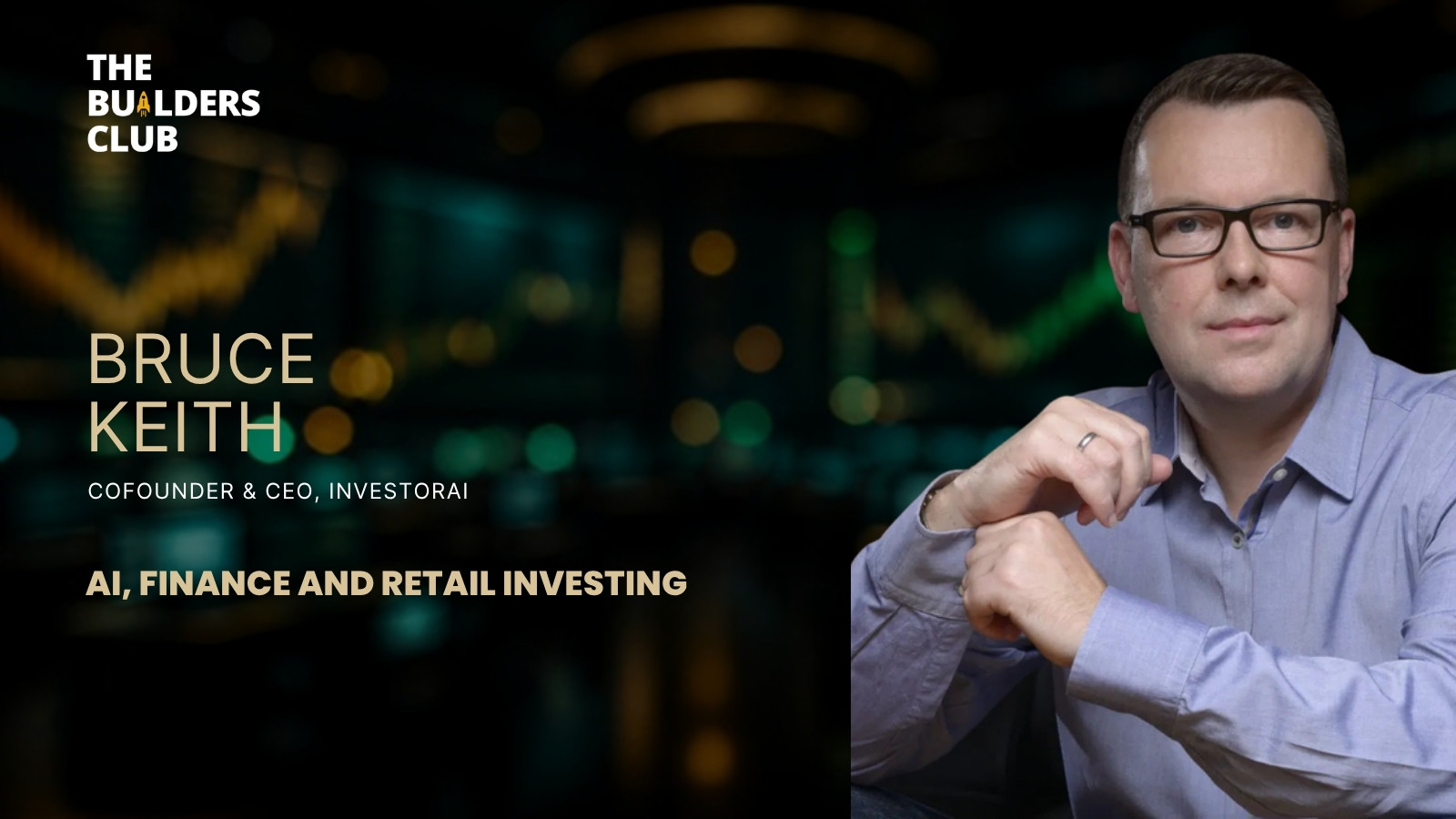
Everyone has a stock tip. Almost nobody tells you when to sell it. Bruce Keith, co-founder and CEO of Investor.ai, built a company around that gap.
On The Builders Club Startup Founders Podcast, the former private equity and hedge fund executive explains AI investing for retail investors, why he based the business in India, and what he thinks both founders and investors get wrong.
What is AI investing, and how does it help retail investors? Bruce Keith’s core thesis
Bruce’s view is that AI does not need to beat the market by a wide margin. It needs to be systematic, tireless and slightly better than the benchmark, again and again, so the advantage compounds.
He uses a cricket analogy: investing is a Test match and trading is a T20. AI can take the intensity of T20 trading and sustain it like a Test match, because it never tires.
- Systematic beats ad hoc. Rules that tell you when to rebalance, sell and buy again remove emotion and forgotten follow-ups.
- Data quality drives outcomes. Hallucinations come from bad data, so what you feed the model matters.
- Small edges compound. A little better than the benchmark, repeated, is enough.
- Convenience wins in India. Users are price-conscious but pay for easy, one-click experiences.
Why build an AI investing company in India?
Bruce has worked across Luxembourg, the US and the UK, and says his earlier business served clients outside India. This time both the company and its customers are in India, which brings product, market and operations closer together.
He points to a growth economy, a strong technology backbone and an optimism that he does not see in Europe.
- Demographics. A young, mobile-first population.
- Price sensitivity. Customers will not overpay, but will pay for convenience.
- Equity culture. In his view India behaves more like the US than Europe, with more direct equity investing.
How does Investor.ai’s model work?
Investor.ai offers model portfolios that users subscribe to. The system tells them when to rebalance, sell and buy, and portfolios can be set to rebalance every two weeks, four weeks or more.
It is delivered business-to-business-to-consumer. Customers reach it through partner brokers, with one-click access and one-click exit. Bruce says this keeps customer acquisition cost down, since users already hold brokerage accounts.
- Choose a model portfolio subscription that suits your style.
- Invest through your existing broker.
- Follow the rebalancing signals.
- Exit or rebalance in one click.
How are PE, hedge fund and individual investing different?
Bruce draws on both worlds. Private equity buys unlisted companies, holds them for years, rarely puts more than 10 percent of a fund in one asset and banks gains when it can.
A hedge fund takes positions but hedges out other risks, and must stay invested and keep looking for the next idea.
- Be invested rather than sitting in cash, since inflation erodes savings.
- Keep some holdings for the long term and actively manage some.
- Buy what you understand; if you cannot explain it, skip it.
What can individuals borrow from each?
He sees value in PE-style discipline such as diversification and knowing why you buy, and in hedge-style churn for part of a portfolio.
How does Bruce structure his own portfolio?
He shares his personal split as an illustration, not advice. About half is in ETFs for long-term market exposure, around 20 percent in stocks he likes, and roughly 30 percent systematic.
He prefers ETFs as a do-it-yourself investor who wants cheap, liquid exposure, and says a mutual fund suits people who are unsure what they want.
- About 50 percent: ETFs for big long-term calls.
- About 20 percent: individual stocks he understands.
- About 30 percent: systematic, AI-driven trading.
What do Indian investors get wrong, and how is AI changing the field?
Bruce says the biggest psychological mistake is unwillingness to crystallise a loss. Holding on while waiting for recovery can mean missing better opportunities, which is why rebalancing matters.
On AI more broadly, he expects generative AI to write a much larger share of his team’s code over time, and he sees quant-style funds as a small share of India’s market compared with the US. He also worries more about governments misusing AI than about companies or individuals.
Further reading and sources
- Exchange-traded fund on Wikipedia
- Private equity on Wikipedia
- Hedge fund on Wikipedia
- The Richest Man in Babylon on Wikipedia
Frequently asked questions
What is systematic investing with AI?
It means following rule-based signals for when to buy, sell and rebalance instead of relying on tips. Bruce Keith says AI can run this discipline continuously and does not need to beat the benchmark by much, since small repeated edges compound.
Should I choose ETFs or mutual funds?
Bruce, speaking from his own experience as a do-it-yourself investor, prefers ETFs for cost, liquidity and clear exposure. He says mutual funds suit people who are unsure what they want. This is his view, not personalised advice, so consider your own situation.
What is the biggest mistake retail investors make?
Bruce says it is refusing to realise a loss and waiting for a recovery, which can cost you better opportunities. He also stresses staying invested rather than holding cash, and only buying what you understand.
Conclusion
Bruce Keith’s message is that discipline beats tips: be invested, be systematic, and let small edges compound. He also shows why India rewards products that are convenient and good value.
If you are building a fintech product, study how your users already invest and meet them inside the tools they use.
Want more conversations like this? Join The Builders Club, our community of 35,000+ founders and CXOs, and explore more episodes of the Startup Founders Podcast.