Skip to content
The Builders Club
HostAdviseVolunteerHiring
Events
ReportsPodcastTBC Weekly NewsletterGlobal GTM BriefVenture Capital WeeklyThe CTO Brief
Discovery CallsProspecting ToolPlaybooksGlobal Events Tracker
Fundraising TrackStrategic PartnershipsAgency MarketplaceLinkedIn Thought Leadership
Join the Community
🚀 New launch — Agency Marketplace ✨

// ARTICLE

The High-Touch Support Equation: Implementation Resource Allocation in the UK vs. Post-Sales Account Management in India

  • By The Builders Club
  • November 12, 2026
  • Articles, B2Bgtm
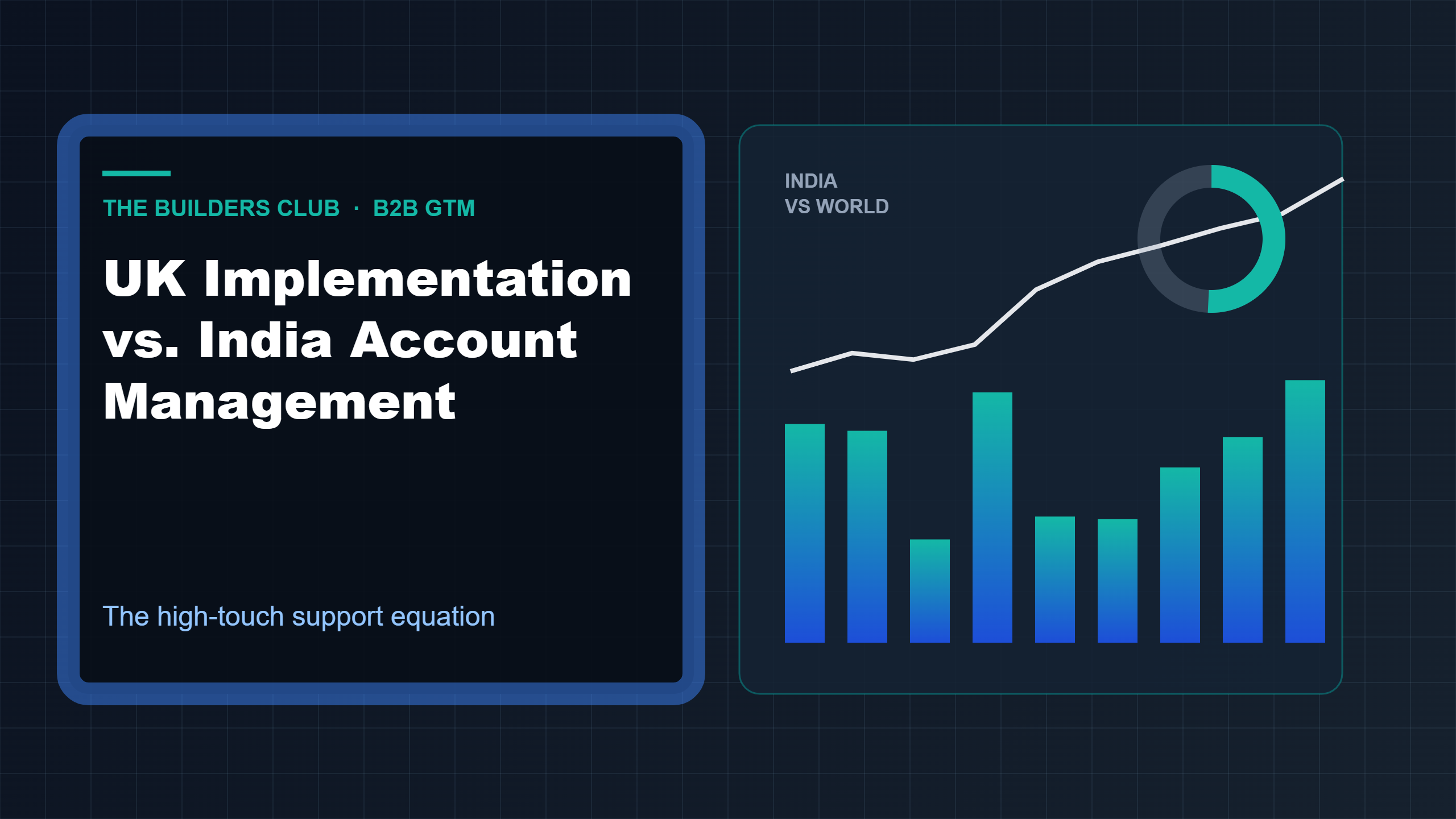
UK Implementation vs. India Account Management
Advertisement

UK customers typically expect a well-scoped implementation and then self-sufficiency. Indian enterprises typically expect a named person who stays close after go-live. The first model concentrates cost before launch; the second spreads it across the life of the account.

If you staff both markets the same way, one will feel under-served and the other will erode your margin.

What does “high-touch” mean in the UK versus India?

In the UK, high-touch usually means a structured onboarding project: defined scope, a project plan, training and a clean handover to a support desk. In India, it more often means continuous access to a senior point of contact who solves problems quickly, including ones outside the contract.

Note: these are structural patterns, not published benchmarks. Use your own staffing and margin data to calibrate.

How should you allocate resources for UK implementations?

  • Front-load the effort. Customers judge you on time to first value, so put your strongest implementation staff in the first 60 to 90 days.
  • Document everything. Clear scope, acceptance criteria and a formal handover reduce disputes. UK buyers often expect process discipline and data-protection clarity, covered in the ICO’s guidance on international data transfers.
  • Move to pooled support. After go-live, a ticket-based desk with defined service levels is usually acceptable.

How should you allocate resources for Indian post-sales account management?

  • Appoint a named account manager. Someone who knows the customer, the stakeholders and the history.
  • Plan for change requests. Indian enterprises often ask for adjustments after launch. Decide what is included and what is billable.
  • Hold regular executive touchpoints. Monthly or quarterly senior reviews protect the relationship.
  • Be responsive on escalation. A fast, senior response during a crisis builds more trust than a flawless SLA report.

Where does the cost fall? A resource allocation comparison

Factor UK pattern India pattern
Peak effort Implementation phase Spread across the contract life
Key role Implementation or project lead Named account manager
Support model Ticketing with defined SLAs Ticketing plus direct escalation contact
Scope discipline Formal change control Informal requests that need a policy
Margin risk Implementation overruns Unbilled post-sales work

How do you protect margin in both models?

  1. Price implementation separately in the UK. Fixed-fee onboarding with clear acceptance criteria.
  2. Price account management into the Indian contract. A tiered success or support package avoids giving it away.
  3. Define the free-versus-paid line. Write down what a change request is and who approves cost.
  4. Track hours per account. Compare effort with revenue each quarter to find accounts that are quietly losing money.

Can one global support team serve both markets?

A shared technical team can work, but pair it with a local relationship role in India and a project-management function in the UK. Time zones, language and expectations of responsiveness all matter.

FAQ

How much implementation support do UK enterprise customers expect?

UK buyers generally expect a defined onboarding project with clear scope, training and a handover to a support desk. They value documentation and predictability over constant availability.

Why do Indian enterprises expect more post-sales account management?

Trust in India is often built through personal relationships, so customers want a named contact who understands their business and responds quickly. Many also request post-launch adjustments, which need a clear commercial policy.

How do I stop post-sales support from eroding margins in India?

Include an account management or success tier in the contract, define what is a change request versus included support, and track hours per account. Review the numbers quarterly.

Conclusion

The UK rewards a sharp, front-loaded implementation. India rewards sustained presence. Staff and price each model deliberately, and track effort against revenue so that service quality never quietly turns into lost margin.

Want to see how other founders staff UK and India customer teams? Join The Builders Club.

References and further reading

  • ICO: A brief guide to UK GDPR international transfers
  • McKinsey: The net revenue retention advantage in B2B tech
  • Harvard Business Review: Winning the right customers isn’t just a sales issue
  • NASSCOM-Frost: Enterprise digital transformation
  • Inc42: Indian family businesses are growth-driven but tech-cautious

About the author: Sohail Khan is Founder and Director of The Builders Club, a professional community of 35,000+ founders and CXOs across India, UAE, Singapore and the US.

Advertisement
Advertisement
Facebook
X
LinkedIn
Picture of The Builders Club

The Builders Club

Keep reading

The Enterprise IT Budget Study: where India corporate groups allocate capital across infrastructure and compliance

The Enterprise IT Budget Study: Where India’s Core Corporate Groups Are Allocating Strategic Capital Across Infrastructure and Compliance

November 14, 2026 No Comments

Where Indian enterprises are putting IT capital in 2026: Gartner, Bain and PwC data on infrastructure, cloud, AI and security and compliance budgets.

Read More »
Building an enterprise sales team in India beyond the founder network

Why Founder-Led Enterprise Sales in India Stops Scaling (And How to Build a Team That Doesn’t Depend on Your Network)

November 13, 2026 No Comments

How to build and manage an enterprise account sales team in India that grows beyond the founder’s personal network: roles, hiring timing, process and compensation.

Read More »
UK Implementation vs. India Account Management

The High-Touch Support Equation: Implementation Resource Allocation in the UK vs. Post-Sales Account Management in India

November 12, 2026 No Comments

UK customers typically expect a well-scoped implementation and then self-sufficiency. Indian enterprises typically expect a named person who stays close after go-live. The first model concentrates cost before launch; the second spreads it across the life of the account. If you staff both markets the same way, one will feel under-served and the other will erode your margin. What does “high-touch” mean in the UK versus India? In the UK, high-touch usually means a structured onboarding project: defined scope, a project plan, training and a clean handover to a support desk. In India, it more often means continuous access to a senior point of contact who solves problems quickly, including ones outside the contract. Note: these are structural patterns, not published benchmarks. Use your own staffing and margin data to calibrate. How should you allocate resources for UK implementations? Front-load the effort. Customers judge you on time to first value, so put your strongest implementation staff in the first 60 to 90 days. Document everything. Clear scope, acceptance criteria and a formal handover reduce disputes. UK buyers often expect process discipline and data-protection clarity, covered in the ICO’s guidance on international data transfers. Move to pooled support. After go-live, a ticket-based desk with defined service levels is usually acceptable. How should you allocate resources for Indian post-sales account management? Appoint a named account manager. Someone who knows the customer, the stakeholders and the history. Plan for change requests. Indian enterprises often ask for adjustments after launch. Decide what is included and what is billable. Hold regular executive touchpoints. Monthly or quarterly senior reviews protect the relationship. Be responsive on escalation. A fast, senior response during a crisis builds more trust than a flawless SLA report. Where does the cost fall? A resource allocation comparison Factor UK pattern India pattern Peak effort Implementation phase Spread across the contract life Key role Implementation or project lead Named account manager Support model Ticketing with defined SLAs Ticketing plus direct escalation contact Scope discipline Formal change control Informal requests that need a policy Margin risk Implementation overruns Unbilled post-sales work How do you protect margin in both models? Price implementation separately in the UK. Fixed-fee onboarding with clear acceptance criteria. Price account management into the Indian contract. A tiered success or support package avoids giving it away. Define the free-versus-paid line. Write down what a change request is and who approves cost. Track hours per account. Compare effort with revenue each quarter to find accounts that are quietly losing money. Can one global support team serve both markets? A shared technical team can work, but pair it with a local relationship role in India and a project-management function in the UK. Time zones, language and expectations of responsiveness all matter. FAQ How much implementation support do UK enterprise customers expect? UK buyers generally expect a defined onboarding project with clear scope, training and a handover to a support desk. They value documentation and predictability over constant availability. Why do Indian enterprises expect more post-sales account management? Trust in India is often built through personal relationships, so customers want a named contact who understands their business and responds quickly. Many also request post-launch adjustments, which need a clear commercial policy. How do I stop post-sales support from eroding margins in India? Include an account management or success tier in the contract, define what is a change request versus included support, and track hours per account. Review the numbers quarterly. Conclusion The UK rewards a sharp, front-loaded implementation. India rewards sustained presence. Staff and price each model deliberately, and track effort against revenue so that service quality never quietly turns into lost margin. Want to see how other founders staff UK and India customer teams? Join The Builders Club. References and further reading ICO: A brief guide to UK GDPR international transfers McKinsey: The net revenue retention advantage in B2B tech Harvard Business Review: Winning the right customers isn’t just a sales issue NASSCOM-Frost: Enterprise digital transformation Inc42: Indian family businesses are growth-driven but tech-cautious About the author: Sohail Khan is Founder and Director of The Builders Club, a professional community of 35,000+ founders and CXOs across India, UAE, Singapore and the US.

Read More »
The Legacy Conglomerate Architecture Audit

The Legacy Conglomerate Architecture Audit: How Indian Enterprise CIOs Balance Legacy Hardware with Modern Cloud Upgrades

November 11, 2026 No Comments

How Indian enterprise CIOs audit legacy systems, decide what to keep, rehost or retire, and sequence cloud upgrades across conglomerate portfolios.

Read More »
Stop a free PoC becoming free software - The Builders Club

How to Stop a Free PoC From Becoming a Permanent Free Product at Indian Enterprises

November 10, 2026 No Comments

A practical guide to keeping proofs of concept paid, time-boxed and convertible: charter, guardrails, warning signs and how to end a PoC cleanly.

Read More »

ACV Realities: Selling Core Infrastructure to Mid-Market UK Firms vs. Tier-1 Indian Corporate Houses

November 9, 2026 No Comments

A UK mid-market firm and a Tier-1 Indian corporate house will both buy core infrastructure from you, but they will not pay, decide or expand the same way. UK mid-market deals tend to be smaller, faster and process-led. Indian group deals tend to start with a modest first contract and grow through relationships across divisions. Founders who price both markets with one ACV assumption end up mispricing one of them. Here is how to think about the difference. What is ACV, and why does it vary so much by market? Annual Contract Value (ACV) is the average yearly revenue from a customer contract, excluding one-time fees. It is shaped by company size, buying authority, budget structure and how the buyer prefers to commit spend. Two companies of similar revenue can have very different ACVs for the same product, because the buying behaviour, not the product, decides how much they sign at once. Note: the comparisons below describe structural patterns, not published statistics. Validate every number against your own deal history before using it in a plan. How do UK mid-market firms buy core infrastructure? The buyer group in a UK mid-market company is usually smaller, with a CTO, head of IT or operations lead holding most of the authority. Procurement follows a defined process, and contracts are generally standardised. Compliance first. Data protection under UK GDPR, supplier due diligence and security questionnaires are routine gates. Clear scope. Buyers expect a defined package, a fixed term and a predictable renewal. Faster decisions, smaller contracts. Fewer approvers usually shorten the cycle, but the initial ACV is often constrained by mid-market budgets. How do Tier-1 Indian corporate houses buy the same infrastructure? Large Indian groups often operate as a portfolio of businesses under a shared brand. Technology decisions can sit with a central IT team, a group CIO, or the individual business heads, and sometimes all three. Wider committee. IT infrastructure, security, finance, legal and the business owner may each have a say. Land small, expand across entities. A first deal in one division can become a group-wide relationship once trust is established. Heavier customisation and negotiation. Expect requests on terms, integration, support models and pricing structure. Regulatory overlays. Sector regulators and India’s phased data protection rollout may shape requirements. UK mid-market vs Tier-1 Indian groups: what changes for ACV? Factor UK mid-market Tier-1 Indian corporate house Buying committee Smaller, role-defined Larger, spans IT, business, finance, legal Sales cycle Usually shorter once process starts Often longer and less linear Initial ACV Capped by mid-market budgets Often a small first step, such as one unit or pilot Expansion path Seats, modules, upgrades Additional divisions, group entities, geographies Negotiation focus Compliance, SLAs, term length Commercial structure, customisation, support Biggest risk Price pressure and churn Stalled approvals and scope creep How should you price and structure deals in each market? For UK mid-market Lead with a clear package, a compliance pack and a defined onboarding plan. Aim for annual contracts with a visible upgrade path, since expansion is usually module-based. Use references from similar-sized companies; they matter more than brand names. For Tier-1 Indian corporate houses Design a first contract small enough to approve quickly, but linked to a roadmap for broader rollout. Define what is standard and what is paid customisation from day one, to protect margins. Map the group structure and identify which entity signs, which pays and which uses the product. FAQ Is ACV higher in India or in the UK? It depends on the segment, product and contract structure, and there is no reliable universal figure. In general, UK mid-market deals may close faster at moderate sizes, while large Indian groups can grow into bigger relationships over time through multi-division expansion. Compare using your own deal data. Should I use the same pricing model in both markets? Keep the core pricing logic consistent, but adapt packaging. UK buyers often prefer clear tiers and fixed terms. Indian enterprises may need flexible rollout phases, with the commercial structure explained in terms of business outcomes. Which market is better for a first enterprise customer? Choose based on your strengths. If you have a compliance-ready product and a repeatable process, UK mid-market can offer quick validation. If you have strong relationships and room to customise, a Tier-1 Indian group can become a long-term anchor account. Conclusion ACV is shaped by how a buyer commits, not just by what they buy. Plan UK mid-market deals around process and compliance, and Indian group deals around relationships and staged expansion. Use one pricing logic, but two go-to-market playbooks. Selling across borders? Compare notes with founders and CXOs who sell in both markets. Join The Builders Club and get invited to our next roundtable. About the author: Sohail Khan is Founder and Director of The Builders Club, a professional community of 35,000+ founders and CXOs across India, UAE, Singapore and the US.
Read More »

A global network of business leaders from US, Europe, Dubai, Singapore and India. We have separate curated communities for Tech and Business focusing on mid market and enterprise CXOs. We help them with content, resources, and connections to grow professionally and personally.

The Builders Club © 2026
Youtube Linkedin Instagram X-twitter Facebook-f

Need help?

Book a consult Explore Services Tech Club Business Club
Whatsapp Us