Walk into a top hospital in India and you may find the best machines and doctors, yet the patient still carries paper reports from one counter to the next.
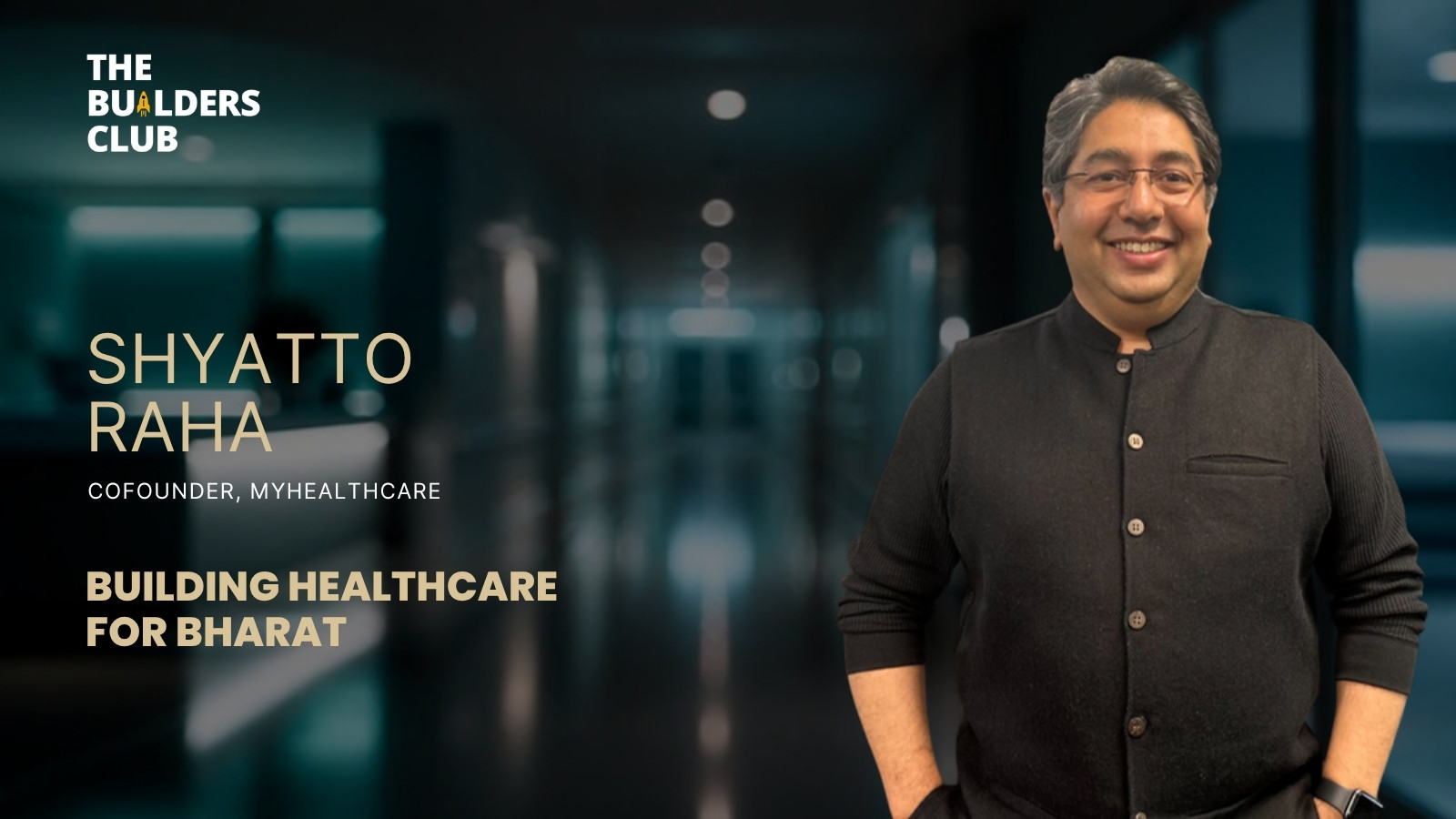
That gap pushed Shyatto Raha to leave more than two decades at NDTV and build MyHealthcare, a digital platform for hospitals. In this episode of The Builders Club Startup Founders Podcast, he explains how hospital digitization in India really works.
What does hospital digitization in India require? Shyatto Raha’s core thesis
Shyatto’s view is that Indian healthcare delivery is fractured because it runs on paper and has no care continuum linking doctor, hospital and patient. MyHealthcare aims to be the plumbing between the three, an operating system for the hospital rather than a single point tool.
He argues the opportunity sits mostly outside the big chains. By his figures India has about 69,000 hospitals, around 49,000 of them private, and the large corporate groups make up only a small share.
- Build the continuum. Connect inpatient, outpatient, remote monitoring, home care and the patient app on one platform.
- Win the doctor first. Doctors drive roughly 80 to 85 percent of the buying decision, so the product must save them time.
- Sell as a managed service. Per-bed SaaS with cloud hosting and upgrades included takes the burden off hospitals.
- Respect the sector. Healthcare is sensitive, so launch only a stable product with clear intent.
Why did a media executive start a healthcare company?
Shyatto spent over 20 years at NDTV, building new businesses from digital media to mobile and e-commerce. Around 2016, while working on hospital website content, he saw a top Gurgaon hospital where records were still on paper and patients ferried their own test results between doctors.
He saw no other consumer sector that would tolerate this, and few health tech companies serving hospitals directly; most were consumer-facing and weighed down by acquisition costs. He left to start MyHealthcare with two former colleagues.
- Divya, co-founder and chief product officer, brings long experience in digital product design.
- Anish, co-founder and chief information officer, is an ethical hacker by profession.
- None of the three had a healthcare background, which he sees as a source of fresh thinking.
What is a hospital operating system and what does MyHealthcare offer?
Shyatto describes the product as an integrated system for care delivery inside the hospital, remote patient monitoring outside it, a home care platform for nursing, and a patient app. Insurance is integrated too.
He sums up the idea with a triangle of doctor, hospital and patient, with MyHealthcare running the pipe that connects them.
- Care delivery inside the hospital, including clinical records.
- Remote patient monitoring beyond the hospital walls.
- A home care platform for nursing and care at home.
- A patient app that ties the experience together.
How do you convince hospitals to switch technology?
Shyatto says timing helped. After the pandemic, the electronic medical record became more important to hospitals than the billing system, because margins are under pressure and hospitals want better patient engagement and lifetime value.
MyHealthcare is also fully cloud-based. He says none of its partner hospitals runs on-premise systems, and he positions the company as a managed service so hospitals can focus on care while it handles updates and optimisation.
How does the pricing and onboarding work?
The platform is priced per bed. Shyatto says guided workflows have cut nurse training time to about two days.
What about healthcare financing?
He describes a planned launch of financing inside the app, including loans or guarantees to hospitals and zero-interest EMI options over 18 to 24 months, aimed at patients who pay in cash and often drop off because they cannot afford admission.
How did the pandemic shape the company?
The team had been working on a primary care record for clinics when lockdown approached. Shyatto says they built a teleconsult network within days and integrated it into the systems of their first large hospital client, going live in early April 2020.
Consults rose from about 100 a day to several thousand a day within weeks. The team then moved into inpatient systems, and he credits long hours and a sense of purpose for the pace.
How do doctors and nurses adopt health technology?
Shyatto says doctors care about one thing: whether the tool saves time with patients. Doctor compliance on the platform, he says, rose from about 2 percent in December 2022 to above 78 percent, and one tier-two hospital reached 98 percent.
He also sees a newer generation of doctors who are comfortable with voice-to-text and analytics, and older department heads who are now asking for digital tools.
- Design for doctor efficiency before anything else.
- Make interfaces guide the user, especially nurses.
- Expect tier-two hospitals to adopt as fast as metros.
What advice does he give health tech founders and investors?
Shyatto says outsiders can succeed if they invest time understanding the problem, spend time with frontline staff, and hire experienced healthcare leaders who know what has not worked. He argues the product must be good enough to sell itself, with strong salespeople to position it.
On funding, he advises choosing investors carefully and finding a mentor outside the sector. He warns that very rapid growth in healthcare is a red flag, and cites Simon Sinek’s golden circle idea of starting with why.
- Go deep rather than scratching the surface.
- Launch only a stable product; hospitals rarely give a second chance.
- Treat entrepreneurship as a marathon, not a sprint.
Further reading and sources
- MyHealthcare official website
- Electronic health record on Wikipedia
- Healthcare in India on Wikipedia
Frequently asked questions
Why is hospital digitization in India slow?
Shyatto Raha points to paper-based processes, fragmented care with no continuum between doctor, hospital and patient, and slow change management. Doctors drive most buying decisions, so tools must save them time. Mandated digital records in markets like the US and UK have sped adoption there.
How does a hospital operating system charge hospitals?
According to Shyatto, MyHealthcare is a SaaS platform priced per bed and delivered as a managed service. Cloud hosting, updates and optimisation are handled by the vendor, so the hospital does not need to build its own technology team.
Can AI replace doctors in healthcare?
Shyatto says no, and calls the idea a fool’s paradise. He expects AI and data management to make doctors more efficient, reduce errors, power early warning systems and eventually support precision medicine, once healthcare data is structured.
Conclusion
Shyatto Raha’s story shows that healthcare is a long game: understand the doctor, build for the whole care journey and offer hospitals a managed service they can trust.
If you are building in health tech, spend time with frontline staff, hire people who know the sector and pick investors who support the long haul.
Want more conversations like this? Join The Builders Club, our community of 35,000+ founders and CXOs, and explore more episodes of the Startup Founders Podcast.