In 2010, a handful of product managers met in a London pub to swap war stories over a few beers. A decade later, that gathering became one of the largest product communities in the world.
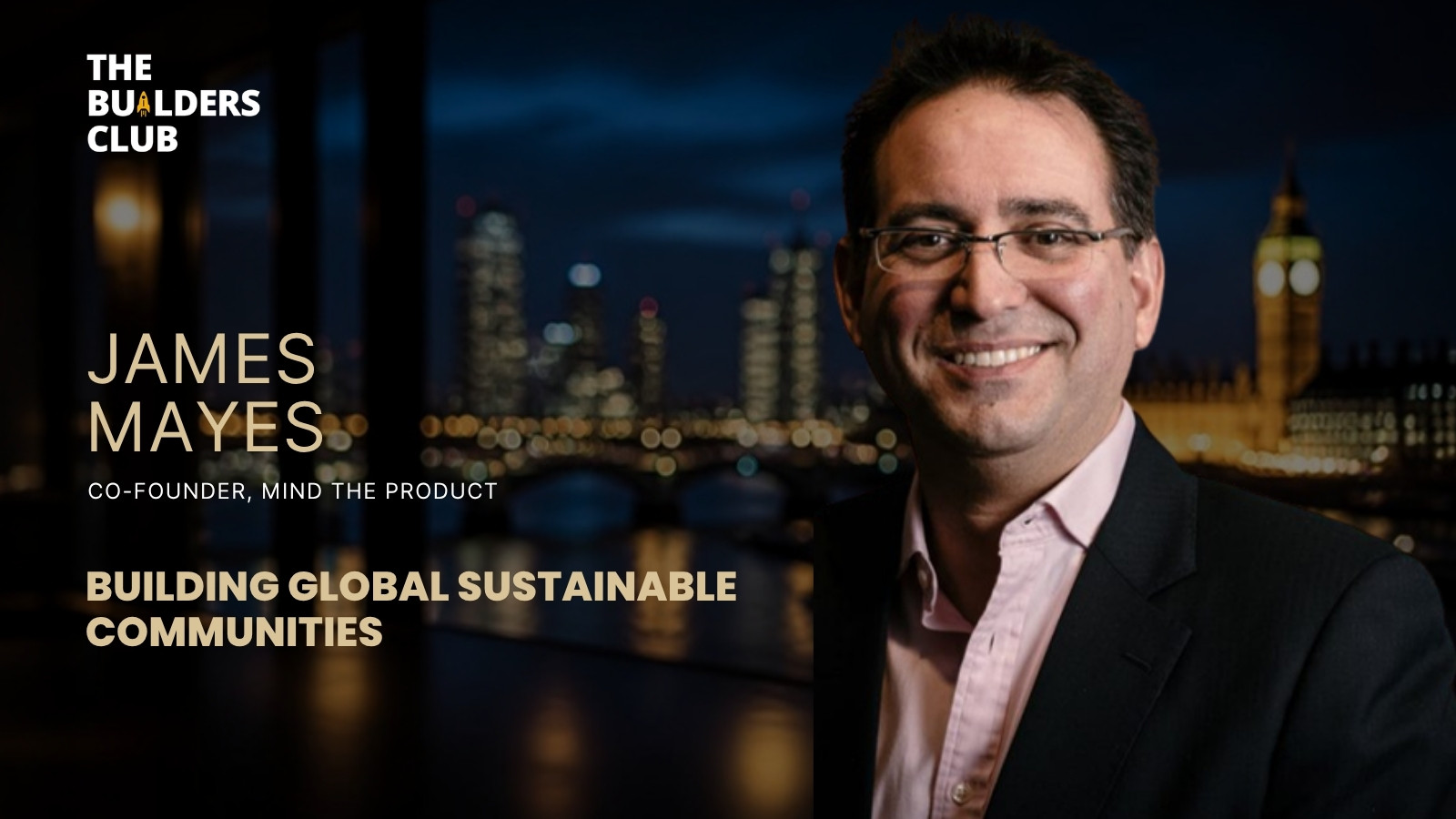
James Mayes, co-founder and CEO of Mind the Product, joined The Builders Club to explain how to build global product communities that last, and how his team rebuilt its business when events stopped.
How do you build a global product community? James Mayes’s core thesis
James’s thesis is that a community lasts when it stays focused, authentic and honest about its value. Mind the Product began with free local meetups, added content and conferences, then moved to a membership model once the audience was large enough.
His rule for monetization is simple: if content comes free from the community, keep it free. If the company pays for it, such as keynote speakers, those who want access should pay.
- Start local and free. ProductTank meetups remain free worldwide and are run by local volunteers.
- Stay credible. Refuse vendor pitches and tell the real story of how products were built, including what went wrong.
- Test before you build. A light paywall on WordPress proved people would pay before heavier investment.
- Focus beats breadth. The communities he values most are narrow and specific.
How did Mind the Product start?
James came from about 15 years in technology recruiting and a failed startup, Tweet Jobs. He later met Janna Bastow while working at a startup. In 2010 Janna, Simon Cast and Martin Eriksson began gathering product managers in a London pub.
At the time, a product manager was often the only one in their company, with little training or peer support. James joined as a fourth co-founder to focus on the commercial side, and the first conference in 2012 drew about 450 people.
- Monthly meetups called ProductTank started the community.
- Content from talks was then shared online.
- Conferences followed, and meetups spread to other cities starting with Amsterdam.
- Today the community spans roughly 200 cities and 300,000 members.
How does a community run across 200 cities?
About 15 people work for Mind the Product in London. The cities themselves are run by local volunteers who are working product managers, usually in pairs so they can support each other.
Volunteers give about eight hours a month. In return they get free membership, free training access and a free conference ticket each year, plus the chance to become well connected in their city.
- A local product manager applies to start a ProductTank.
- They are paired with a second organizer in the city.
- They run the meetup and handle local logistics.
- A community manager supports them with a monthly newsletter and speaker introductions.
- The team watches live streams and flags cities that go quiet.
What is the free versus paid model for communities?
ProductTank meetups and any content contributed free by the community stay free. James says charging for something you got for free would be wrong.
Conferences needed ticket revenue because speakers were flown in and paid. The same logic now applies online: free guest content stays open, while conference videos with paid keynotes sit behind a membership paywall.
- Free: local meetups and community-contributed content.
- Paid: content the company pays to produce.
- Rule of thumb: if we pay to build it, someone else pays to see it.
What are the challenges of scaling a community globally?
James calls it a relentless ten-year headache. Local culture shapes everything: Londoners wanted a free beer after work, while the first San Francisco attendees asked for smoothies, and in parts of Southeast Asia people preferred a later start after going home.
The harder problem was tax. Each new country meant registering locally and hiring accountants, which made scaling costly.
How did going online help?
Moving workshops online let the team use Paddle as a merchant of record. They stay based in London, while Paddle handles local tax and compliance for buyers in places like India.
How did Mind the Product pivot online during the pandemic?
The team already worked remotely, and in 2019 had started discussing that it was really a media and publishing business that happened to earn most of its revenue from events. When events stopped, it looked at subscription models used by publishers.
Rather than spend a long time and a big team building a paywall, one developer built a light version with WordPress plugins and a card payment engine. It was live in roughly three to three and a half months.
- First test: would anyone pay at all?
- Stack-ranked membership benefits with the audience.
- Discounted conference tickets ranked low; online training, new content and expert AMAs ranked high.
- Next step: selling multi-seat licenses to companies, including banks.
What advice does James give founders on hiring and direction?
On hiring, he looks for adaptability over narrow skills, since a startup’s problems change weekly. He wants people who know how to learn and ask the right questions.
On disagreement, his line is that everyone else should bring evidence. Customer interviews and clear problem statements beat opinions.
Why listening to users matters
He cited the retweet on Twitter, which emerged because users were already typing RT and copying tweets by hand. The team built what users were already doing.
Product versus project management
His shorthand: product management is about building the right thing, and project management is about building the thing right. The two should work together.
Further reading and sources
Frequently asked questions
How do I start a local product management meetup?
James says Mind the Product wants organizers who work as product managers and understand the role. Pairing with a second organizer in the same city makes the work sustainable. Volunteers spend about eight hours a month and get benefits such as membership access.
Should a community charge for content?
James’s approach is to keep free what the community contributes for free, and charge for what the company pays to produce, such as keynote speakers. Test willingness to pay early with a simple paywall before building more. Stack-rank possible member benefits with your audience.
How do I choose a product management framework?
James says the right framework depends on your situation, such as team size and customer count. He mentioned the value proposition canvas, business model canvas, lean canvas and lean UX canvas. His advice is to stay open and pick the one that fits the moment.
Conclusion
James Mayes’s story shows that a community can outlast any single format. A pub meetup became a conference business, then a membership-led media business.
If you are building a community, write down what value members get, keep it credible, and test willingness to pay before you build.
Want more conversations like this? Join The Builders Club, our community of 35,000+ founders and CXOs, and explore more episodes of the Startup Founders Podcast.