
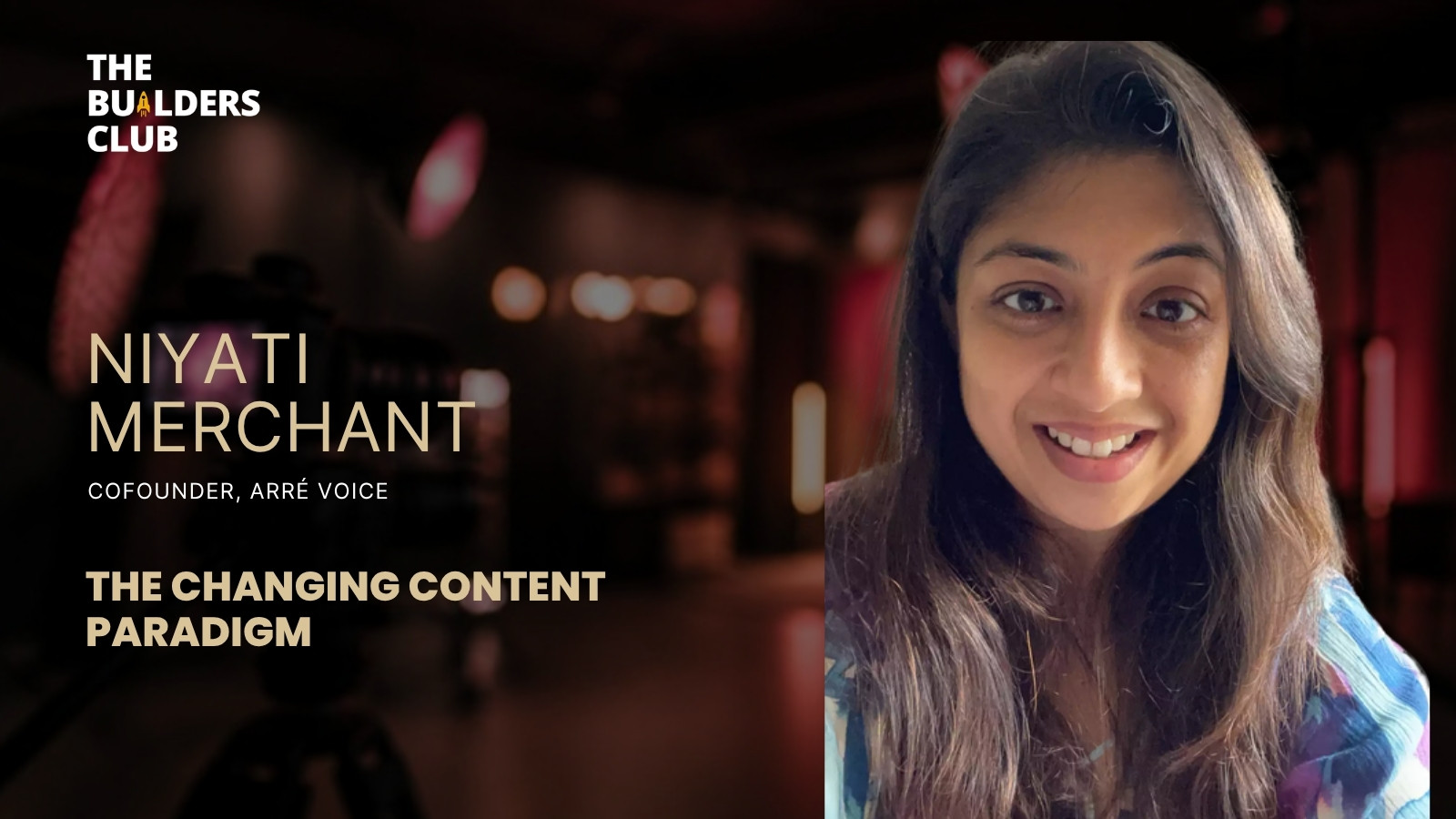
When dozens of OTT platforms launched at once, Arre was one of the few digital media brands still standing. Now its co-founder Niyati Merchant is betting on something far smaller: a 30-second voice note.
In this episode of The Builders Club Startup Founders Podcast, she explains why short-form audio could open the creator economy to people who never want to appear on camera.
What is short-form audio and why is Arre Voice betting on it?
Niyati’s thesis is that audio is authentic, appearance-agnostic and easy to create, so it lowers the barrier for people who want to be creators without showing their face. On Arre Voice, the unit of content is a 30-second voice clip organised around interests, from spoken-word poetry to K-drama reviews.
The platform launched women-first. Women were onboarded first, invites went to women, and the moderation team is all women, though the app has since opened to men as well.
- Voice lowers the barrier. No ring lights or on-camera pressure, so more people create.
- Small followings can earn. Content-led commerce lets creators sell with a thousand or two thousand followers.
- Multi-format helped brands. Video, text and audio together gave Arre a differentiated package.
- Community drives monetisation. Shared-interest groups build trust that brands value.
How did Niyati Merchant go from consulting to co-founding Arre?
Niyati started in consulting at KPMG and EY, focusing on consumer, retail, media and sports clients. Network18 was one of those clients, and she later joined it for about two years, where she met the founding team of Arre.
She joined Arre when the team was three or four people. It has since grown to about 35, with a small in-house writing and development team for the studio and a larger group for Arre Voice, mostly engineers and community managers.
How did Arre survive the OTT boom?
Arre started as a digital media brand producing original content in many formats: videos, podcasts, web series, short videos and long-form essays. It distributed through its own site, YouTube and, as Niyati recalls, was among the first to syndicate content to emerging OTT platforms in India.
Around 2018 to 2019 it formalised Arre Studio, co-creating content with platforms such as Hotstar, Amazon Prime Video, MX Player and Mini TV. When shoots were rescheduled in 2020, the team used the pause to think about a bigger tech product, which became Arre Voice.
- Own-brand content across text, video and audio.
- Syndication to early OTT platforms.
- A studio business co-creating exclusive content.
- A new tech product born during the pandemic pause.
Why choose audio, and why start with women?
Niyati calls audio deeply authentic and easy to create, with low production value and no need to put your face out. That makes it attractive to writers, poets, counsellors and anyone who wants to create without being on camera.
She believes women are natural first adopters because there is less pressure to be visible. So the team inverted the usual go-to-market and started only with women.
- Onboard women first and give them the first invites.
- Run a women-only moderation team.
- Open the platform to everyone once the culture is set.
- Treat women as privileged citizens of the platform.
How can creators and brands make money in short-form audio?
Niyati sees two revenue streams. Advertising follows any audience, but the one she is most excited about is creator-led monetisation, including storefronts and content-led commerce.
She notes that of 80 to 90 million creators, only about the top 5 percent earn. By making a creator’s sales for a brand measurable, the platform lets someone with a thousand or two thousand followers earn, which opens monetisation to far more people.
- Advertising on a growing audience.
- Creator storefronts selling their own or brand products.
- Professional tools once a creator reaches a modest following.
- Measurable results that give brands a clearer return.
Does production value still matter to brands?
Niyati says brands look for reach, return and impact, and the format is incidental. A costly ad film can work, and so can an influencer creating from home.
She argues that for many users a favourite short-form creator is more premium than a high-budget show, because relevance defines value. Arre’s multi-format approach helped here, since it could bring a brand campaign alive through video, article and audio together.
How do communities help a content platform grow?
Niyati says a community-led approach is essential for user-generated products, because people bond over shared interests or life stages. Arre Voice has a large K-pop community whose members are bound by interest and not by who they know.
The host raises the challenge that communities are small compared with the reach brands usually expect. Niyati responds that engagement and impact matter more, and trust inside a community raises its monetisation value.
- Communities create relevant content and belonging.
- Interest-based groups see strong engagement.
- Brands partnering with small groups can get deeper impact.
- Short clips can also be shared outside the app.
Further reading and sources
- Arre official site
- Creator economy on Wikipedia
- Over-the-top media service on Wikipedia
- Podcast on Wikipedia
Frequently asked questions
What is Arre Voice?
Arre Voice is a short-form audio app from the media company Arre where users create and listen to 30-second voice clips organised by interest. It began women-first and invite-only, and has since opened to men as well.
How can small creators earn on an audio platform?
Niyati Merchant says creators can earn through advertising, storefronts and content-led commerce. Because sales for brands are measurable, even creators with a thousand or two thousand followers can make money.
Why do brands care about small communities?
Brands want engagement and impact, not just reach. According to Niyati, organic conversation inside an interest-based community builds trust, which makes the audience more likely to buy.
Conclusion
Niyati Merchant’s journey shows how a content brand can adapt to a changing market, from branded content to studio work to a product built on one simple unit: 30 seconds of voice.
For founders in media and community, the lesson is to lower the barrier to creation, make creator earnings measurable, and let community trust do the heavy lifting.
Want more conversations like this? Join The Builders Club, our community of 35,000+ founders and CXOs, and explore more episodes of the Startup Founders Podcast.